
Estimated Reading Time: 30 minutes

Shoppers today are relentlessly price-checking and brand-agnostic. So how do top-performing retailers convince them to stop comparison shopping and consolidate their spending under one roof?
The secret lies in moving away from pure price wars to focus on a superior digital experience.
To uncover what actually drives modern retention, this comprehensive 50-state guide breaks down the best retail loyalty program examples across America. Whether you are searching for innovative loyalty program ideas for your own business or exploring the exact mechanics behind today’s top rewards, we dive deep into the strategies that regional heavyweights and national titans use to protect their margins.
From frictionless digital cash-back to exclusive early-access product drops, discover the proven frameworks you need to upgrade your digital infrastructure and turn first-time walk-ins into lifelong regulars.
- Best Retail Rewards Programs at a Glance
- State of the Cart: America's Top Retail Rewards Programs
- Alabama – Hibbett Sports
- Alaska – Three Bears Alaska
- Arizona – PetSmart
- Arkansas – Murphy USA
- California – Sephora
- Colorado – North Face
- Connecticut – Stew Leonard’s
- Delaware – Wawa
- Florida – Publix Super Markets
- Georgia – The Home Depot
- Hawaii – Foodland Super Market
- Idaho – Albertsons
- Illinois – Ulta Beauty
- Indiana – Lids
- Iowa – Hy-Vee
- Kansas – AMC Theaters
- Kentucky – Thorntons
- Louisiana – BBQGuys
- Maine – L.L. Bean
- Maryland – Under Armour
- Massachusetts – TJ Maxx
- Michigan – Meijer
- Minnesota – Target
- Mississippi – Sprint Mart
- Missouri – Bass Pro Shops
- Montana – Murdoch's Ranch & Home Supply
- Nebraska – Omaha Steaks
- Nevada – Zappos
- New Hampshire – Timberland
- New Jersey – The Vitamin Shoppe
- New Mexico – Allsup’s
- New York – Barnes & Noble
- North Carolina – Lowe’s
- North Dakota – Scheels
- Ohio – Kroger
- Oklahoma – QuikTrip
- Oregon – Nike
- Pennsylvania – Urban Outfitters
- Rhode Island – CVS Health
- South Carolina – Palmetto Moon
- South Dakota – Lewis Drug
- Tennessee – Tractor Supply Co.
- Texas – H-E-B
- Utah – Backcountry
- Vermont – Burton Snowboards
- Virginia – Fas Mart
- Washington – REI
- West Virginia – GoMart
- Wisconsin – Kohl’s
- Wyoming – Sierra
- 5 Defining Trends Reshaping Modern Retail Loyalty Ecosystems
- Conclusion
Best Retail Rewards Programs at a Glance
Before exploring each state individually, here’s a quick overview of the most common retail loyalty program models for your reference:
| Loyalty Model | How It Works | Best For |
|---|---|---|
| Points-Based | Earn points and redeem later | Frequent purchases |
| Tiered | Unlock better benefits over time | High-value customers |
| Membership | Ongoing perks and exclusives | Premium retail |
| Cashback | Receive value back after purchases | Broad appeal |
| Referral Rewards | Incentivize bringing new customers | Customer growth |
The best retail loyalty programs make it easy for customers to earn and redeem rewards while creating consistent reasons to shop again. Whether through points, exclusive perks, tiered benefits, or personalized offers, strong retail rewards programs are designed to increase repeat purchases, strengthen customer retention, and encourage long-term brand loyalty.
State of the Cart: America’s Top Retail Rewards Programs
To curate this guide, we evaluated several regional and national loyalty programs, focusing on brands that successfully change how their customers interact with them long-term. Here are the core factors we used to choose the top retail loyalty programs for each state:
- Regional & Cultural Dominance: We looked for brands that possess an undeniable connection to their geographic headquarters or regional footprint. Whether it is H-E-B’s absolute monopoly on Texas grocery shoppers or Wawa’s cult-like status among Delaware Valley commuters, the chosen programs leverage intense local pride and community integration that massive, faceless e-commerce giants cannot easily replicate.
- Frictionless Omnichannel Utility: A modern loyalty program must seamlessly bridge the gap between the smartphone and the physical cash register. The selected retailers excel at digital integration. Programs like Target Circle (which auto-applies deals) or The Home Depot’s Pro Xtra (which acts as a mandatory workflow and accounting tool for contractors) were chosen because they actively remove checkout friction rather than adding to it.
- Value Beyond the Transaction: Consumers are experiencing “discount fatigue.” To stand out, we selected brands that offer high-utility, experiential perks rather than just pennies on the dollar. Programs like Burton Snowboards (which uses points purely for VIP access and product drops) or Timberland (which rewards eco-conscious recycling) were highlighted for their ability to monetize attention, lifestyle, and brand ethos even when the customer’s wallet is closed.
- Ecosystem Subsidization & Consolidation: Finally, we examined how effectively a program monopolizes a consumer’s total budget. Retailers like Hy-Vee, Kroger, and Fas Mart were selected for their brilliant cross-vertical integration—allowing customers to use high-margin grocery or snack purchases to aggressively subsidize their daily fuel costs, forcing the customer to consolidate their weekly errands entirely under one brand’s umbrella.
- Industry and Public Sources: Wherever possible, selections were supported with publicly available sources such as official brand reports, websites, industry analyses, loyalty tracking firms, and reputable media coverage.
With these strategic pillars in mind, let’s see how the most successful brands execute them in the wild. From regional grocery titans to global apparel brands, here is our definitive 50-state breakdown of the most innovative and profitable retail loyalty programs in the U.S.
Let’s dive in.
Alabama – Hibbett Sports
Originating in Birmingham, Alabama, Hibbett Sports stands out by pairing neighborhood brand recognition with a highly connected rewards experience. With hundreds of locations primarily serving localized markets across the South and Midwest, Hibbett has built a loyal following rooted in accessibility, premium athletic apparel, and consistency.
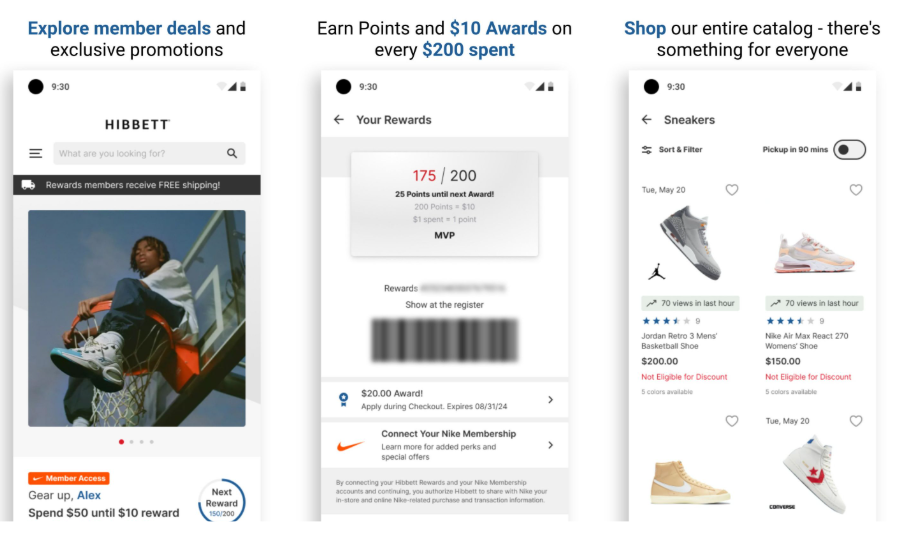
The Hibbett Rewards program allows customers to earn points on qualifying purchases and redeem them for top-tier footwear and athletic gear, making repeat visits both easy and worthwhile. The app itself acts as a strategic gateway; members accumulate points through standard shopping, but the true draw is the connection with the NIKE Membership program. By linking their accounts, members unlock exclusive “Launch Raffles” directly within the app. Members also receive app-only promotions, limited-time offers, and early access to highly anticipated sneaker drops that encourage ongoing engagement.
From a brand performance standpoint, Hibbett maintains strong regional customer sentiment. Many of their neighborhood locations serve as primary hubs for local sneaker culture, reflecting consistent product availability and community satisfaction. The Hibbett app has also generated millions of downloads, signaling massive adoption among its core customer base and reinforcing the program’s role in driving both digital and physical foot traffic.
| Feature | Description |
| Loyalty program type | Tiered Points System + Connected Brand Partnership |
| Welcome reward | 15% off the next purchase simply for signing up (no minimum spend) |
| Birthday reward | $10 reward for MVP, $15 for VIP |
| Earning method | MVP Tier: 1 Point per $1 spent VIP Tier (200+ Points): 1.5 Points per $1 spent |
| Referral reward | – |
| Rewards | Members automatically receive a $10 Award for every 200 Points earned |
| Exclusive perks | Sneaker Launch Raffles: App-exclusive access to buy limited-edition footwear VIP Extras: Double point events, early access to sales, and free shipping. |
| Mobile app integration | Android / iOS |
Why It Works:
- Artificial Scarcity: Gates highly desirable inventory (limited-edition sneakers) behind app engagement, forcing adoption.
- Borrowed Brand Equity: Leverages the massive cultural power of the NIKE Membership program to elevate its own regional retail status.
- High-Stakes Engagement: Transforms passive browsing into an active, competitive experience through digital launch raffles.
While Hibbett’s loyalty program features the standard earn-and-burn mechanics seen at larger national chains, its true value lies in how it complements what the brand already does well: providing local access to premium global brands. In a market where securing limited-edition footwear matters, the connected loyalty program enhances an already strong customer relationship by serving as the ultimate gatekeeper to the products they want most.
Hibbett Rewards is a two-tiered customer loyalty program (MVP and VIP) that seamlessly integrates with the NIKE Membership ecosystem. While members earn standard points on purchases that convert into cash awards, the program’s true anchor is digital exclusivity. By connecting their accounts through the Hibbett mobile app, members unlock access to digital sneaker raffles, ensuring the retailer maintains an engaged audience for major product drops.
Alaska – Three Bears Alaska
Consumers in Alaska aren’t just battling neighborhood traffic; they are navigating extreme geographic isolation. When an Alaskan resident sets out on a supply run, they cannot afford to bounce between five different specialty stores scattered across fifty miles of frozen highway. They needed a reliable, centralized outpost.
Three Bears Alaska recognized this vulnerability in the massive corporate supply chains; national big-box stores don’t always understand the unique blend of bulk groceries, heavy-duty hardware, and serious sporting goods required to survive and thrive in Alaska. Three Bears built a localized empire by offering all of it under one roof. But to keep those massive shopping carts exclusive to their registers, they needed a mechanism to connect a $500 hunting rifle to a $5 gallon of milk.
And thus, Bear Bucks was born.
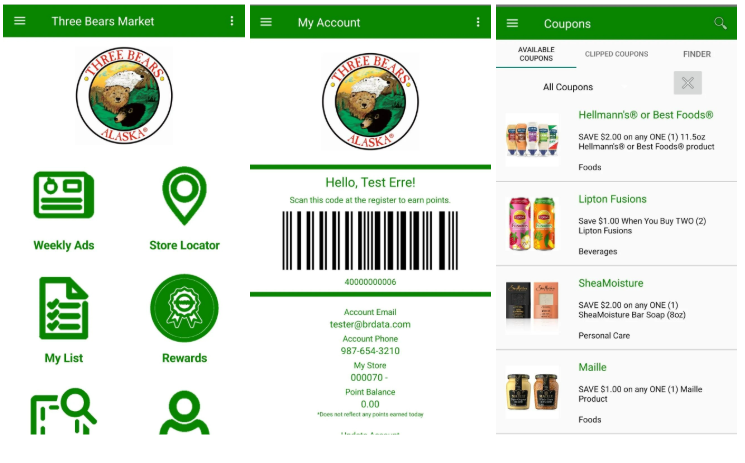
They engineered what is known as “ecosystem subsidization”, in which the program operates as a unified currency across their entire footprint, which includes grocery aisles, sporting goods counters, hardware sections, and fuel stations.
Here’s how the behavioral trap is set: a customer buys a high-ticket item; say, a generator or seasonal camping gear. That massive transaction floods their digital wallet with Bear Bucks. But instead of saving those points for another high-ticket item a year later, the software allows them to immediately burn that currency on high-frequency, everyday necessities like groceries or gas.
The customer mathematically realizes that buying their expensive outdoor gear at Three Bears actively pays for their family’s weekly food run. And once that connection is made in the consumer’s brain, driving to a competitor for a tent feels like actively stealing grocery money from their own pocket.
| Feature | Description |
| Loyalty program type | Unified Ecosystem Currency (Earn & Burn) |
| Welcome reward | – |
| Birthday reward | – |
| Earning method | Standard: Earn $0.02 for every $5 spent Elevated: Earn $0.05 for every $5 spent when the total basket is over $50 Members earn points on virtually every purchase across all departments (Grocery, Hardware, Sporting Goods, Gas Stations, etc.) |
| Referral reward | – |
| Rewards | Points convert directly into “Bear Bucks” cash value, which can be applied to the total basket cost at the register. |
| Exclusive perks | Digital Deal Clipping: Access to member-only manufacturer discounts directly within the app. Sweepstakes Entry: Automatic entry into high-value localized giveaways (e.g., ATVs, free groceries for a year) upon scanning. |
| Mobile app integration | Android / iOS |
Why It Works:
- Ecosystem Subsidization: Uses rare, high-margin transactions (sporting goods) to actively fund high-frequency, necessary purchases (groceries).
- Geographic Monopolization: Keeps consumer spending trapped within a single corporate footprint in a state where driving to competitors is logistically difficult.
- Unified Currency: Strips away the confusion of department-specific sales, allowing the customer to clearly see the mathematical value of their total basket.
However, based on the structural mechanics of Bear Bucks, the primary source of friction is “value-visibility” and rigid category exclusions. Earning rewards in fractions of a penny ($0.02 per $5) makes it incredibly difficult for the average consumer to mentally track their progress, leading to a program that feels less like a rewarding game and more like a slow, invisible drip. Furthermore, despite operating their own gas stations and pharmacies, Three Bears explicitly excludes fuel, tobacco, and prescriptions from earning Bear Bucks. This creates point-of-sale friction when rural customers spend hundreds of dollars filling up their trucks or buying medicine, only to realize none of that massive spend counts toward their loyalty balance.
Bear Bucks is a unified, spend-based rewards currency that connects Three Bears Alaska’s diverse retail departments, including grocery, hardware, sporting goods, and fuel. Customers earn points on virtually every purchase across the massive footprint, which then convert into cash-value Bear Bucks. The program allows Alaskans to leverage massive transactions like outdoor equipment to instantly subsidize the cost of their everyday essentials at the checkout counter.
Arizona – PetSmart
When e-commerce giants can deliver a 40-pound bag of dog food to a customer’s front porch in two days (often for less money), physical retailers are instantly at a disadvantage. Competing strictly on retail pricing is just corporate suicide for those in the petcare industry. PetSmart, headquartered in Phoenix, had to weaponize the one thing the online titans absolutely could not put inside a cardboard box: physical, hands-on pet care.
Their strategic counter-offensive was Treats Rewards.
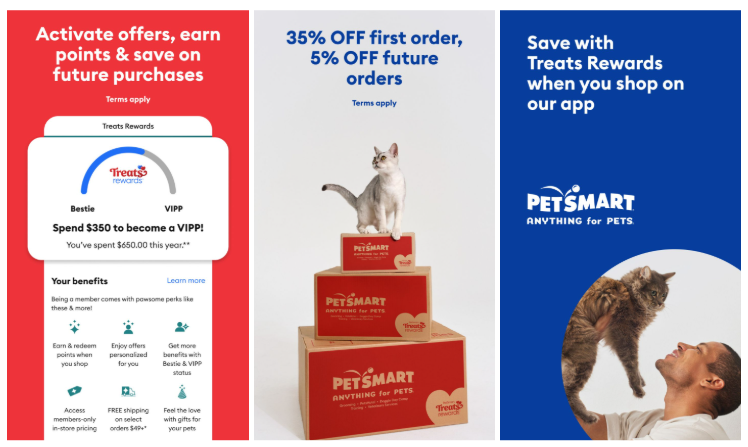
The program integrates every single touchpoint of a pet’s life into one centralized point balance. By awarding points not just for high-margin bags of food, but also for booking grooming appointments or dropping a dog off at Doggie Day Camp, PetSmart drastically increases the customer’s “switching cost.” If a pet owner decides to buy their dog food on Amazon instead, they will be actively slowing down the rate at which they earn free grooming sessions, along with the discount.
Furthermore, PetSmart recently transitioned to a tiered VIP system (Member, Bestie, VIPP) that actively gamifies a pet parent’s devotion. By tying “Very Important Pet Parent” status to a $1,000 annual spend, the brand taps into the owner’s emotional identity, making the consolidation of their pet budget a point of pride rather than a chore.
| Feature | Description |
| Loyalty program type | Service-Integrated Points System (Tiered: Member, VIP, Bestie) |
| Welcome reward | 1,000 bonus points upon profile completion (equivalent to a $2.50 reward). |
| Birthday reward | Birthday Surprise: Free customized treats for the pet’s birthday |
| Earning method | Member: 8 points per $1 spent VIP: 9 points per $1 spent Bestie: 10 points per $1 spent (Points earned across both retail products and services) |
| Referral reward | – |
| Rewards | Points convert to cash discounts at the register: $2.50 off for every 1,000 points redeemed. |
| Exclusive perks | Service Integration: Earn points on grooming, PetsHotel, and training.Tiered Shipping: Free shipping with no minimum spend for the highest tier. |
| Mobile app integration | Android / iOS |
Why It Works
- The “Un-Shippable” Moat: Relies on physical, hands-on services that e-commerce competitors like Amazon simply cannot replicate.
- Cross-Pollination: Actively uses the points generated from high-friction services (grooming) to guarantee the customer returns to buy their commoditized retail goods (food).
- Emotional Anchoring: Personalizes the shopping experience by rewarding the pet directly, such as offering customized birthday surprises.
PetSmart’s Treats Rewards program is a massive omnichannel ecosystem designed to merge product retail with pet care services. Members earn 10 points for every dollar spent across the entire store footprint (including the salon, training, and PetsHotel). The program utilizes three spending tiers (Member, Bestie, and VIPP), with the upper tiers unlocking accelerated earning rates, exclusive annual gifts, and advanced booking priority. Points are highly liquid and act as flat digital cash at the register, making it a solid retail loyalty solution.
Arkansas – Murphy USA
Fuel is the ultimate commoditized market. Drivers will routinely cross four lanes of traffic just to save three cents a gallon. For Murphy USA, headquartered in El Dorado, winning this battle meant disrupting the commuter’s autopilot behavior. Since their stations are primarily located near Walmart stores, they already had the convenience factor. They just needed a mechanism to turn a convenient stop into a mandatory one.
They achieved this by launching Murphy Drive Rewards, a loyalty program designed for absolute, frictionless velocity.
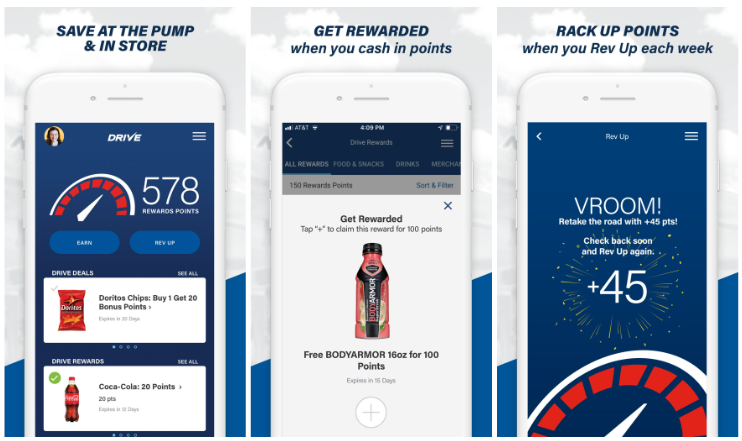
While the baseline program offers standard points for in-store merchandise and fuel discounts, the true retention engine is the app’s targeted “Rev Up” campaigns. They use their digital infrastructure to drop highly localized, hyper-specific bonuses directly to a commuter’s phone. By giving the customer an app-exclusive reason to pull in—whether it’s an age-restricted discount on tobacco or a customized snack offer—they effectively break the driver’s habit of just looking at the big numbers on the street sign.
| Feature | Description |
| Loyalty program type | Points-based system |
| Welcome reward | 100 bonus points upon sign-up |
| Birthday reward | – |
| Earning method | 1 point per 1 gallon of gas 2 points per $1 spent on in-store merchandise (excluding restricted items) |
| Referral reward | – |
| Rewards | Points convert into free snacks, fountain drinks, or fuel discounts (1$ off per gallon) up to 20 gallons |
| Exclusive perks | Rev Up Rewards: App-exclusive bonus point multipliers.Age-Restricted Savings: Specialized discounts on tobacco products for verified adult users. |
| Mobile app integration | Android / iOS |
Why It Works
- Frictionless Velocity: Designed for extreme speed, allowing commuters to claim deals and accumulate points without slowing down the pump or the checkout line.
- Targeted Interruption: Uses app-exclusive “Rev Up” bonuses to actively break a driver’s autopilot commute and force an in-store visit.
- Commodity Gamification: Turns the painful, mandatory chore of buying gas into a gamified system where the user is constantly chasing the next cents-off discount.
Murphy Drive Rewards is a high-velocity convenience and fuel loyalty program engineered to capture daily commuter traffic. Members earn points on every gallon of gas pumped and every dollar spent on in-store merchandise. The app acts as the central command center, allowing drivers to track points, activate targeted snack deals, and redeem their balance for direct, cents-off-per-gallon discounts at the pump before they even lift the nozzle.
California – Sephora
The beauty industry is inherently disloyal. A consumer can easily buy their favorite cleanser directly from the manufacturer, grab a cheap mascara at the local drugstore, and order their moisturizer on Amazon. When your inventory consists of hundreds of different brands that the customer could easily buy somewhere else, how do you force them to voluntarily consolidate their entire beauty spend at your checkout counter?
Sephora, with its massive North American footprint anchored in California, realized they couldn’t just sell makeup. They had to sell status. They built their digital moat using Beauty Insider.
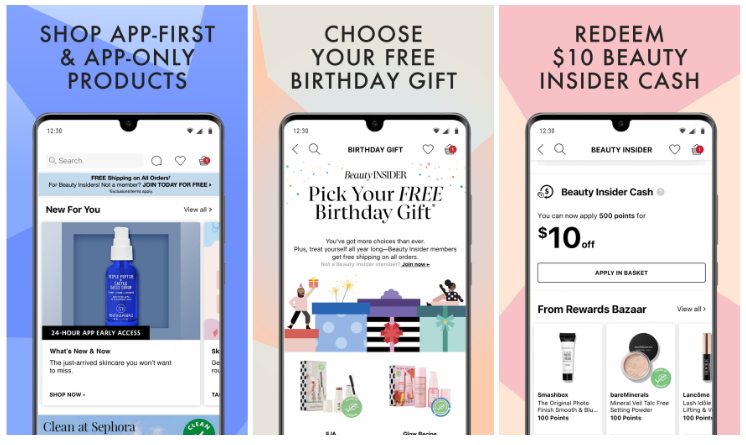
The program is ruthlessly structured into three distinct levels: Insider, VIB, and the highly coveted Rouge tier. If you spend $1,000 in a calendar year, you hit Rouge. Sephora does not just give Rouge members a boring discount; they give them first access to highly anticipated product launches, exclusive masterclasses, and an insane $100 Rouge Reward in exchange for their points. They turn the top tier into a VIP club.
The moment a shopper gets close to that $350 (VIB) or $1,000 (Rouge) threshold, the trap snaps shut. Buying lipstick at a department store suddenly feels like a catastrophic waste, because those dollars aren’t helping them climb the Sephora ladder. They actively consolidate their spending just to hit the mathematical tipping point and maintain their elite status for the following year.
| Feature | Description |
| Loyalty program type | Gamified Tiered Points System (Insider, VIB, Rouge) |
| Welcome reward | Free standard shipping on all orders, plus immediate access to the Rewards Bazaar |
| Birthday reward | Highly coveted annual gift sets (featuring brands like Glossier or Dr. Dennis Gross) Special item for VIB and Rouge tiers |
| Earning method | 1 point per $1 spent across all tiers (Tier-specific multipliers like 2x, 3x, and 4x are triggered during seasonal savings events) |
| Referral reward | Varies by campaign; occasionally offers bonus points (e.g., 100-500 points) or percentage discounts for successfully referring a new shopper. |
| Rewards | Points are redeemed in the “Rewards Bazaar” for deluxe beauty samples, exclusive brand sets, or $10 Beauty Insider Cash (for 500 points) Rouge members can redeem 2,500 points for a $100 Rouge Reward. |
| Exclusive perks | Early Access: VIB and Rouge members get first dibs on major sales events and limited product drops. |
| Mobile app integration | Android / iOS |
Why It Works
- Aspirational Status: Leverages the psychology of the “velvet rope,” driving customers to spend more simply to achieve and display the elite Rouge tier status.
- Spend Consolidation: Prevents customers from buying their beauty products at pharmacies or department stores by making every outside dollar feel like a wasted opportunity to climb the tier ladder.
- Experiential Currency: Offers rewards that money cannot easily buy, such as exclusive masterclasses and early access to limited-edition products, rather than just basic discounts.
Beauty Insider is a massive, gamified, three-tier loyalty program (Insider, VIB, and Rouge) that dominates the North American cosmetics market. Members earn points on every dollar spent, which can be redeemed in the highly addictive “Rewards Bazaar” for deluxe samples or cash discounts. The true engine of the program is its elite tiering structure, which forces beauty consumers to voluntarily consolidate their annual spending at Sephora to unlock VIP perks, coveted birthday gifts, and first access to major sales events.
Colorado – North Face
Outdoor apparel is built to survive extreme conditions, which creates a massive financial paradox for the people selling it. When you engineer a $400 waterproof alpine shell designed to last a decade, you inherently destroy your own repeat purchase cycle. A customer simply doesn’t need to buy a new jacket every season.
For The North Face, headquartered in Denver, Colorado, the challenge was keeping a customer completely locked into the brand during the years-long gap between transactions. If they only communicated when it was time to sell a winter coat, they would lose their audience’s attention entirely.
Their answer was the XPLR Pass.
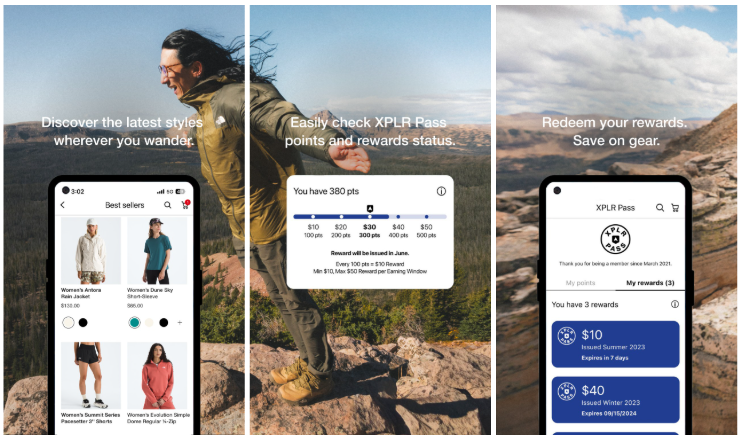
They stopped rewarding just the swipe of a credit card and started rewarding the lifestyle itself. The program is built around experiential engagement. While members absolutely earn points for buying gear, the true genius lies in the non-transactional triggers. Members earn points for checking in at National Parks, downloading the mobile app, or bringing a reusable bag into the physical retail store.
By tying the loyalty currency to the actual usage of the product—hiking, exploring, and environmental consciousness—The North Face transformed their loyalty program from a boring discount catalog into an active lifestyle companion. The customer is constantly interacting with the brand, accumulating a digital balance that guarantees their next major gear purchase will happen nowhere else.
| Feature | Description |
| Loyalty program type | Experiential Points & Perks System |
| Welcome reward | 10% off the first online purchase upon sign-up. |
| Birthday reward | – |
| Earning method | 1 point per $1 spent on merchandise Bonus points earned for checking in at National Parks, bringing a reusable bag, or downloading the app |
| Referral reward | Occasional bonus point promotions for referring friends to the program (e.g., 25 bonus points). |
| Rewards | Points convert to cash value: $10 reward for every 100 points earned, issued periodically. |
| Exclusive perks | Gear Field Testing: Opportunities for members to test unreleased products. Exclusive Drops: Early access to limited-edition collections and collaborations. Dedicated Support: Access to a dedicated customer service line. |
| Mobile app integration | Android / iOS |
Why It Works
- Non-Transactional Engagement: Keeps the customer locked into the brand’s ecosystem during the long, multi-year gaps between expensive jacket purchases.
- Lifestyle Alignment: Rewards the customer for actually living the brand’s ethos (exploring National Parks, recycling), creating deep emotional loyalty.
- Extended Lifetime Value: Builds a digital sunk-cost balance in the background, mathematically guaranteeing the customer returns when their gear finally wears out.
The XPLR Pass is an experiential loyalty program that rewards customers for both their purchases and their outdoor lifestyle. While members earn standard points for buying apparel and equipment, the program differentiates itself by offering non-transactional triggers—such as earning points for checking in at National Parks or bringing reusable bags into retail stores. The points convert into cash-value rewards, keeping the brand intimately connected to the customer’s adventures long after they leave the cash register.
Connecticut – Stew Leonard’s
Stew Leonard’s is famous in the Northeast for its labyrinthine, farm-fresh grocery layout, animatronic displays, and incredibly high customer satisfaction. Historically, their loyalty model was deeply analog and straightforward: spend a certain amount on groceries, get a free coffee or ice cream cone. However, realizing that customer preferences are diverse and digital engagement is paramount, they overhauled the Stew Leonard’s App to introduce a highly gamified system.
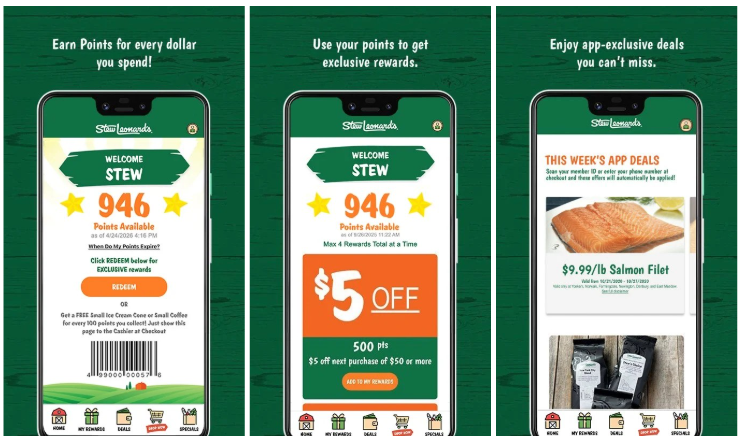
The strength of their loyalty program relies on a rotating set of redeemable items. Instead of offering a static reward catalog or standard digital cash, Stew Leonard’s updates their rewards menu monthly. Members earn points on their massive grocery runs, but the items they can burn those points on—ranging from seasonal baked goods and fresh produce to exclusive high-margin discounts—are in a constant state of flux. This introduces a “treasure hunt” element directly into the app dashboard. The shopper is mathematically forced to log in frequently just to check the current month’s offerings, incentivizing them to burn their points on new, trial-size, or seasonal items before the catalog rotates and the reward disappears.
| Feature | Description |
| Loyalty program type | Spend-Based Milestone System |
| Welcome reward | Free ice cream or coffee upon app download and registration. |
| Birthday reward | – |
| Earning method | Scanned spend accumulation. Tracks cumulative spending across visits. |
| Referral reward | – |
| Rewards | Rotating set of items, such as: 100 pts – Eggs 200 pts – Cheddar cheese 400 pts – Soda 800 pts – Frozen Ice Cream / Yogurt Free Coffee or Ice Cream triggered automatically for every $100 spent. |
| Exclusive perks | Digital Receipts: Automatic storage of all purchase history. App-Only Discounts: Access to rotating weekly specials that are automatically applied at checkout without needing to “clip” them. |
| Mobile app integration | Android / iOS |
Why It Works
- Zero Checkout Friction: Consolidates digital coupon clipping, loyalty tracking, and payment into a single, rapid smartphone scan, keeping the checkout line moving.
- High-Frequency Attainability: A $100 spend threshold is crossed rapidly in the grocery sector, ensuring the customer experiences the “win” state frequently and predictably.
- Tangible Gratification: Rewards customers with physical, immediate treats (ice cream or coffee) rather than abstract, unexciting percentage discounts.
The Stew Leonard’s Loyalty App operates as a straightforward, spend-based milestone program designed to streamline the high-volume grocery experience. Customers scan their digital barcode at checkout to log their purchases, automatically receiving a free coffee or ice cream for every $100 spent cumulatively. The app also functions as a frictionless digital hub, automatically applying weekly rotating discounts to the customer’s basket without the need to manually clip digital coupons.
Delaware – Wawa
Imagine a regional convenience chain with a fanbase so intensely devoted that people actually get its corporate logo tattooed on their bodies. In most parts of the country, grabbing unleaded fuel, a freshly brewed coffee, and a custom-built sandwich means visiting a gas station, a café, and a deli. But if you are commuting through Delaware or the surrounding mid-Atlantic, you bypass all three and head straight to one place.
This is the reality of Wawa. It is not merely a convenience store; it is the undisputed center of gravity for the regional commuter.
To capture and monetize this relentless daily foot traffic, the company engineered Wawa Rewards.
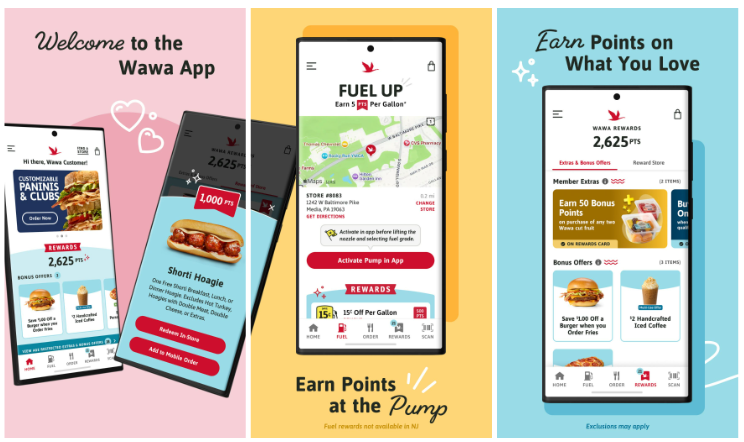
In the competitive landscape of retail loyalty programs, Wawa wields what we classify as the “High-Frequency Routine” Moat. Most standard customer loyalty programs fight a difficult, expensive battle for occasional discretionary spending—hoping you choose their storefront to buy a new shirt once a season. Wawa entirely bypasses that struggle by anchoring itself to your non-negotiable daily grind. They deal in absolute, biological, and mechanical necessities: morning caffeine, lunch-hour calories, and vehicle fuel.
The psychological hook is frictionless consolidation. By linking the gas pump and the touchscreen deli kiosk under a single, unified digital currency, Wawa mathematically persuades the regional workforce to completely centralize their daily errands. You are financially incentivized to route your entire morning routine through their ecosystem.
| Feature | Description |
| Loyalty program type | Points-based loyalty program |
| Welcome reward | Typically features an immediate burst of welcome points (e.g., 350 points) upon making the first eligible purchase. |
| Birthday reward | A customized digital perk, allowing members to choose 1 of 3 rewards during their birth month. |
| Earning method | Earn 10 points per $1 spent on eligible in-store items and 5 points per gallon on fuel. |
| Referral reward | – |
| Rewards | Redeem points for free items or discounts: pretzel (small points), Sizzli breakfast sandwich (~500 points), hoagie, pizza, coffeetiered unlocks for higher-value rewardsweekly rotating coupons. |
| Exclusive perks | Personalized promotions based on purchase history, early access to limited-time menu items, app-exclusive deals; receipt-free checkout via mobile pay. |
| Mobile app integration | Android / iOS |
Why It Works
- The Dual-Earning Engine: By awarding points for both fuel (5 points per gallon) and in-store purchases (10 points per $1), Wawa effectively uses the gas pump as a funnel. Drivers quietly accumulating fuel points are mathematically drawn inside the store to redeem them, driving high-margin interior foot traffic.
- The Mobile Order Bypass: For the morning commuter, speed is everything. Integrating mobile ordering directly into the rewards app turns it into a VIP fast-pass. Allowing members to skip the notoriously long deli lines drastically increases daily app engagement compared to standard retail rewards programs.
- Cross-Category Subsidization: Because points can be redeemed across a massive, built-to-order menu, the program gamifies the daily routine. Users feel a genuine sense of accomplishment when they use the points earned from their commuting gas budget to completely subsidize their lunch.
Wawa Rewards dominates the regional convenience sector by merging the absolute necessities of fuel and food into a single, high-frequency digital ecosystem. By turning the daily commute into a gamified point-earning engine, the brand successfully monopolizes the morning routine, even if its confusing redemption math occasionally frustrates its most analytical buyers.
Florida – Publix Super Markets
The supermarket industry is notoriously reliant on massive, gamified points systems to survive. Most major chains bribe their customers with convoluted gas points or digital tokens just to get them to walk through the door. Publix, the employee-owned juggernaut headquartered in Lakeland, Florida, famously refused to play that game for decades. They relied entirely on their legendary customer service and iconic “BOGO” (Buy One, Get One) sales. But as e-commerce grocery delivery threatened to sever the in-store relationship, Publix had to digitize their customer base without destroying their straightforward brand identity.
Their counter-offensive is Club Publix.
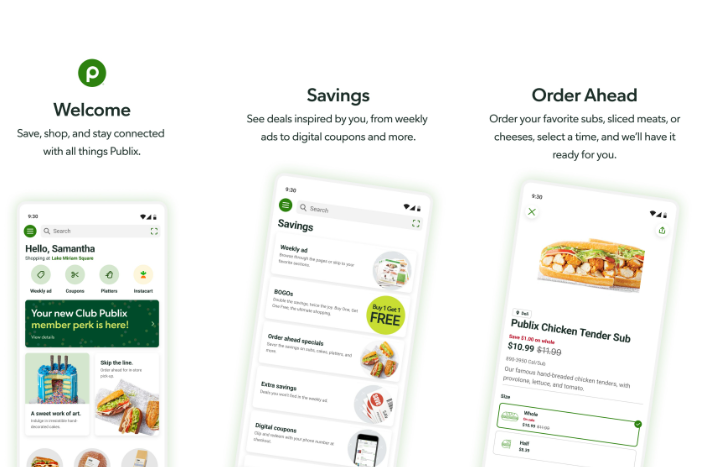
Instead of forcing a confusing points currency onto their shoppers, they built a “Predictive Personalization” engine. They use the digital platform strictly for behavioral tracking and frictionless utility. When a customer enters their phone number at checkout, the software builds an invisible, highly detailed profile of their household’s consumption habits.
Here is where the behavioral trap is set. Because the algorithm knows exactly what the customer buys, it doesn’t spam them with generic flyers. It serves them with relevant, customized digital coupons and grants them an exclusive “Sneak Peek” at the upcoming weekly ad a day before the general public. By giving the shopper early intelligence on when their specific favorite items are going on sale, Publix guarantees that the customer builds their weekly meal plan (and their weekly budget) entirely around the Publix ecosystem.
| Feature | Description |
| Loyalty program type | Personalization & Digital Utility Program (No Points) |
| Welcome reward | $5 discount with a $20 purchase or more upon registration. |
| Birthday reward | plus a free annual birthday treat. |
| Earning method | Savings are generated through algorithmic deal matching and digital coupon clipping. |
| Referral reward | – |
| Rewards | Direct, personalized discounts applied automatically at checkout, |
| Exclusive perks | Weekly Ad Sneak Peek: Access to the highly anticipated weekly BOGO sales a day early.Digital Organization: In-app creation of shopping lists organized by store aisle based on the user’s specific local Publix. |
| Mobile app integration | Android / iOS |
Why It Works
- Rejection of Points: Avoids the fatigue of complex earning tiers, opting instead for instant gratification through personalized, digital coupon clipping.
- Information Asymmetry: The “Sneak Peek” feature gives members a feeling of insider status, allowing them to plan their shopping trips around upcoming BOGO sales before non-members even see the flyer.
- Habitual Utility: Integrates e-receipts, automatic past-purchase reordering, and digital shopping lists, making the physical act of grocery shopping significantly faster for members.
Despite its digital utility, Club Publix faces significant user friction stemming from an “expectation gap” between shoppers and modern app mechanics. According to feedback from customers and employees on community forums like the r/publix subreddit, the most prominent complaint is the lack of a transparent, traditional points system; many shoppers report entering their phone number for years without seeing a benefit, unaware that perks are algorithmically randomized rather than earned per dollar spent.
Club Publix is a free, personalization-driven loyalty program that eschews traditional points in favor of highly targeted digital utility. Members identify themselves at the register via phone number or the mobile app to automatically apply clipped digital coupons and log their purchase history. The program rewards consistent shoppers with algorithmic, personalized deals on the items they buy most, alongside surprise perks like birthday treats and early access to weekly sales advertisements.
Georgia – The Home Depot
The home improvement industry is split into two distinct battlegrounds: the weekend DIYer who buys a single drill, and the professional contractor who buys $10,000 worth of lumber every month. And to dominate the market, capturing the contractor is a mandatory survival metric. The Home Depot, the massive retail titan headquartered in Atlanta, Georgia, realized that professional builders do not care about cute gamified points. They care about margins, speed, and accounting.
To permanently lock in the most lucrative demographic in retail, they built Pro Xtra.
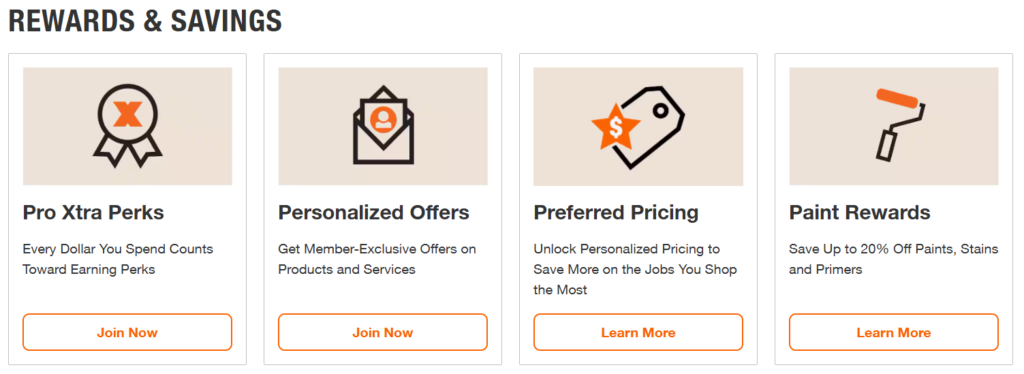
Rather than designing a standard customer rewards app, they engineered a complete B2B workflow trap. Pro Xtra embeds itself directly into the contractor’s daily business operations. Members receive volume pricing, allowing them to instantly protect their project margins. But the true behavioral hook is the digital back-end. The system automatically tracks every purchase, organizes receipts for tax season, and even saves an unlimited history of specific paint color matches for client jobs.
If a professional contractor decides to cross the street and buy materials from a competitor, they aren’t just losing a small discount. They are actively disrupting their own accounting system, losing their volume-tiered pricing, and forfeiting the dedicated “Pro-Only” checkout lanes that save them an hour of labor every week. The Home Depot effectively transforms their loyalty program from a retail gimmick into an indispensable piece of business management software.
| Feature | Description |
| Loyalty program type | B2B Tiered Spend & Workflow Utility Program |
| Welcome reward | Immediate access to volume pricing and a digital perk (often a direct discount coupon) upon registration. |
| Birthday reward | A complimentary pint during the member’s birthday month. |
| Earning method | Tracks cumulative dollar amount spent to unlock VIP tiers (Member, Elite, VIP) |
| Referral reward | – |
| Rewards | Direct volume pricing discounts, tool rental perks, and targeted business offers based on trade specialty. |
| Exclusive perks | Business Tools: Advanced purchase tracking, digital receipt organization, and an unlimited paint color history log Personalized offers on products and services |
| Mobile app integration | Android / iOS |
Why It Works
- Workflow Integration: Embeds the retailer directly into the customer’s business operations, making the platform a mandatory accounting and job-tracking tool.
- Volume-Tiered Sunk Cost: The more a contractor spends, the cheaper their future materials become, making it mathematically irresponsible for them to split their budget with a competitor.
- Operational Speed: Offers tangible, time-saving physical perks—like dedicated parking and exclusive checkout lanes—that immediately reduce labor costs for the buyer.
Pro Xtra is a specialized, B2B-focused loyalty program engineered specifically for professional contractors, builders, and tradespeople. Instead of traditional points, the loyalty program tracks aggregate spending to unlock escalating tiers (Member, Elite, VIP). Members gain access to volume pricing discounts, reduced tool rental rates, and personalized account management. The digital dashboard serves as a comprehensive business hub, allowing professionals to track spending, organize digital receipts for client billing, and manage their procurement seamlessly.
Hawaii – Foodland Super Market
Island logistics make Hawaii the most expensive grocery market in the United States. When standard pantry staples cost significantly more than on the mainland, pricing isn’t just a competitive advantage for a supermarket; it is a critical daily concern for residents. Foodland, the beloved local chain headquartered in Honolulu, needed to defend its turf against massive, well-funded mainland big-box retailers like Costco and Target.
They didn’t just offer standard discounts; they deployed Maika’i (meaning “good” or “excellent” in Hawaiian).
The program functions as an aggressive two-tiered pricing gate. If a shopper doesn’t scan their Maika’i card, they pay a severe premium at the register. But the true genius is the “Cultural Currency” exchange. Foodland partnered directly with Hawaiian Airlines.
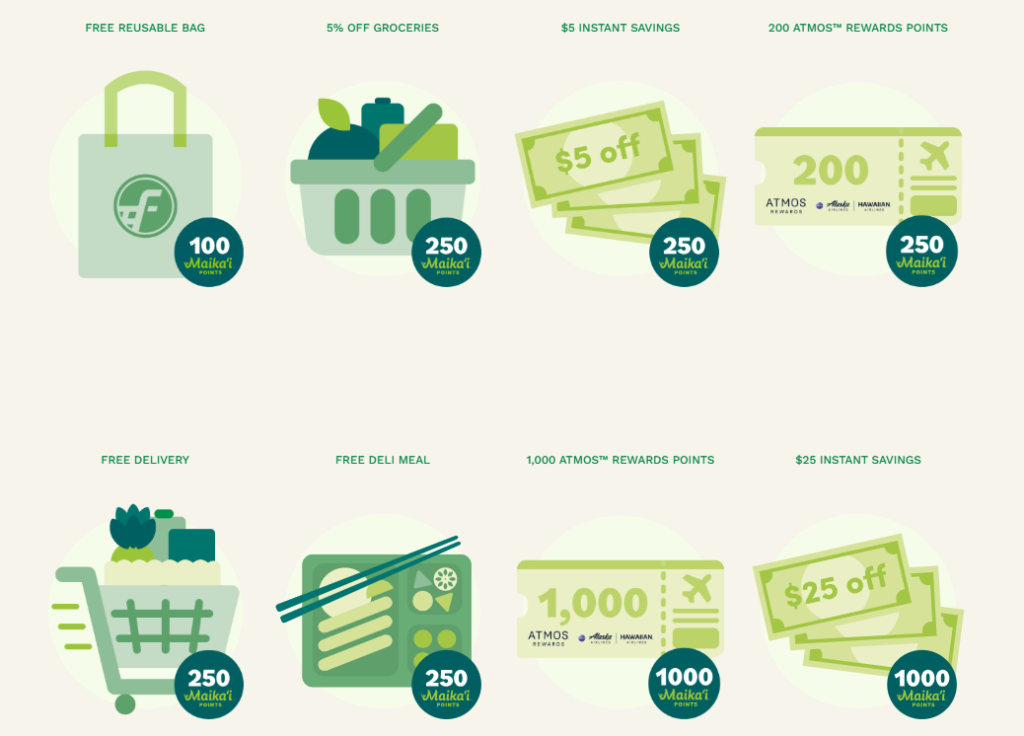
Members who hit 250 points earn a “My Rewards Certificate,” which can be used for free groceries, up to 5% off their total bill, or converted directly into Atmos Rewards points. In an island state where air travel is a fundamental necessity for visiting family or traveling to the mainland, tying grocery spending directly to airline flights creates a valuable ecosystem. The customer will be able to buy poke and rice while actively financing their inter-island commutes or vacations with every grocery run.
| Feature | Description |
| Loyalty program type | Two-Tier Pricing Gate & Spend-Based Points |
| Welcome reward | Immediate access to volume pricing and a digital perk (often a direct discount coupon) upon registration. |
| Birthday reward | Birthday perks via mobile subscription, including bonus points or special offers. |
| Earning method | 1 point per $1 spent on qualifying groceries; link to Atmos™ for additional gas rewards points |
| Referral reward | – |
| Rewards | Tiered redemptions: 250 points for 5% off groceries, free deli meal, or 200 Atmos points; 1,000 points for $25 savings or 1,000 Atmos points; free reusable bag, delivery, or products (limits apply) |
| Exclusive perks | Free/specially priced products, instant savings, digital coupons; in-store tabling events for enrollment help |
| Mobile app integration | Android / iOS |
Why It Works
- Strategic Partnerships: Converts grocery points into high-value airline miles, tapping into an absolute geographic necessity for island residents.
- Two-Tiered Pricing Gate: Forces immediate program adoption by heavily penalizing non-members at the cash register with significantly higher baseline prices.
- Cultural Anchoring: Leverages deep local brand equity, framing the mainland big-box competitors as outsiders while actively rewarding localized shopping behavior.
Foodland’s Maika’i retail loyalty program is a hybrid discount and spend-based points program that dominates the Hawaiian grocery market. Members unlock exclusive “Maika’i Prices” on thousands of items instantly at checkout. Simultaneously, they earn one point per dollar spent. Accumulating 250 points generates a My Rewards Certificate, which can be redeemed for a 5% basket discount, free specific grocery items, or converted into HawaiianMiles, making it one of the most culturally integrated loyalty programs in the country.
Idaho – Albertsons
Grocery margins are notoriously unforgiving, and customer loyalty is fleeting. If a competitor across town drops the price of milk by twenty cents, standard shoppers will defect without a second thought. For Albertsons, the grocery behemoth headquartered in Boise, Idaho, simply having a large regional footprint wasn’t enough to prevent attrition to aggressive national discounters. They needed to make the act of switching grocery stores mathematically painful.
They achieved this by launching Albertsons for U.
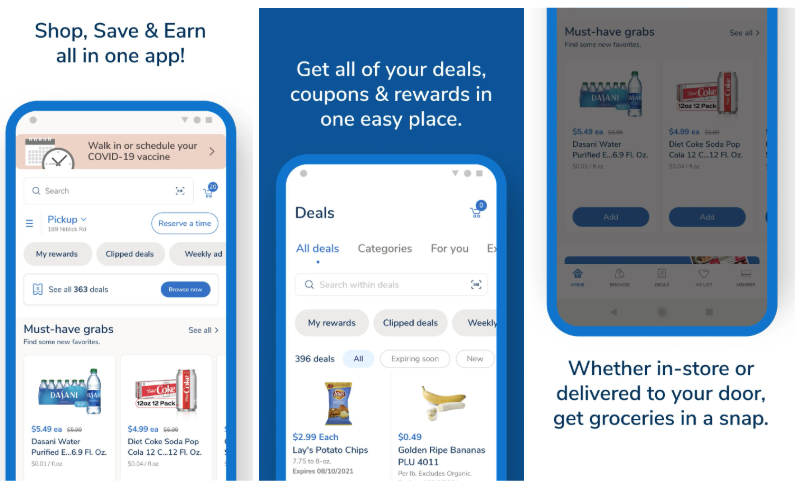
Instead of relying on generic, paper weekly circulars, they turned the shopper’s smartphone into a personalized digital command center. The program forces engagement through an active “clip-to-save” mechanic. The software continuously analyzes past purchases and pushes highly specific discounts directly to the user’s app—but the customer has to physically tap to claim them before hitting the register.
This subtle layer of friction is entirely intentional. It creates the “IKEA effect” for grocery shopping. Because the customer actively hunted and “clipped” their customized deals, they feel a deep sense of psychological ownership over the savings. Couple this with a powerful fuel points engine, and Albertsons effectively locks the customer into a closed loop: they gamify the food purchase, and use the resulting points to heavily subsidize the drive home.
| Feature | Description |
| Loyalty program type | Algorithmic Digital Couponing |
| Welcome reward | $5 off the next $25+ purchase, plus a free introductory item upon sign-up |
| Birthday reward | A special digital offer or free item loaded automatically into the app during the member’s birthday month. |
| Earning method | 1 point per $1 spent on groceries and pharmacy.2 points per $1 spent on participating gift cards. Occasional 2x, 4x and 6x point multiplier events |
| Referral reward | – |
| Rewards | 100 points = 1 Reward. Rewards can be redeemed for free specific groceries, cash off the total basket, or up to $1.00 off per gallon of gas at partner stations. |
| Exclusive perks | Monthly Free Item: A rotating, app-exclusive free product offered every month to drive physical foot traffic. Personalized Pricing: Algorithmic discounts based strictly on the user’s historical checkout data |
| Mobile app integration | Android / iOS |
Why It Works
- The IKEA Effect of Savings: Forcing the customer to actively “clip” digital coupons creates psychological ownership over the deals, making them highly unlikely to abandon their curated digital cart for a competitor.
- Cross-Vertical Subsidization: Seamlessly links high-frequency grocery spending to a highly volatile commodity (gasoline), allowing food purchases to actively drive down the cost of commuting.
- Predictive Replenishment: Uses algorithmic tracking to push personalized deals on items the customer was already going to buy, creating a highly addictive illusion of serendipitous savings.
Albertsons for U is a massive, multi-tiered digital loyalty and fuel rewards program. Members earn points on eligible grocery and pharmacy purchases, which accumulate into digital “Rewards” that can be burned for either direct cash off the total grocery bill or significant cents-off-per-gallon discounts at participating gas stations. The program heavily relies on its mobile app to deliver personalized digital coupons, a dedicated birthday treat, and monthly free item offers to maintain high weekly engagement rates.
Illinois – Ulta Beauty
The beauty industry is sharply divided. You have high-end department stores selling prestige cosmetics, and you have big-box pharmacies selling affordable drugstore staples. Historically, a consumer split their wallet between the two. For Ulta Beauty, headquartered in Bolingbrook, Illinois, capturing just one side of that spending wasn’t enough. They wanted the entire wallet.
They bridged this massive retail gap using Ulta Beauty Rewards.
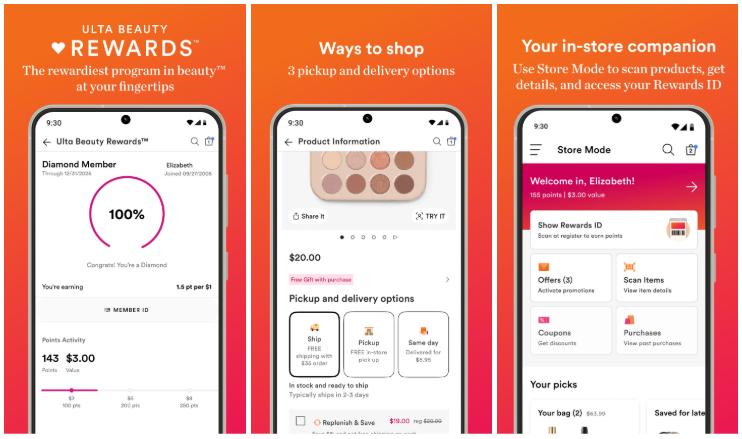
Instead of relying on a standard, boring point system, they engineered what the industry refers to as a “Non-Linear Value Curve.” Here is the psychological trap. At most retailers, points scale linearly. If 100 points equal one dollar, 1,000 points equal ten dollars. There is no strategic advantage to saving them.
Ulta broke that math entirely. If you redeem 1,000 points, you get $50 off. But if you hold out and save 2,000 points, the value jumps dramatically to $125.
This creates an intense, gamified behavioral loop. The customer realizes that cashing out early actually destroys their own purchasing power. They become obsessed with hitting that 2,000-point threshold. To get there faster, they stop buying their cheap mascara at the grocery store and their premium fragrance at the department store, aggressively consolidating every single beauty and salon dollar at Ulta.
| Feature | Description |
| Loyalty program type | Gamified Tiered Points System (Member, Platinum, Diamond) |
| Welcome reward | Frequently offers a sign-up discount (e.g., $5 off a $10 purchase) to trigger an immediate first transaction. |
| Birthday reward | 2X points during the entire birth month, plus a free curated beauty gift. (Platinum/Diamond members receive an additional $10 coupon) |
| Earning method | Member: 1 point per $1 spent Platinum ($500/yr): 1.25 points per $1 Diamond ($1,200/yr): 1.5 points per $1 |
| Referral reward | – |
| Rewards | Exponential cash-back rewards:100 pts = $31,000 pts = $502,000 pts = $125 |
| Exclusive perks | Service Integration: Points can be earned and spent on physical salon services.Diamond Perks: Free shipping on orders over $25, an annual $25 salon service coupon, and a full-size welcome gift upon tier entry. |
| Mobile app integration | Android / iOS |
Why It Works
- The Non-Linear Value Curve: By making points exponentially more valuable at higher thresholds, the program actively prevents consumers from cashing out early, building a massive “sunk-cost” digital balance.
- Wallet Consolidation: Because points can be earned and burned on anything from a $4 lip balm to a $150 salon haircut, the consumer is mathematically incentivized to never spend a beauty dollar anywhere else.
- Multiplier Gamification: Frequent, app-exclusive “Point Multiplier Days” (offering 3X, 5X, or even 10X points on specific brands) trigger immense FOMO and manufacture artificial shopping urgency.
Ulta Beauty Rewards is a gamified, three-tier points system (Member, Platinum, Diamond) that operates as the gold standard for retail beauty loyalty. Members earn points on all retail purchases and in-store salon services, which act as direct cash at the register. The program relies heavily on an addictive mobile app where users activate personalized multipliers, driving massive retention through a redemption structure that heavily rewards patience and spending consolidation.
Indiana – Lids
Licensed sports merchandise is a fiercely competitive market. If a fan wants a new Los Angeles Dodgers cap or a Dallas Cowboys jersey, they can buy it at the stadium, at a massive sporting goods big-box store, or directly from the league’s website. For Lids, headquartered in Indianapolis, Indiana, simply having hundreds of mall-based storefronts wasn’t enough to prevent fans from buying their gear elsewhere. They needed to turn the casual fan into a hyper-loyal collector.
They achieved this by creating Lids Access Pass Premium.
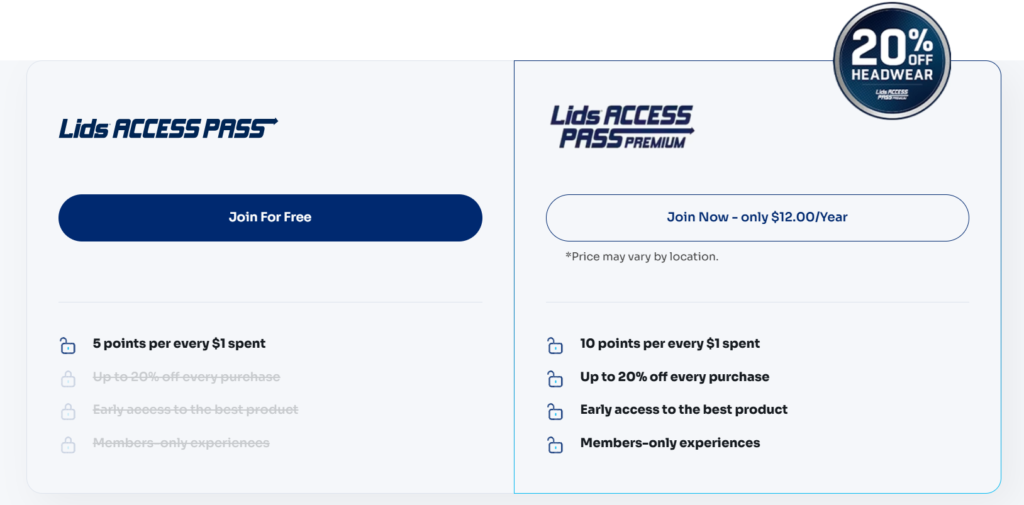
While they offer a Basic tier for Lids Access Pass, the true retention engine is the Premium tier, which costs just $10 a year. This upfront fee triggers the classic “sunk-cost fallacy.” But Lids makes the math impossible to ignore. Premium members get a massive 20% off eligible hats all year long. Because a standard premium fitted hat costs around $40 to $50, the $10 membership literally pays for itself on the very first purchase.
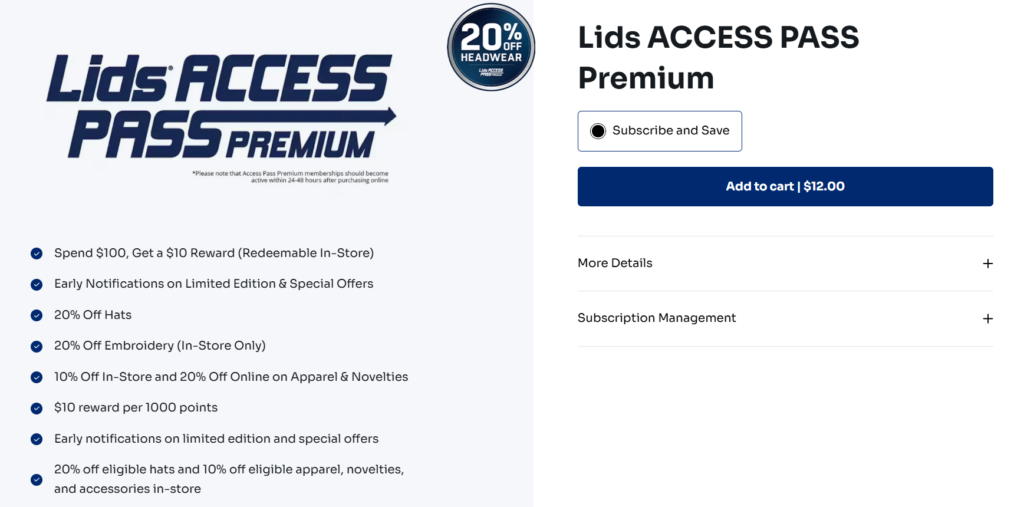
The psychological trap is set instantly. Once a customer pays that $10 and sees the immediate 20% discount, they feel mathematically obligated to exploit the system. They stop buying their hats at the stadium or from online competitors because purchasing anywhere else means throwing away the massive discount they already “paid” for at Lids. They actively consolidate their entire headwear and sports apparel spend into a single storefront, transforming a one-time transaction into a high-frequency collecting habit.
| Feature | Description |
| Loyalty program type | Paid Annual Subscription |
| Welcome reward | – |
| Birthday reward | A special birthday gift (typically a digital coupon or bonus points) strictly redeemable in-store. |
| Earning method | Basic: 5 points per $1 spent. Premium ($10/year): 10 points per $1 spent. |
| Referral reward | – |
| Rewards | 100 pts = $3 1,000 pts = $50 2,000 pts = $125 |
| Exclusive perks | Permanent Markdown: Premium members receive 20% off all eligible hats, 20% off in-store embroidery, and 10% to 20% off apparel. Drop Access: Early notifications and buying windows for limited-edition caps and collaborations. |
| Mobile app integration | – |
Why It Works
- The Instant ROI Trap: By pricing the premium membership at just $10 and offering a flat 20% discount on hats, the program pays for itself on day one, completely eliminating the hesitation to subscribe.
- Spend Consolidation: Once the consumer holds the Premium pass, buying licensed gear from any other retailer feels like a catastrophic mathematical waste, ensuring Lids captures 100% of their headwear budget.
- Collector Gamification: High-frequency buyers (like fitted hat collectors) earn points twice as fast on the premium tier, meaning their constant purchasing yields frequent $10 cash rewards, further subsidizing the addiction.
Lids Access Pass is a two-tiered loyalty program (Free and Premium) designed for high-frequency sports merchandise buyers. The Free tier awards 5 points per dollar spent, but the true driver is the $10/year Premium tier. Premium members earn double points (10 points per dollar spent) and unlock massive, permanent discounts: 20% off eligible hats, 20% off in-store embroidery, and up to 20% off apparel and novelties. Points from both tiers convert directly into $10 rewards (every 1,000 points), making it one of the most aggressive and successful paid retail programs in the country.
Iowa – Hy-Vee
In the Midwest, the grocery wars are won on pure utility. Hy-Vee, headquartered in West Des Moines, Iowa, recognized that having friendly service and a massive regional footprint wasn’t enough to fend off the digital convenience of Walmart or Amazon. To completely dominate their market, they needed to control the customer’s entire weekly errand run, linking the pantry, the pharmacy, and the gas tank.
They achieved this omnichannel lockdown through Hy-Vee PERKS.
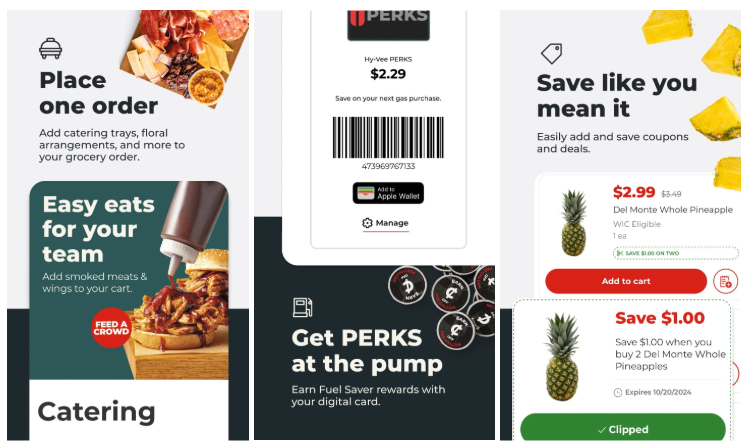
While the program offers a standard free tier that issues digital coupons and fuel discounts, the true retention engine is their paid subscription tier: PERKS Plus. By charging an annual fee (similar to Amazon Prime) in exchange for free “Aisles Online” grocery delivery and express pickup, they trigger a powerful sunk-cost fallacy.
Once a family pays that upfront membership fee, the psychological trap snaps shut. Driving across town to a competitor or ordering from a different delivery service feels like a catastrophic waste of money. They are mathematically obligated to consolidate their entire household grocery spend with Hy-Vee to maximize the return on their investment. To solidify the loop, the massive grocery orders actively generate high-value fuel discounts, ensuring that the customer’s food budget directly subsidizes their daily commute.
| Feature | Description |
| Loyalty program type | Spend-Based Rewards & Paid Subscription (Free & PERKS Plus) |
| Welcome reward | Frequently offers a high-value digital coupon (e.g., $10 off) or a free trial of the Plus tier upon registration. |
| Birthday reward | An exclusive digital discount or free bakery treat loaded automatically into the app during the member’s birthday month. |
| Earning method | Earn points on groceries, prescriptions, and purchases (100 points = 5¢/gal fuel discount) Fuel Saver + Perks gives 10¢/gal per $50 spent at partners; Plus adds 3¢/gal extra per transaction. |
| Referral reward | – |
| Rewards | Rewards can be flexibly redeemed either as direct cash discounts on future grocery baskets or as cents-off-per-gallon discounts at participating fuel stations. |
| Exclusive perks | PERKS Plus: Unlimited free Aisles Online delivery, free 2-hour pickup, and exclusive “Red Line” concierge access. Pharmacy Integration: Points earned on out-of-pocket prescription costs. |
| Mobile app integration | Android / iOS |
Why It Works
- The Subscription Moat: The paid PERKS Plus tier guarantees that high-value, high-frequency customers consolidate 100% of their grocery spending to justify their annual membership fee.
- Cross-Vertical Subsidization: By allowing rewards earned on groceries and pharmacy prescriptions to directly lower the price of gasoline at their Fast & Fresh locations, they seamlessly connect two major household budgets.
- Frictionless Fulfillment: The program is deeply integrated into their e-commerce platform, ensuring that customers who prefer digital ordering, curbside pickup, or home delivery are rewarded just as heavily as in-store shoppers.
Hy-Vee PERKS is a hybrid digital coupon, fuel reward, and subscription program. On the free tier, members unlock exclusive pricing, clip digital coupons, and earn rewards that can be burned for either cash off their grocery bill or cents-off-per-gallon at the pump. The premium PERKS Plus tier requires an annual subscription fee, which unlocks highly coveted logistical perks like unlimited free grocery delivery, free two-hour express pickup, and exclusive premium digital offers, effectively building an unbreakable wall around their most profitable demographic.
Kansas – AMC Theaters
The theatrical exhibition industry is engaged in a brutal war against the living room. With streaming services offering endless content on massive 4K televisions, the modern consumer increasingly views the movie theater as an expensive, unnecessary hassle. The traditional model (which relied on massive blockbusters to drive occasional weekend traffic) was leaving auditoriums completely empty on a Tuesday night. AMC Theatres, headquartered in Leawood, Kansas, realized they had an agonizing amount of perishable inventory (empty seats) that was generating zero revenue.
To fundamentally alter how Americans consume cinema, they launched the subscription tier of their loyalty program: AMC Stubs A-List.
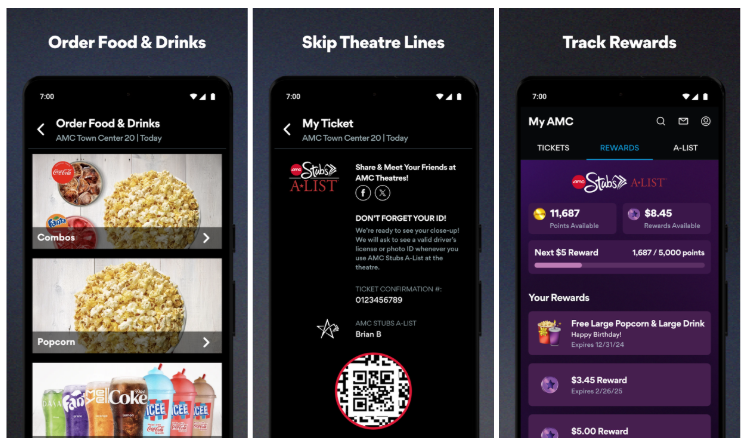
Rather than trying to convince a customer to spend $15 on a single ticket for a mid-tier movie, AMC charges a flat monthly fee (around $20-$25, depending on the state) allowing the member to see up to three movies every single week. This triggers a massive psychological shift for the movie-goer. Because the monthly fee is a sunk cost, the subscriber begins to view the actual movie tickets as “free.”
Here is the behavioral trap: movie theaters do not make their real money on ticket sales; they make their profit on concessions. By removing the financial friction at the box office, A-List drastically increases the frequency of a customer’s visits. A member who used to go to the theater twice a year now goes three times a month. And every time they walk through the doors to see their “free” movie, they purchase a $10 bucket of high-margin popcorn. The subscription doesn’t just sell tickets; it guarantees a continuous, high-volume pipeline of concession stand buyers.
| Feature | Description |
| Loyalty program type | Tiered Spend-Based Points & Subscription |
| Welcome reward | Half-off online ticketing fees for the first purchase (Insider). |
| Birthday reward | Insider tier: Free large popcorn. Premiere & A-List tier: Free large popcorn and free large fountain drink. |
| Earning method | Insider: 20 points per $1 spent. Premiere & A-List: 100 points per $1 spent. |
| Referral reward | – |
| Rewards | 5,000 Points = $5 Reward (usable on tickets, concessions, or premium dine-in food). |
| Exclusive perks | A-List Reservations: Up to 3 movies per week, including IMAX and Dolby Cinema, with zero upcharges. Priority Access: Exclusive VIP lanes at the box office and concession stands for Premiere and A-List. |
| Mobile app integration | Android / iOS |
Why It Works
- The “Free” Illusion: By converting the ticket price into a fixed, recurring monthly cost, the consumer’s brain stops worrying about the price of admission, completely removing the primary reason people avoid the theater.
- Concession Subsidization: The subscription actively drives up sheer foot traffic, directly fueling the theater’s actual profit engine: high-margin food and beverage sales.
- Perishable Inventory Monetization: An empty theater seat on a Wednesday afternoon generates zero dollars. Putting a subscriber in that seat costs the theater almost nothing, but virtually guarantees a high-profit snack transaction.
AMC Stubs is a massive, multi-tiered loyalty program (Insider, Premiere, and A-List). The free Insider tier offers standard point accumulation and waived online ticketing fees for four or more tickets. The $15/year Premiere tier accelerates point earning and waives all ticketing fees. However, the true anchor is the A-List subscription tier. For a flat monthly fee, A-List members can reserve tickets for up to three movies per week in any format (including IMAX and Dolby Cinema), while earning points on their monthly subscription fee and all in-theater food purchases, effectively gamifying the entire movie-going experience.
Kentucky – Thorntons
The convenience store industry relies heavily on morning commuter traffic. But a general “points per dollar” system is often too abstract to change daily behavior. To ensure commuters pull into their specific parking lot every morning instead of the competitor across the street, Thorntons, headquartered in Louisville, Kentucky, launched Refreshing Rewards.
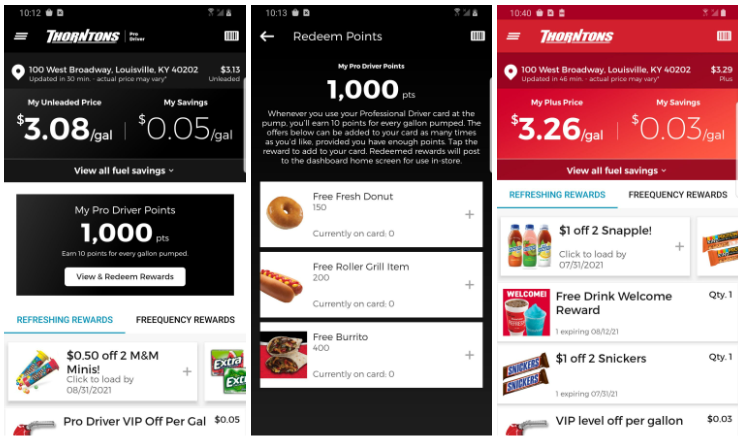
While the program offers standard fuel discounts, the true retention engine is their “FREEquency Clubs.” Rather than just tracking general spend, the app tracks the purchase of highly specific, habitual items—like 20oz Pepsi products, Rockstar energy drinks, or Reese’s peanut butter cups.
This creates a powerful “micro-habit.” The commuter isn’t just trying to earn generic points; they are actively filling out a digital punch card for their specific daily vice. Because the reward (a free item after a set number of purchases) is perfectly tailored to what they were already going to buy, driving to a competitor feels like actively throwing away progress on their morning routine.
| Feature | Description |
| Loyalty program type | Digital Frequency Clubs, Sweepstakes & Fuel Subsidies |
| Welcome reward | – |
| Birthday reward | A customized digital freebie loaded into the app during the birth month. |
| Earning method | Points earned on qualifying in-store merchandise and fuel pumped. Automatic tracking for “Buy X, Get 1 Free” beverage clubs. |
| Referral reward | – |
| Rewards | Points convert into digital rewards and fuel discounts. Every swipe acts as an automatic entry into rotating sweepstakes events. |
| Exclusive perks | The Lottery Hook: Automatic, frictionless entry into massive giveaways (vehicles, year-long free fuel, concert tickets) simply by scanning the app at checkout. |
| Mobile app integration | Android / iOS |
Why It Works
- SKU-Level Addiction: By tracking specific brands and products rather than just overall dollar spend, the program gamifies the customer’s existing daily habits.
- Vendor Subsidization: These item-specific clubs are often heavily funded by the brands themselves (e.g., Pepsi or Snapple), minimizing the financial burden on the retailer.
- High-Frequency Anchoring: The “Buy X, Get 1 Free” mechanic accelerates the purchase of daily consumables, ensuring the commuter skips rival gas stations to complete their digital punch card.
Thorntons Refreshing Rewards is a comprehensive convenience and fuel loyalty program. Members earn baseline fuel discounts and standard points, but the core of the program is built on its “FREEquency Clubs.” These digital punch cards track the purchase of items like energy drinks and snacks, automatically rewarding the user with a free item after reaching the threshold. The program also features “Pro Driver Rewards” specifically tailored to commercial fleet drivers, offering accelerated points for high-volume diesel fill-ups.
Louisiana – BBQGuys
Selling premium outdoor kitchens is a difficult retention business. A customer who spends $4,000–$10,000 on a built-in grill, refrigeration, cabinetry, and installation may not make another major purchase for years. For most retailers, that means customer acquisition starts over from zero.
BBQGuys approaches the problem differently through BBQGuys Rewards.
The program activates immediately after account creation: members receive a small signup bonus (300 points) and then earn 1 point per dollar spent on qualifying purchases. Those points can later be redeemed as order credit across most of the site, turning a one-time outdoor kitchen purchase into the beginning of an account relationship.
Imagine a customer placing a $5,000 order. Instead of ending the transaction emotionally and financially, the purchase creates a visible rewards balance attached to the customer’s login. Suddenly, future purchases (covers, grill tools, replacement parts, smoking wood, patio upgrades) feel discounted before the customer even starts shopping. The important mechanism is not lock-in through contracts or subscriptions. It is stored value plus account continuity.
Because rewards are tied to the same online account that stores order history, balances, and account management, returning to BBQGuys becomes frictionless. The customer already has purchase records, already has credit waiting, and already knows compatible products exist inside the ecosystem. This matters especially in categories where accessory margins and repeat purchases often outlive the original hardware sale.
| Feature | Description |
| Loyalty program type | Spend-Based Points |
| Welcome reward | Immediate 300 points ($3.00 value) granted upon profile registration. |
| Birthday reward | – |
| Earning method | 1 point per $1 spent on all eligible items directly on BBQGuys.com. |
| Referral reward | – |
| Rewards | 100 Points = $1.00 Reward (usable as flat digital cash on future merchandise). |
| Exclusive perks | – |
| Mobile app integration | – |
Why It Works
- Extends Customer Lifetime Value: A rare, high-ticket purchase generates incentives for lower-ticket repeat purchases over time.
- Reduces Re-acquisition Costs: Account-linked rewards, order history, and redemption create reasons to return instead of restarting the shopping journey elsewhere.
- Maintains Low Operational Friction: Enrollment is free and redemption happens directly through the customer account and checkout flow.
A particular downside to this program comes from the exclusion of certain brands from its program. BBQGuys excludes a meaningful number of premium brands from being purchased using rewards points, including high-end names such as Lynx Grills, Fire Magic, Twin Eagles, Kamado Joe, Viking Appliances, Zephyr, DCS, Perlick, and others. If any excluded brand appears in the cart, rewards redemption becomes unavailable for that order.
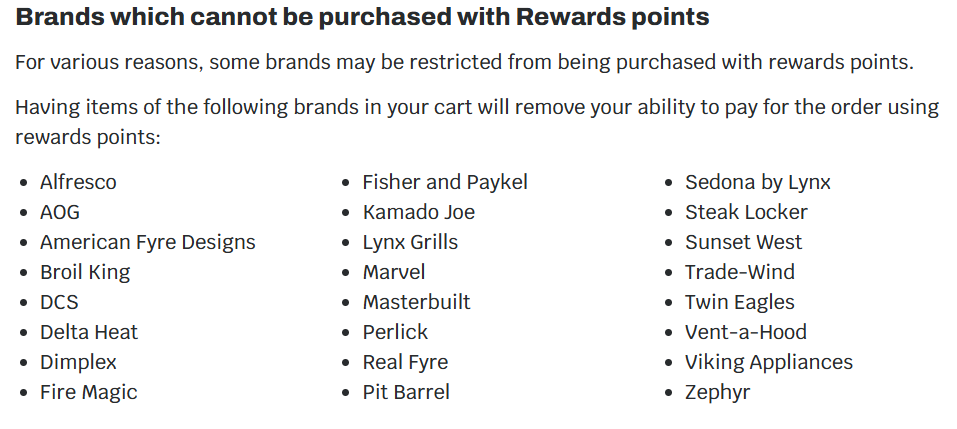
BBQGuys Rewards demonstrates how a retailer in a low-frequency, high-ticket category can extend customer lifetime value beyond the initial purchase. By awarding points on major outdoor kitchen investments and tying redemption directly to customer accounts, BBQGuys creates a reason for customers to return for accessories, maintenance products, and future upgrades instead of drifting to competitors. At the same time, exclusions on certain premium brands reveal the program’s real objective: not to discount every transaction, but to protect margins while capturing the recurring purchases that surround a once-in-a-decade investment.
Maine – L.L. Bean
Selling highly durable outdoor equipment inherently cannibalizes repeat business. When a company engineers a legendary pair of duck boots or a canvas tote bag designed to survive decades of abuse, standard retail loyalty models completely fall apart. A customer simply does not need to return to the store frequently. For L.L.Bean, headquartered in Freeport, Maine, offering a basic free-tier points program wasn’t enough to capture their audience’s attention during the long gaps between jacket purchases.
Instead, they embedded themselves directly into the customer’s daily financial life by engineering a “Credit-Anchored” ecosystem: the L.L.Bean Mastercard.
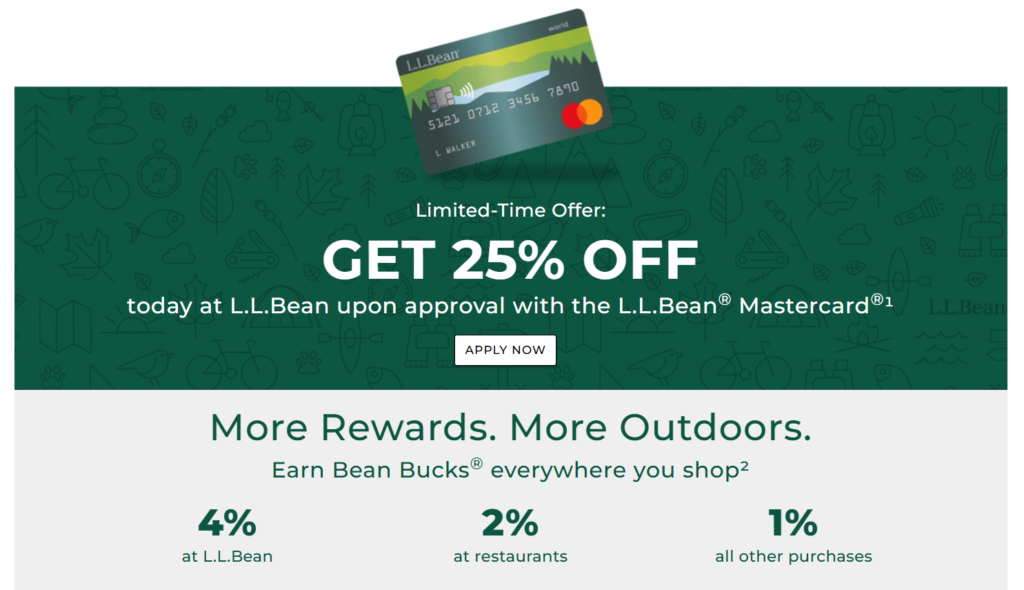
By completely bypassing a traditional free loyalty program in favor of a co-branded credit card, they successfully shifted the point-earning mechanism from infrequent outdoor apparel purchases to high-frequency daily habits. A customer uses the card to buy groceries, fill up their gas tank, or pay for a restaurant bill, automatically generating “Bean Bucks” in the background.
Because Bean Bucks never expire (as long as the card remains active), a customer can casually build up $50 to $100 in rewards just by paying their monthly bills. When winter rolls around and they finally do need a new parka, driving to a competing sporting goods store feels like throwing away cash. They are mathematically forced back to the L.L.Bean catalog to burn the massive sunk-cost balance they generated throughout the year.
| Feature | Description |
| Loyalty program type | Co-Branded Credit Card & Logistical Subsidies |
| Welcome reward | Frequently features an immediate flat discount (e.g., 15% off the first purchase) upon Mastercard approval. |
| Birthday reward | – |
| Earning method | L.L.Bean Mastercard: 4% back at L.L.Bean, 2% back at restaurants/gas, 1% back everywhere else. |
| Referral reward | – |
| Rewards | Points instantly convert to Bean Bucks (flat digital cash) to be applied directly at checkout. |
| Exclusive perks | The Friction Shield: Mastercard holders receive permanent free standard shipping with no minimums, completely free return shipping, and complimentary monogramming. |
| Mobile app integration | – |
Why It Works
- Ubiquitous Earning: Removes the burden of having to actually shop at the retailer to earn rewards, generating points on daily consumables like gas and dining.
- Built-In Utility: Eliminates major e-commerce friction points by using the card to completely waive shipping, return shipping, and custom monogramming fees.
- Unexpiring Sunk Cost: Because the points do not expire for active users, customers easily build massive digital balances that guarantee their next major outdoor purchase happens exclusively at L.L.Bean.
The L.L.Bean Mastercard acts as the brand’s sole, exclusive loyalty program. It operates as a no-annual-fee, co-branded credit card that rewards users with “Bean Bucks.” Cardmembers earn 4% back on L.L.Bean purchases, 2% back at restaurants and gas stations, and 1% back on all other purchases. The accumulated Bean Bucks act as direct cash value that can be seamlessly applied during checkout online, over the phone, or at their physical retail locations, aggressively subsidizing the cost of premium outdoor gear.
Maryland – Under Armour
The athletic apparel market is incredibly saturated, and customers are famously brand-agnostic. A weekend runner might wear Nike shoes, an Adidas shirt, and Under Armour shorts all at the same time. To break this fragmented spending habit, Under Armour, headquartered in Baltimore, Maryland, needed a mechanism to prove they were invested in the athlete’s actual lifestyle, not just their wallet.
Their counter-offensive is UA Rewards.
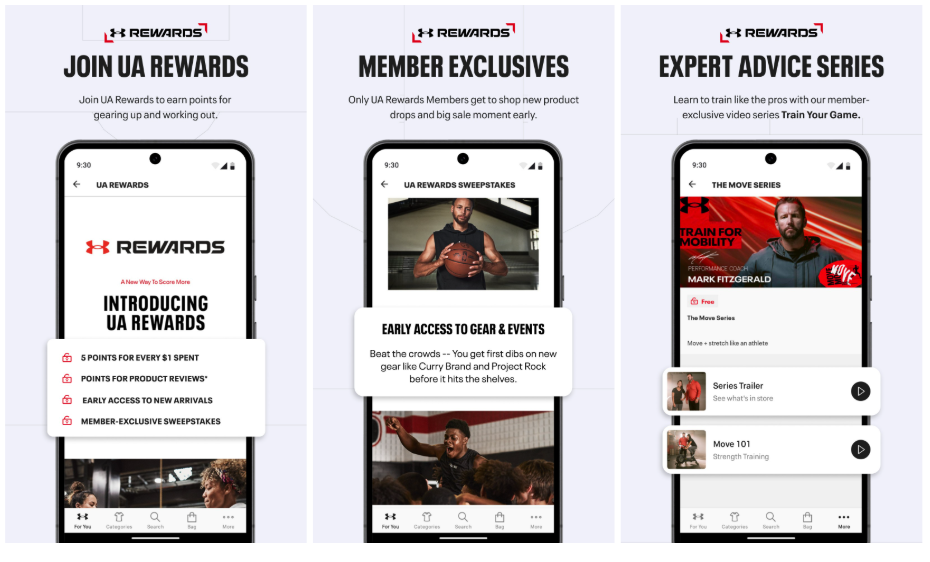
While the program functions as a standard points-per-dollar system at the cash register, the true retention engine is the integration of “Sweat Equity.” Under Armour linked their loyalty ecosystem directly to their proprietary fitness tracking app, UA MapMyRun. Members don’t just earn points by swiping a credit card; they earn points by completing specific, physical running challenges.
This creates an intense emotional anchor to the brand. When a customer earns a discount simply because they spent $100, they feel nothing. But when they earn a discount because they successfully completed a grueling 30-day running challenge, they feel a deep sense of psychological ownership over the reward. By gamifying the physical act of working out, Under Armour ensures their brand is front-of-mind every single time the customer laces up their shoes, perfectly positioning themselves to capture the sale when that customer eventually needs to replace their worn-out gear.
| Feature | Description |
| Loyalty program type | Spend-Based Points & Experiential Access |
| Welcome reward | Immediate base points upon sign-up and instant access to member-only training content. |
| Birthday reward | A 2X point multiplier on a purchase made during the member’s birth month. |
| Earning method | 5 points per $1 net spend across all qualifying purchases. |
| Referral reward | – |
| Rewards | Points convert directly into “Checkout Wins” (dollar certificates) or can be burned on exclusive gear and VIP athlete experiences. |
| Exclusive perks | The Athlete Toolkit: Gated access to advanced training videos, performance tips from UA professionals, and early access to highly anticipated product drops. |
| Mobile app integration | Android / iOS |
Why It Works
- Sweat Equity Integration: Allows users to earn points through physical exertion (via app challenges) rather than just financial transactions, building massive emotional loyalty.
- Gated Hype: Uses the digital ecosystem to offer first dibs on highly anticipated, limited-edition product drops (like Curry Brand shoes) before they hit the general sales floor.
- Purpose-Driven Burning: Offers members the unique ability to convert their hard-earned points into direct cash donations for youth sports charities, appealing directly to the community-focused athlete.
UA Rewards is a free, omnichannel spend-and-activity program designed to motivate athletes while driving retail consolidation. Members earn 5 points for every dollar spent online or at participating Brand and Factory House locations. Furthermore, users can generate points by leaving product reviews or completing fitness challenges via UA MapMyRun. These accumulated points can be redeemed for digital dollar certificates to heavily discount future gear, entered into sweepstakes for VIP athlete experiences, or donated directly to sports-related charities.
Massachusetts – TJ Maxx
Headquartered in Framingham, Massachusetts, TJX Companies built TJ Maxx around the off-price retail model: branded merchandise sold at rotating discounts, limited inventory depth, and constantly changing assortments. The challenge with this model is unusual—customers already have reasons to visit frequently because inventory changes rapidly. The loyalty question becomes: how do you capture value from behavior that already exists?
TJ Maxx’s answer is TJX Rewards, a loyalty ecosystem built around a branded credit card rather than a universal free points program.
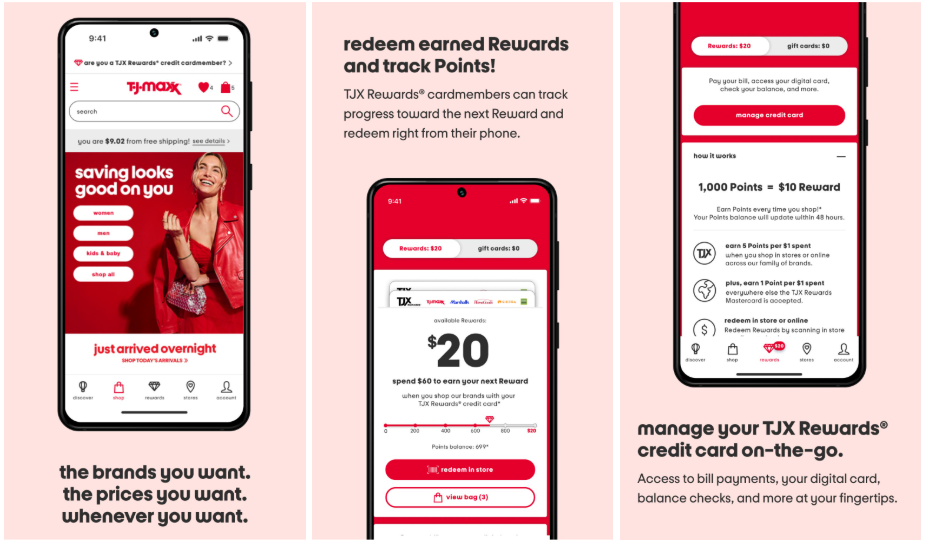
Instead of a standard free-tier points program, TJ Maxx relies heavily on the TJX Rewards Credit Card. The brilliance of the program lies in its massive, interconnected brand ecosystem. The card offers a staggering 5% back in rewards, but not just at TJ Maxx. The earning power spans across Marshalls, HomeGoods, Homesense, and Sierra.
This completely changes the customer’s internal math during a shopping trip. When a shopper is holding an unpredictable, unplannable “treasure hunt” find—like a discounted piece of luxury luggage or a high-end skillet at HomeGoods—the 5% back acts as the ultimate purchase rationalization. The points accumulate rapidly into $10 Reward Certificates, which act as a constant, recurring siren song. By issuing frequent digital cash certificates, they guarantee the customer is forced back into the stores to start the unpredictable treasure hunt all over again.
| Feature | Description |
| Loyalty program type | Co-Branded Credit Card |
| Welcome reward | 10% flat discount upon card approval for your first purchase |
| Birthday reward | – |
| Earning method | Earn 5 points per $1 spent at T.J. Maxx, Marshalls, HomeGoods, Homesense, and Sierra |
| Referral reward | – |
| Rewards | 1000 points = 10$ Reward Certificate |
| Exclusive perks | Private Shopping Events: Cardholders receive exclusive invitations to private shopping hours to hunt for newly delivered, premium off-price inventory before the general public. Lucky 25 Sweepstakes entry: Immediately gain the chance to win a 100$ gift card upon making a purchase at participating stores using a TJX Rewards credit card |
| Mobile app integration | Android / iOS |
Why It Works
- Ecosystem Consolidation: Unifies five highly distinct off-price brands under a single currency, allowing the company to monopolize a customer’s apparel, home decor, and outdoor equipment budgets.
- Impulse Rationalization: The high 5% earning rate (equivalent to 5 points per dollar) heavily subsidizes the “buy it now before it’s gone” mentality that drives off-price retail margins.
- Credit-Anchored Commitment: By requiring a credit application rather than a simple email sign-up, the program filters for highly committed, high-volume shoppers who treat the brands as their primary retail destinations.
TJX Rewards operates primarily as a co-branded, credit-anchored loyalty ecosystem (offering both a store card and a Mastercard variant). Cardholders earn a massive 5 points per $1 spent across the entire TJX family of brands (TJ Maxx, Marshalls, HomeGoods, Homesense, and Sierra). The program is designed for rapid, recurring gratification: every time a member hits 1,000 points, a $10 digital Reward Certificate is automatically issued to their account, heavily driving repeat visits and cross-brand shopping.
Michigan – Meijer
The supercenter model is a brutal battle for the massive, weekly household stock-up trip. Meijer, the pioneering hypermarket headquartered in Grand Rapids, Michigan, refuses to lose ground to national titans like Walmart or Target. To defend their Midwestern turf, they knew they couldn’t just rely on standard paper coupons or generic discounts. They needed a system that actively manipulated the shopper’s basket size in real-time.
They built their digital moat using mPerks.
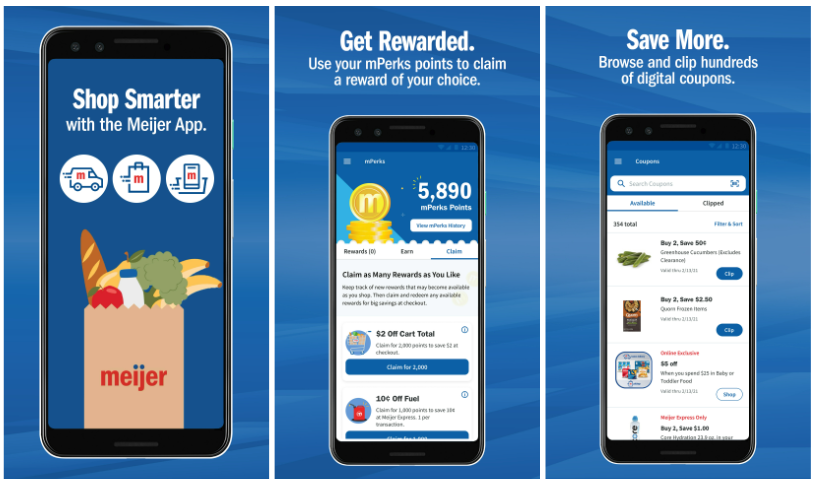
While the program offers standard points on every purchase, the true behavioral trap is their “Algorithmic Milestone” system. Instead of offering a flat percentage off the total bill, the mPerks algorithm analyzes the shopper’s historical data and sets personalized, gamified hurdles. If the system knows a family normally spends $40 a month in the pet department, it will automatically generate a custom reward challenge: “Spend $50 on Pet Care, Get $5 Off.”
This is retail behavioral engineering at its finest. It forces “basket stretching.” The customer is mathematically incentivized to throw an extra box of dog treats or a new toy into their cart just to trigger the “free money.” By gamifying specific categories and setting the threshold just slightly higher than the customer’s average spend, Meijer uses the illusion of a discount to actively drive up their own gross revenue and average ticket size on every single shopping trip.
| Feature | Description |
| Loyalty program type | Omnichannel spend-based points |
| Welcome reward | Immediate access to personalized digital deals within the app ecosystem |
| Birthday reward | Customized digital freebies or high-value coupons loaded during the birth month. |
| Earning method | Standard: Members earn 10 points for every $1 spent on qualifying groceries and general merchandise both in-store and online. Pharmacy: Members earn a flat 1,000 points for every eligible prescription filled. |
| Referral reward | – |
| Rewards | Points are highly liquid and convert to digital cash discounts on future shopping trips or massive fuel rollbacks (up to $1 off per gallon). |
| Exclusive perks | Hyper-Personalization: The algorithm curates weekly discounts strictly based on the user’s exact historical purchase data. |
| Mobile app integration | Android / iOS |
Why It Works
- Basket Stretching: Personalized spend targets mathematically force customers to buy slightly more than they initially intended to hit the required milestone.
- The IKEA Effect of Savings: By forcing the shopper to physically tap and “clip” these personalized milestones and digital coupons within the app, it creates a sense of psychological ownership over the deal, preventing them from abandoning their cart for a competitor.
- Cross-Category Penetration: The algorithm actively pushes shoppers to explore high-margin departments they might normally skip (like Apparel or Home Goods) to complete specific, high-value reward challenges.
mPerks is an omnichannel, data-driven ecosystem designed to monopolize the modern family’s entire errand run. Members earn points on almost every dollar spent across the massive supercenter footprint. The program relies heavily on the Meijer mobile app to deliver hyper-targeted digital coupons, track pharmacy rewards, and seamlessly deploy accumulated points as massive fuel subsidies.
Minnesota – Target
The big-box retail space is notoriously utilitarian, but Target doesn’t just sell household goods; it sells a highly curated lifestyle. The brand has successfully engineered the “Target Run” into a shareable, visually driven experience tailor-made for the age of Instagrammability and influencer marketing. To monetize this massive cultural footprint and defend against digital titans, Target entirely revamped their loyalty infrastructure, stripping away the friction of manual couponing to build an invisible, highly personalized ecosystem: Target Circle.
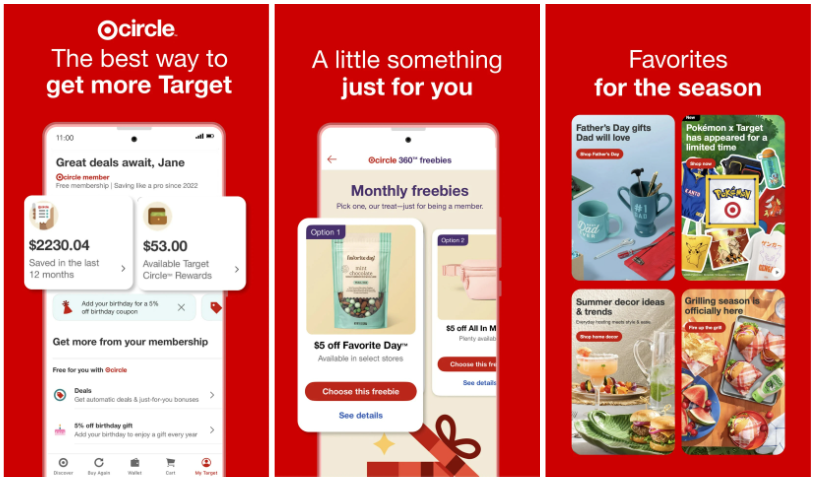
The behavioral trap lies in their frictionless algorithm. In a major 2024 update, Target eliminated the tedious chore of manual “clipping” and universal points. Now, Target Circle automatically applies personalized deals directly at checkout. This creates a highly profitable environment for impulse buying. When a shopper walks in for basic pantry staples, they are inevitably drawn to the highly aesthetic, limited-edition home decor collaborations. Knowing the algorithm is silently optimizing their discounts in the background actively removes the financial guilt, transforming a quick errand into an unplannable, high-volume spending spree.
To permanently seal the deal, Target utilizes a ruthless three-tiered approach. They use the massive free tier for data collection and algorithmic personalization, while the payment-linked Target Circle Card offers an immediate, flat 5% daily discount to build a sunk-cost habit. Finally, they capture the high-frequency household with Target Circle 360, a $99 paid subscription offering unlimited same-day delivery. By bridging highly visual, shareable merchandise with an entirely frictionless discount engine, Target ensures their customers never have to sacrifice aesthetics for savings.
| Feature | Description |
| Loyalty program type | Tiered Ecosystem & Paid Fulfillment Subscription |
| Welcome reward | Base tier offers immediate access to automatic deals; Target Circle Card frequently offers a $50 digital coupon upon approval. |
| Birthday reward | 5% off a single purchase, valid for 30 days after the member’s birthday. |
| Earning method | Free Tier: Earn 1% in Target Circle rewards on eligible purchases. Cardholders: Earn a flat 5% discount at the register (but do not earn the 1% base rewards). |
| Referral reward | – |
| Rewards | Base 1% earnings pool in the app wallet as flat digital cash to be burned on future purchases. |
| Exclusive perks | Target Circle 360: Unlimited free same-day delivery (on orders $35+), access to the Shipt Marketplace with no markup fees, and monthly exclusive “freebie” drops on the 1st of the month. |
| Mobile app integration | Android / iOS |
Why It Works
- Frictionless Impulse: Auto-applying deals at checkout removes the psychological barrier of manual couponing, actively encouraging spontaneous, unplanned purchases in high-margin departments.
- The Three-Tiered System: Operates a comprehensive ecosystem (Free, Cardholder, and 360 Subscription) designed to capture and lock in every type of consumer, from casual browsers to high-frequency delivery users.
- Cultural Consolidation: Merges algorithmic savings with highly aesthetic, limited-edition brand collaborations, driving immense organic social sharing and validating the “Target Run” as a cultural event.
Target Circle is a massive, three-tiered loyalty ecosystem redesigned for complete frictionless utility. The base tier is free, offering automatically applied deals, personalized Circle Bonuses (custom spend thresholds to unlock cash rewards), and partner perks like Ulta Beauty integration. The payment-linked Target Circle Card guarantees a flat 5% discount on every purchase. Finally, the premium Target Circle 360 tier functions as a paid subscription ($99/year), unlocking unlimited same-day delivery via Shipt, free two-day shipping, and an extended return window, positioning Target to directly rival major e-commerce delivery networks.
Mississippi – Sprint Mart
In the highly competitive world of roadside convenience and travel plazas, customer retention usually relies on who has the cheapest fountain drink or the most convenient off-ramp. Sprint Mart, a rapidly expanding convenience chain headquartered in Ridgeland, Mississippi, recognized that treating a daily commuter the exact same way as a long-haul trucker was a massive missed opportunity.
To segment and capture these two entirely different demographics, they expanded their Sprint Mart Rewards program into a two-pronged ecosystem.
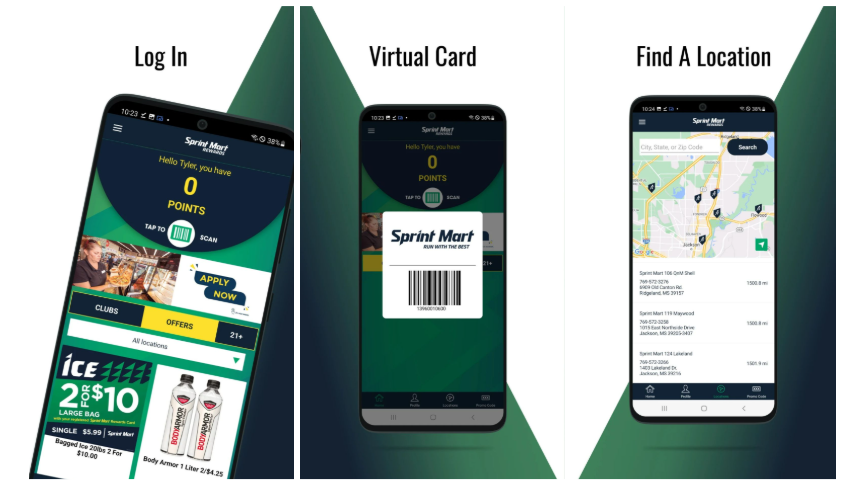
At its core, the baseline program operates on a standard cash-back model. Members earn 1 point per gallon of gas and 2 points per dollar spent inside the store, with every 100 points acting as $1.00 in flat digital cash. However, the true retention engine is the recently launched Professional Driver integration.
Sprint Mart realized that professional truckers do not want a $1 coupon for a candy bar; they want high-utility amenities. The professional tier allows commercial drivers to earn points tailored to their specific lifestyle, burning them for free showers, fountain drinks, and targeted discounts on trucker supplies like emergency gear and Bluetooth headsets. By shifting the loyalty currency away from simple discounting and toward roadside hospitality, Sprint Mart mathematically incentivizes logistics fleets and independent truckers to map their cross-country routes specifically to hit Sprint Mart travel centers.
| Feature | Description |
| Loyalty program type | Spend-Based Points, Frequency Clubs & Demographic Segmentation |
| Welcome reward | Access to immediate member-only pricing and digital clubs upon registration. |
| Birthday reward | Customized digital freebies or bonus points loaded into the app during the birth month. |
| Earning method | Fuel: 1 point per gallon pumped. In-Store: 2 points per $1 spent. |
| Referral reward | – |
| Rewards | 100 Points = $1.00 (usable as flat digital cash on future fuel or convenience merchandise) |
| Exclusive perks | Professional Driver Tier: Tailored rewards allowing commercial truckers to burn points on high-utility needs like free hot showers, meals, and emergency travel gear. |
| Mobile app integration | Android / iOS |
Why It Works
- The “Club” Frequency: For the standard commuter, the app digitizes the classic “Buy X, Get 1 Free” punch card. Members automatically enroll in specific clubs (like the coffee or pizza club) on their first purchase. This guarantees high-frequency morning and lunch traffic.
- The Hospitality Subsidy: By offering free showers to professional drivers, Sprint Mart leans into the emotional and physical toll of long-haul driving. Offering a hot shower creates intense, emotional brand affinity that a simple fuel discount can never replicate.
- The Gamified Transaction: The app frequently triggers “Random Rewards” and sweepstakes entries at the point of sale. A customer buying a standard energy drink might randomly trigger an entry to win a massive prize, adding a layer of unpredictability to a normally mundane transaction.
Sprint Mart Rewards is a highly liquid, dual-audience loyalty ecosystem designed to capture both the daily suburban commuter and the cross-country commercial driver. Members earn base points on fuel and high-margin inside merchandise, which immediately convert into flat digital cash (100 points = $1.00). The program heavily utilizes digitized frequency “Clubs” for standard shoppers, while offering premium, hospitality-driven rewards (like free showers and headset discounts) strictly for their professional trucking demographic.
Missouri – Bass Pro Shops
The outdoor recreation industry is built on massive, aspirational purchases. When a consumer dreams of buying a $40,000 Tracker Boat, a premium ATV, or top-tier hunting gear, standard retail discounts like getting 10% off a $20 t-shirt do absolutely nothing to move the needle. Bass Pro Shops knew that to capture these massive transactions, they had to help the consumer finance them without ever involving a bank.
To monetize this, they built the free Outdoor Rewards program and the co-branded Bass Pro Shops CLUB Mastercard.
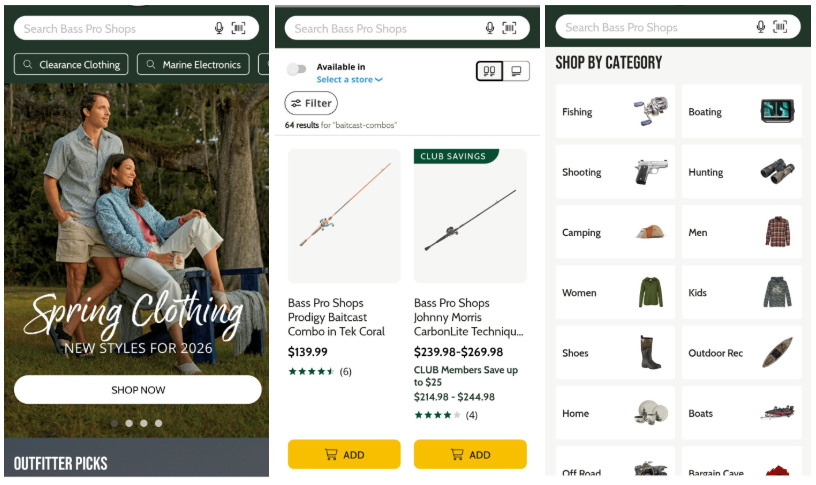
The program shifts the earning mechanism away from the rare retail visits and places it directly on the consumer’s daily life. A customer uses the card to buy their weekly groceries, pay their utility bills, and fill up their gas tank, silently accumulating “CLUB Points” (acting as direct cash value) in the background. When the time finally comes to buy that $2,000 fish finder or down payment on a boat, the customer doesn’t shop around at local marine dealerships. They look at their CLUB account and realize they have generated hundreds of dollars in “free” money simply by paying their mortgage and buying groceries.
By turning daily household expenses into a dedicated outdoor savings account, Bass Pro Shops ensures that the customer’s most massive, once-in-a-lifetime transactions happen exclusively under their roof.
| Feature | Description |
| Loyalty program type | Tiered credit card loyalty (CLUB: Classic, Silver, Black) Free points-based Outdoor Rewards |
| Welcome reward | Typically features an immediate “CLUB Points” bonus (e.g., $20–$60 in points) upon approval and first purchase. |
| Birthday reward | No official, ongoing digital birthday reward currently advertised for the base tiers. |
| Earning method | Classic: 2% back at Bass Pro Shops Silver ($10k spend): 3% back Black ($25k spend): 5% back (All tiers earn 1% back on all other Mastercard purchases). |
| Referral reward | Periodic “Refer-a-Friend” bonuses offering $20–$50 in CLUB points for successful card approvals. |
| Rewards | Points convert directly into CLUB Points (1 point = $0.01), redeemable as flat digital cash strictly at Bass Pro Shops and Cabela’s. |
| Exclusive perks | Member-Only Pricing: Gated access to “CLUB Deals” and exclusive events like the Fall Hunting Classic or Spring Fishing Classic. Priority Logistics: Silver and Black members often receive exclusive access to dedicated customer service lines and early product drops. |
| Mobile app integration | Android / iOS |
Why It Works
- High-Ticket Subsidization: Transforms everyday spending (gas, groceries) into a dedicated digital savings account, actively subsidizing the cost of massive, aspirational outdoor equipment.
- Ecosystem Consolidation: Merges the entire Johnny Morris portfolio under one currency. Points can be earned and burned across Bass Pro Shops, Cabela’s, Tracker Off Road, and even luxury vacations at Big Cedar Lodge.
- The “Country Club” VIP Tiers: Rather than just offering discounts, the elite Silver and Black tiers offer true, money-can’t-buy experiences, granting high-spenders exclusive access to Worldwide Trophy Adventures, celebrity hunting trips, and VIP outdoor retreats.
The Bass Pro Shops loyalty ecosystem dominates the outdoor sporting goods sector by merging the immersive thrill of destination retail with scalable rewards. By offering a solid free tier via Outdoor Rewards and a lucrative credit tier via the CLUB card, they’ve turned both everyday spending and high-ticket outdoor lifestyle purchases into a subsidized pipeline.
Montana – Murdoch’s Ranch & Home Supply
The agricultural and ranch supply sector is driven by massive, recurring, utilitarian purchases. When a customer needs a 50-pound bag of horse feed or premium dog food, they need it regularly, and the shipping costs to buy it online are astronomical. This forces the customer to shop locally. But for Murdoch’s Ranch & Home Supply, headquartered in Bozeman, Montana, simply being the closest physical store wasn’t enough to guarantee long-term loyalty. They needed to mathematically lock in that recurring feed budget.
They engineered this using the Murdoch’s Frequent Buyer Program, which operates seamlessly alongside their standard Murdoch’s Rewards points system.
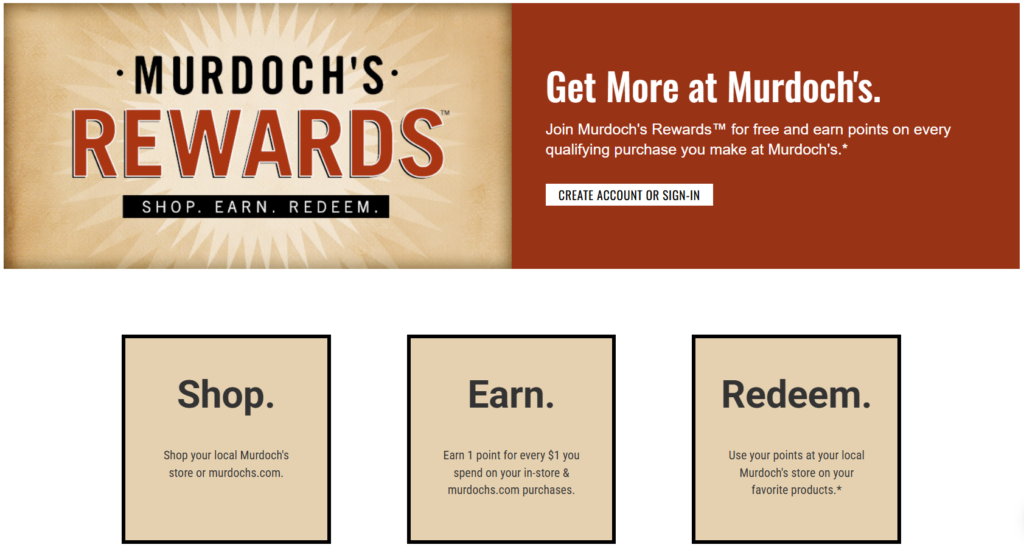
Murdoch’s Rewards functions as a broad spend-based loyalty system. Members join for free and earn 1 point for every $1 spent on qualifying purchases across stores and Murdochs.com, with points tracked directly through the customer account and redeemable in-store. The system creates a persistent incentive to consolidate everyday spending inside the Murdoch’s ecosystem rather than splitting purchases across local feed stores, farm supply chains, and general retailers.
But the more strategically interesting layer is the Frequent Buyer Program.
Instead of rewarding total spend, Frequent Buyer ties rewards to specific replenishment categories—especially pet food, horse feed, cattle feed, and bird seed. Customers progress toward rewards by repeatedly purchasing the same eligible brand, with structures such as Buy 10, Get 1 Free, Buy 12, Get 1 Free, or brand-specific incentives depending on the manufacturer. Rewards are typically redeemed as free product or occasionally alternative rewards depending on the supplier.
This design changes customer psychology.
A rancher buying feed every month or a pet owner replacing food every few weeks begins accumulating progress toward a visible milestone. Once six or seven qualifying purchases have already been made, switching brands or retailers starts to feel like abandoning earned progress. Loyalty becomes attached not just to Murdoch’s, but to the combined retailer–brand relationship.
The model also benefits manufacturers. Because progress is tracked by brand and reward qualification rules, the program encourages customers to stay inside specific product lines instead of treating feed and pet food as interchangeable commodities.
| Feature | Description |
| Loyalty program type | Spend-Based Points |
| Welcome reward | Access to immediate member-only pricing and base-point accumulation. |
| Birthday reward | – |
| Earning method | Base Points: 1 point per $1 spent in-store or online. Clubs: 1 credit per eligible bag of feed purchased. |
| Referral reward | |
| Rewards | 100 Points = $1.00 Reward (redeemable in 100-point increments). Clubs: A free bag of feed after hitting the specific brand threshold (typically 8, 10, or 12 bags). |
| Exclusive perks | Agricultural Consolidation: Unlocks massive cash value specifically for working animals and livestock, a high-spend category largely ignored by standard grocers and big-box retailers. |
| Mobile app integration | – |
Why It Works
- Captures Everyday Spend: Murdoch’s turns routine feed and pet purchases into a long-term customer relationship.
- Replenishment into Retention: Because agricultural feed and large pet food bags are incredibly expensive to ship via e-commerce, the physical punch card actively forces the customer back into the brick-and-mortar location.
- Granular Cross-Selling: While the customer comes in exclusively to buy their horse feed and get their digital punch, the standard Murdoch’s Rewards program continues to quietly accumulate points, eventually issuing cash discounts that encourage them to explore high-margin departments like apparel, footwear, and hardware.
Murdoch’s retention ecosystem is two-fold. The baseline Murdoch’s Rewards program is a straightforward spend-based system where members earn 1 point per $1 spent, with points acting as direct cash value at the register (100 points = $1 off). However, the true anchor for high-frequency shoppers is the Frequent Buyer Program. This system operates as a series of brand-specific digital punch cards for premium pet, equine, and bovine feed, which rewards bulk and repeat purchases with high-value free products to ensure complete domination of the local agricultural market.
Nebraska – Omaha Steaks
In the world of direct-to-consumer e-commerce, shipping a t-shirt or a book is cheap and frictionless. Shipping thirty pounds of premium filet mignons, burgers, and stuffed potatoes packed inside a styrofoam cooler filled with dry ice is a logistical nightmare. For Omaha Steaks, headquartered in Omaha, Nebraska, the sheer cost of frozen fulfillment has historically been the highest barrier to repeat purchase. A customer might love the product, but a $20 to $40 shipping fee at checkout causes massive cart abandonment.
Its answer to this issue was Steaklover Rewards.
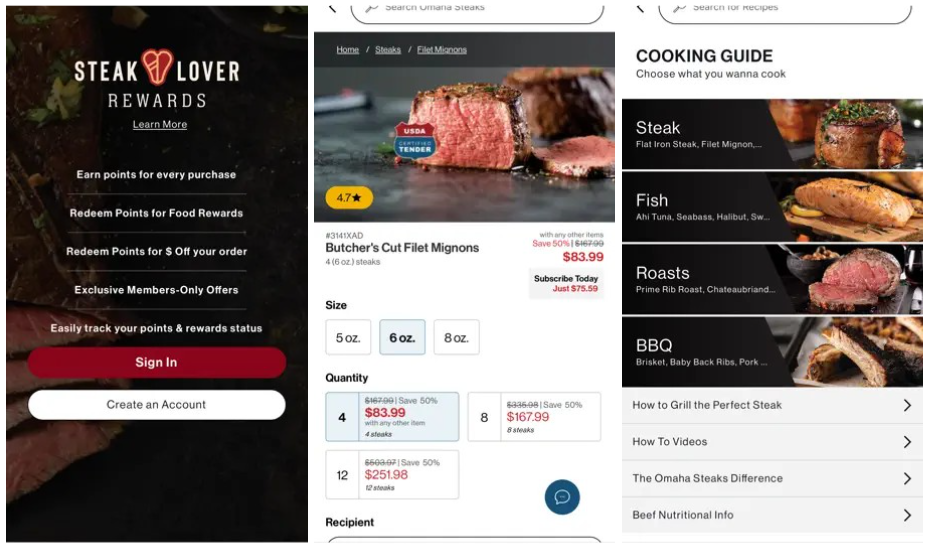
Originally launched in 2014 and later expanded, Steaklover Rewards combines a traditional points system with tiered membership benefits to encourage customers to stay engaged between infrequent purchases. Members earn points through purchases and additional interactions such as referrals and promotional engagement, then redeem those points for free products or discounts on future orders. Members also receive exclusive offers, early product access, and special perks unavailable to non-members.
The free, base tier of the program operates on a standard point-per-dollar earning structure, heavily relying on the “Self-Gifting Loop” (where a customer buys a $150 holiday package for their parents, and uses the resulting points to subsidize a steak dinner for themselves). However, the absolute engine of the brand’s retention is the $39.99/year Gold tier.
By paying this annual fee, the customer unlocks free standard shipping on all orders over a specific threshold (typically $49.99), alongside double point accumulation. The psychological hook is profound. Because the baseline cost of shipping frozen goods is so high, the $39.99 membership effectively pays for itself in just two orders. Once a consumer pays that entry fee, they are mathematically obligated to route all of their premium grilling, holiday dining, and gourmet gifting budgets exclusively through Omaha Steaks, simply to avoid the punishing shipping fees they would incur anywhere else.
| Feature | Description |
| Loyalty program type | Spend-Based Points & Paid Fulfillment Subscription |
| Welcome reward | Often features an immediate point bonus or free promotional item (e.g., free burgers or hot dogs) added to the first order upon sign-up. |
| Birthday reward | Free gourmet dessert or premium side dish added to a purchase during the birth month or membership anniversary. |
| Earning method | Standard: Earn points per $1 spent on merchandise. Gold Tier ($39.99/year): Earn 2X points per $1 spent. |
| Referral reward | Members can send a referral link; the new buyer receives a discount, and the referring member receives bonus points upon successful checkout. |
| Rewards | Points convert directly into flat digital dollars applied at checkout, or can be redeemed for specific free food items (like a box of Omaha Steaks Burgers). |
| Exclusive perks | The Dry-Ice Subsidy: Gold members receive unlimited free standard shipping on qualifying orders, effectively neutralizing the brand’s largest checkout friction point. |
| Mobile app integration | Android / iOS |
Why It Works
- The Replacement Monopoly: By offering a massive 20% discount in exchange for old inventory, Timberland guarantees they capture the customer’s replacement purchase, completely boxing out competitors.
- Purpose-Driven Loyalty: Aligns the financial discount directly with the brand’s eco-conscious ethos, generating massive goodwill and emotional loyalty among younger demographics.
- Frictionless Entry: The core program acts as a standard point-per-dollar system with a low barrier to entry, offering immediate perks like free shipping to capture casual shoppers before pulling them into the Timberloop ecosystem.
While the Gold tier offers massive utility for heavy users, the free base tier suffers from “reward erosion.” According to consumer feedback, non-Gold members frequently complain that their hard-earned rewards feel virtually worthless at checkout. Because base members must still pay the premium dry-ice shipping rates, applying a $10 Steaklover reward often just barely takes the sting out of a $25 shipping charge, leaving the customer feeling like they didn’t actually receive a discount on the food itself. Furthermore, customers note that the program’s strict point expiration policy directly conflicts with the seasonal nature of their purchasing habits; users who only buy steaks for Father’s Day and Christmas frequently find their points wiped out before their next major holiday order.
Steaklover Rewards is a dual-tiered e-commerce loyalty ecosystem built to conquer the extreme logistical costs of shipping frozen, perishable goods. The free base tier captures the lucrative holiday gifting market by offering points that convert into flat digital cash or free items. The apex of the strategy is the Steaklover Rewards Gold tier ($39.99/year), which uses unlimited free standard shipping to mathematically lock the consumer into treating Omaha Steaks as their exclusive, year-round neighborhood butcher.
Nevada – Zappos
Picture this. You are staring at a $160 pair of premium running shoes online. You love the design, but a nagging thought creeps in: What if they pinch my toes? In the early days of e-commerce, that simple hesitation killed millions of sales. Zappos, headquartered in Las Vegas, Nevada, realized they weren’t just in the business of selling shoes; they were in the business of selling peace of mind. And to permanently secure that peace of mind, they engineered Zappos VIP.
Rather than relying entirely on their own internal point system, Zappos executed a brilliant “Ecosystem Integration” by allowing users to link their Zappos VIP account directly to their Amazon Prime membership. The psychological trap here is immense. By linking the accounts, the customer instantly unlocks free, upgraded expedited shipping and accelerated point earning. Because the consumer is already paying for Amazon Prime, they feel entitled to exploit its perks wherever possible. This completely cuts out rival shoe retailers. If a customer needs a new pair of running shoes, they will actively choose Zappos simply because their existing Prime membership makes the Zappos transaction faster and more rewarding than shopping anywhere else.
| Feature | Description |
| Loyalty program type | Spend-Based Points & Cross-Brand Ecosystem Integration |
| Welcome reward | Immediate access to VIP perks; bonus points are occasionally offered for making the first purchase within the app. |
| Birthday reward | – |
| Earning method | 1 point per $1 spent on all merchandise. Bonus points awarded for writing reviews or simply logging into the VIP portal. |
| Referral reward | – |
| Rewards | 100 Points = $1 VIP Code (usable as flat digital cash at checkout). |
| Exclusive perks | Prime Integration: Linking an Amazon Prime account unlocks permanent free expedited shipping. Rapid Refunds: Funds are released the exact moment a return code is scanned by UPS, completely removing post-purchase anxiety. |
| Mobile app integration | Android / iOS |
Why It Works
- Ecosystem Piggybacking: By linking with Amazon Prime, Zappos immediately captures the loyalty of millions of high-frequency shoppers who demand fast, frictionless shipping.
- Sweat Equity Reviews: The program frequently offers bonus points for writing product reviews, gamifying user-generated content and drastically improving the site’s SEO and conversion rates.
- Uncapped Accumulation: VIP Codes act as direct cash, and members can hoard them to apply massive discounts to premium, rarely-discounted footwear brands.
Zappos VIP is a straightforward, spend-based digital loyalty program that is hyper-charged by its Amazon Prime integration. Members earn points on every purchase, which are automatically converted into VIP Codes (digital cash) to be used on future orders. The true value of the program is its frictionless logistics: VIP members who link an active Amazon Prime account receive free upgraded shipping, effectively making Zappos the default, rapid-delivery shoe provider for Prime households.
New Hampshire – Timberland
In the modern retail landscape, competing purely on the quality of a leather boot is no longer enough to secure lifelong retention. Consumers, particularly younger demographics, increasingly demand that their brands reflect their personal ethics. Timberland, headquartered in Stratham, New Hampshire, recognized that their rugged, outdoor heritage provided the perfect foundation to build a loyalty program based not just on transactions, but on shared values.
To turn casual shoppers into brand advocates, they built the Timberland Community.
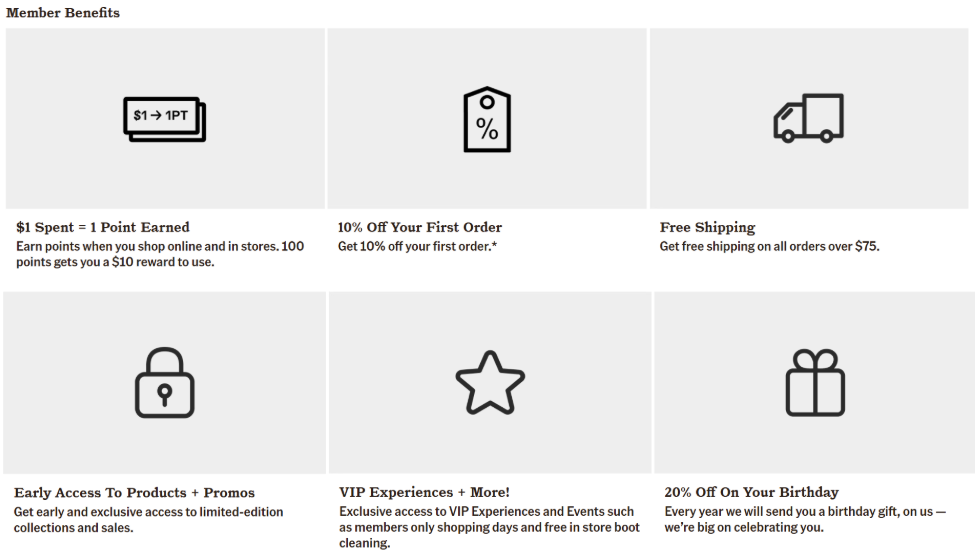
While the baseline program operates on a standard earn-and-burn point system (members earn 10 points per $1 spent), the true psychological hook lies in rewarding non-transactional, eco-conscious behavior.
Timberland brilliantly integrated their loyalty ecosystem with Timberloop, their circular design and recycling initiative. Members are actively rewarded for returning their beat-up, end-of-life boots and apparel to be refurbished or recycled. By incentivizing the consumer to literally hand back their old gear in exchange for loyalty points and a 10% discount on their next purchase, Timberland mathematically guarantees the replacement cycle happens exclusively within their own ecosystem.
Why It Works
- The Circular Lock-In: Traditional apparel brands lose the customer the moment a product wears out, hoping they choose them again for the replacement. By rewarding the disposal of the old product, Timberland intercepts the consumer at the exact moment of their next buying decision.
- Values-Based Subsidies: Members can earn points for simple, sustainable actions, like bringing a reusable bag to a physical retail store. This allows the consumer to feel a sense of moral superiority while simultaneously padding their digital wallet, blending ethical satisfaction with financial incentivization.
- High-Margin Aspiration: Because the brand frequently drops limited-edition collaborations (like partnerships with streetwear brands or high-end designers), points and tier status are often used to gatekeep early access, turning sustainable actions into a currency for hype-beast exclusivity.
| Feature | Description |
| Loyalty program type | Spend-Based Points |
| Welcome reward | Immediate 10% off the first purchase upon profile registration. |
| Birthday reward | A 20% off digital coupon loaded into the account during the member’s birth month. |
| Earning method | 10 points per $1 spent at official Timberland stores/website. Bonus points awarded for eco-actions (e.g., using a reusable bag, returning old gear via Timberloop). |
| Referral reward | Periodic “Refer-a-Friend” campaigns offering flat discounts to both parties. |
| Rewards | 250 Points = $5 Reward (redeemable as flat digital cash on future merchandise). |
| Exclusive perks | Explicit financial integration with the Timberloop recycling program, ensuring the brand controls the customer’s entire product lifecycle. |
| Mobile app integration | – |
While the conceptual integration of sustainability and loyalty is highly praised, the physical execution suffers from severe omnichannel fragmentation. According to consumer feedback, the primary friction point is the reliance on wholesale partners. Because Timberland sells a massive volume of its inventory through third-party retailers (like Macy’s, Journeys, or Dick’s Sporting Goods), customers frequently expect to earn points or utilize Timberloop drops at those locations. When they discover that the Timberland Community perks are strictly limited to direct-to-consumer channels (Timberland.com and official flagship stores), it creates massive point-of-sale confusion. Furthermore, users report frustration with the rapid point expiration windows, noting that unless they are buying premium boots every single season, their accumulated “eco-points” often vanish before they can be deployed.
The Timberland Community is a values-driven digital ecosystem designed to merge outdoor apparel sales with sustainable consumer habits. Members earn baseline points on standard purchases, but the program is differentiated by its focus on the circular economy; rewarding users for recycling old gear and making eco-conscious retail choices. The points pool into a digital wallet to be used for flat cash discounts, while the membership itself gates early access to highly anticipated product drops and exclusive sales.
New Jersey – The Vitamin Shoppe
The health and wellness industry thrives on rigid, recurring 30-day cycles. A customer taking a daily multivitamin or a post-workout protein powder knows exactly when they are going to run out. But the supplement space is brutally competitive; major e-commerce giants and grocery chains constantly undercut specialty stores on price. To prevent their customers from treating health supplements like a cheap commodity, The Vitamin Shoppe, headquartered in Secaucus, New Jersey, built a multi-tiered loyalty ecosystem called Healthy Awards.
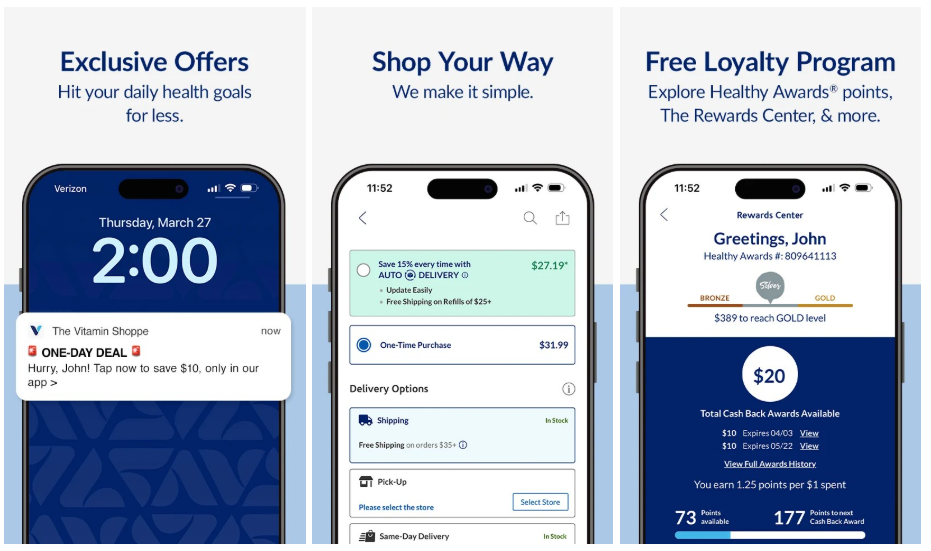
While the program features a standard point system (125 points = a $5 Cash Back Award), the true psychological hook kicks in at their premium Silver and Gold tiers: the “Choose Your Own Sale” day.
Traditionally, retail conditions the consumer to passively wait for a brand to announce a Black Friday or summer clearance event. The Vitamin Shoppe flips this entirely, granting the consumer the autonomy to trigger their own massive discount whenever it fits their specific replenishment cycle. By giving the customer control over the promotion, the brand drastically increases emotional investment. The customer feels a sense of ownership over the deal, practically guaranteeing they will consolidate their massive, quarterly supplement restocks exclusively at The Vitamin Shoppe rather than picking up a random bottle at the local grocery store.
For brands operating in the wellness, beauty, or recurring consumable space, building complex, autonomous reward triggers or managing subscription tiers can be a logistical nightmare. Utilizing a dedicated platform like SimpleLoyalty allows regional retailers to effortlessly deploy advanced, tier-based “Choose Your Own Sale” mechanics and auto-delivery discounts without requiring a massive in-house IT infrastructure.
| Feature | Description |
| Loyalty program type | Tiered Spend-Based Points & Ecosystem Subscriptions |
| Welcome reward | Typically 25 bonus points simply for adding a password and completing the digital profile setup. |
| Birthday reward | A customized “Birthday Surprise” (usually a digital discount or bonus points) loaded during the birth month for all active tiers. |
| Earning method | Bronze: 1 point per $1 spent. Silver ($200/yr): 1.25 points per $1 spent. Gold ($700/yr): 1.5 points per $1 spent. |
| Referral reward | – |
| Rewards | 125 Points = $5 Cash Back Award. (Note: Automatically issued awards expire in 30 days unless the user manually toggles the “Save Points” setting). |
| Exclusive perks | Nutrition Coaching: Silver unlocks standard virtual coaching; Gold unlocks Advanced coaching with meal plans. Choose Your Own Sale Day: Gold members can manually trigger a personalized discount day once per year. |
| Mobile app integration | Android / iOS |
Why It Works
- The Autonomy Hook: Allowing premium members to dictate the timing of their own sales events removes the frustration of missing out on brand-scheduled promotions, heavily incentivizing the customer to reach the Silver and Gold tiers.
- The Auto-Delivery Moat: The brand seamlessly merges their loyalty program with an “Auto Delivery” subscription, offering a flat 10% discount and free shipping on recurring orders, completely eliminating the monthly decision of where to shop.
- Experiential Wellness: Beyond basic discounts, upper-tier members receive advanced virtual nutrition coaching, shifting the brand’s perceived value from a simple transaction center to a personalized health clinic.
Healthy Awards is a three-tiered spend and engagement program (Bronze, Silver, Gold). Members earn points on every purchase (escalating from 1 point to 1.5 points per dollar as they move up tiers), which automatically convert into $5 Cash Back Awards. However, the program extends well beyond the cash register. It actively rewards members for reading educational blogs or downloading the app, gamifying the wellness journey. The premium Silver ($200/year spend) and Gold ($700/year spend) tiers act as the true retention engines, unlocking exclusive VIP events, advanced virtual nutrition coaching, and the highly coveted “Choose Your Own Sale” days.
New Mexico – Allsup’s
Most gas stations view their hot food as an afterthought; a desperate, low-quality necessity for tired drivers. In New Mexico, however, the dynamic is entirely reversed. People do not go to Allsup’s Convenience Stores because they need fuel; they go because they crave the World Famous Allsup’s deep-fried Beef and Bean Burrito. They just happen to buy gas while they are there.
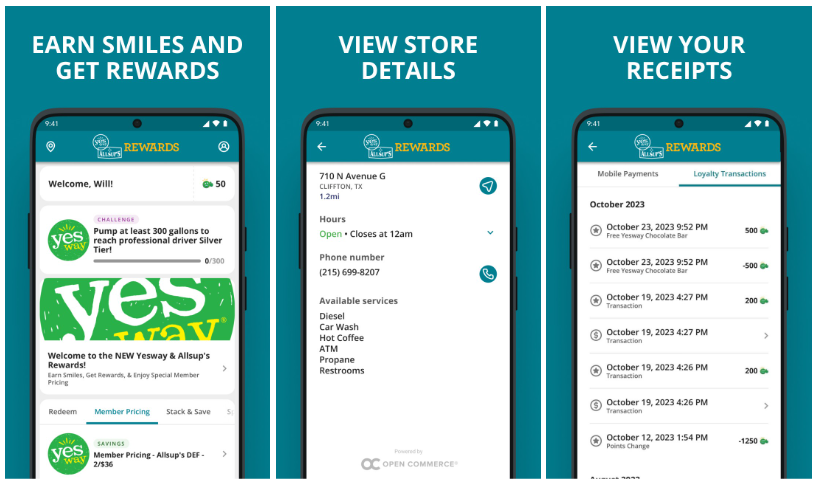
The brand, now fully integrated under the unified Yesway & Allsup’s Rewards program, builds a digital ecosystem around this iconic product. The “Cult-Item Anchor” creates high emotional switching costs: competitors may offer cheaper gas, but none match the proprietary burrito craving. Once anchored by food, the app’s “Stack & Save Fuel Rewards” activates—members earn 10 Smiles per $1 in-store (including burritos and Tallsup combos) and 5 Smiles per gallon of fuel, stacking uncapped for massive cents-off-per-gallon discounts at checkout.
| Feature | Description |
| Loyalty program type | Points-based loyalty program |
| Welcome reward | Immediate access to member-only pricing and introductory points upon registration. |
| Birthday reward | Customized digital freebies or bonus points loaded into the app during the birth month. |
| Earning method | Earn 10 Smiles for each $1 spent in-store and 5 Smiles for each gallon of fuel purchased. |
| Referral reward | – |
| Rewards | Rewards range from:Free or discounted burritos, Tallsup combos, hot food ($3 off).Fuel discounts (stackable vouchers, e.g., cents off per gallon, up to 30-day expiry).Drinks like Pepsi products, coffee (e.g., Free Coffee Friday), or half-price during promos.Snacks such as Hostess cakes (free on birthdays), candy, Frito-Lay items.Member-only deals on gift cards, Marlboro packs, or seasonal offers like “Stack & Save” |
| Exclusive perks | Stack & Save Fuel: Purchasing specific vendor items instantly adds stackable cents-off-per-gallon discounts to the user’s next fill-up. |
| Mobile app integration | Android / iOS |
Why It Works
- Uncapped Cross-Subsidization: By allowing fuel discounts to stack infinitely based on in-store purchases, the program transforms the high-margin snack aisle into an aggressive tool to lower the cost of a necessary commodity (gasoline).
- The Hero Product Anchor: Using their “World Famous Burritos” as a daily traffic driver ensures a massive baseline of foot traffic, which the app then monetizes through member-only pricing and combo deals.
- Frictionless Member Pricing: The app completely gates the best promotional pricing. If a customer doesn’t enter their phone number at the register, they pay full price for their breakfast, creating an immediate, undeniable penalty for non-participation.
Yesway & Allsup’s Rewards is a hybrid convenience and food-service loyalty ecosystem designed to anchor daily commuters through proprietary, cult-status hot food. Members earn points on in-store purchases and fuel, but the true value lies in the “Stack & Save” system, which allows users to accumulate uncapped cents-off-per-gallon discounts by purchasing specific promotional snacks and beverages.
New York – Barnes & Noble
Most bookstore loyalty programs are free. But for Barnes & Noble, they took the opposite approach: it asks customers to pay upfront for the privilege of becoming more loyal.
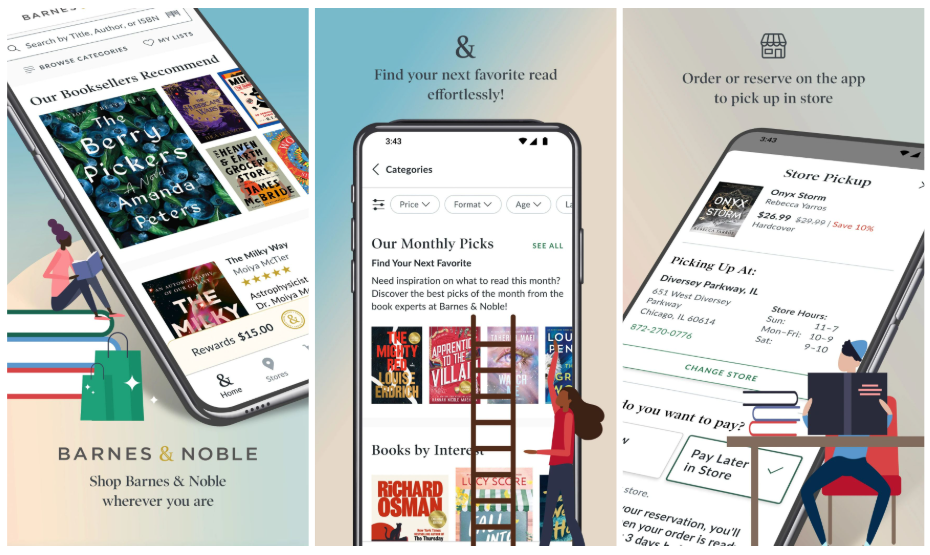
The company operates a two-tier structure consisting of a free Rewards Membership and a paid Premium Membership. Rather than awarding points per dollar spent, members collect virtual stamps: customers earn 1 stamp for every $10 spent on eligible items in a single transaction, and once 10 stamps are collected, they automatically convert into a $5 reward that can be redeemed in stores or on their website. Eligible categories extend beyond books into café purchases, gifts, movies, music, toys, games, NOOK devices, eBooks, and selected digital content.
This seemingly small design decision changes customer behavior.
Traditional points systems quietly accumulate in the background. Barnes & Noble’s stamp system makes progress tangible. A customer spending $70 can immediately see themselves become “7 stamps toward the next reward,” creating a stronger sense of completion and return behavior than abstract percentages. Because rewards do not expire and stamps remain active as long as the account stays active, the system encourages customers to continue the cycle instead of treating each bookstore visit as isolated.
On top of their loyalty program, the brand also realized that their core customer isn’t just buying paper. They are buying an identity. They want the vibe of being a reader. Premium members receive a free tote bag every year and free size upgrades on prepared beverages in the B&N Café, subsidizing the coffee shop experience. Barnes & Noble mathematically incentivizes the customer to linger in the physical store for their weekend coffee habit and a physical status symbol. It stands as one of the most effective customer loyalty programs because a purely digital competitor simply cannot replicate that physical comfort.
| Feature | Description |
| Loyalty program type | Tiered stamped-based & paid subscription |
| Welcome reward | Base members begin accumulating stamps immediately; Premium members typically receive immediate access to their annual tote bag at the physical register. |
| Birthday reward | Free B&N Café treat (and a Paper Source craft for children) during the birth month. |
| Earning method | Free Rewards Tier: 1 digital “stamp” for every $10 spent in a single transaction. Premium Tier ($39.99/yr): Same stamp accumulation, plus an automatic 10% off the total basket. 10 Stamps = 5$ Reward |
| Referral reward | – |
| Rewards | Stamps redeemable as flat digital cash in-store or online purchases |
| Exclusive perks | The “Third Place” Subsidy: Premium members receive free size upgrades on café beverages and a yearly tote bag, blending retail discounting with hospitality perks. |
| Mobile app integration | Android / iOS |
Why It Works
- The Bifurcated Moat: By offering both a free gamified tier and a premium paid tier, the brand successfully captures data from casual, low-volume shoppers while aggressively locking in their most profitable, high-volume readers.
- Creates Commitment Through Membership: Premium members have already paid to participate, creating an incentive to return repeatedly and extract value from discounts, rewards, and shipping benefits.
- Encouraged Basket Consolidation: Because stamps are earned in $10 increments per transaction with no cross-transaction carryover, customers are subtly pushed to combine purchases and increase order value.
The B&N loyalty ecosystem is divided into two distinct paths. B&N Rewards is a free, gamified tracking program where members earn 1 virtual stamp for every $10 spent, converting 10 stamps into $5 of digital cash. The B&N Premium Membership operates as a paid subscription ($39.99/year), designed for high-frequency readers. Premium members receive a permanent 10% discount across Barnes & Noble and Paper Source stores, free shipping with no minimums, a free annual tote bag, and complimentary café upgrades, all while continuing to earn stamps on their purchases.
North Carolina – Lowe’s
The home improvement sector is fiercely divided into two distinct camps: the weekend DIY homeowner and the professional contractor. Historically, hardware loyalty programs only catered to the high-volume professional, leaving massive amounts of casual consumer spending completely un-tracked and un-rewarded. Lowe’s, headquartered in Mooresville, North Carolina, realized they were bleeding casual market share to direct competitors. To fix this, they engineered a massive, interconnected ecosystem: MyLowe’s Rewards.
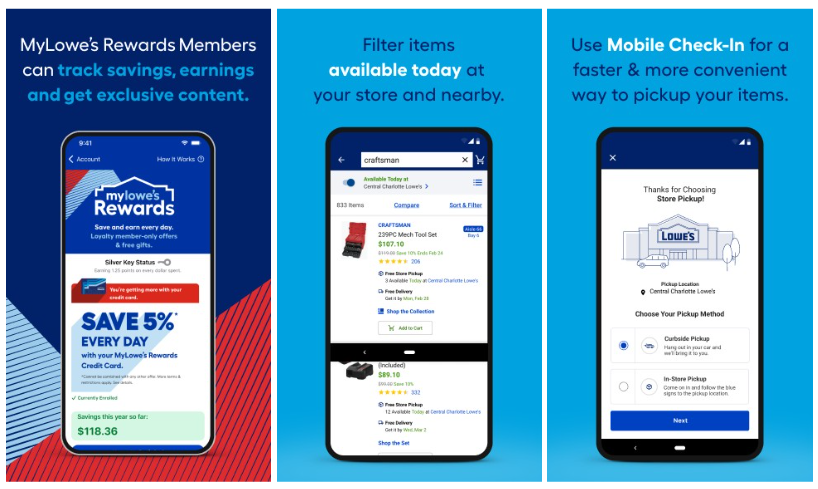
The program utilizes a three-tiered structure (Bronze, Silver, and Gold Key). When a young family buys their first home, they might spend $300 on paint and basic tools, placing them in the Bronze tier. But as they gain confidence and decide to tackle a $2,500 bathroom renovation the following year, the program’s algorithm automatically tracks that spend and accelerates their earning power by bumping them up to Gold Key status (1.5 points per dollar). The psychological trap is the “Tiered Sunk Cost.” Once a homeowner hits Silver or Gold and unlocks permanent free shipping with no minimums, driving to a competing hardware store for a $15 box of screws feels like a logistical and financial waste. They actively consolidate their long-term renovation budgets entirely with Lowe’s to defend their hard-earned tier status.
| Feature | Description |
| Loyalty program type | Tiered Spend-Based Points & Co-Branded Credit Ecosystem |
| Welcome reward | Base members receive member-only deals upon sign-up; Credit card approvals often feature an immediate flat discount (e.g., 20% off up to $100) on the first purchase. |
| Birthday reward | – |
| Earning method | Bronze: 1 point per $1 spent. Silver: 1.25 points per $1 spent. Gold: 1.5 points per $1 spent. |
| Referral reward | – |
| Rewards | 1,000 Points = $5 MyLowe’s Money (usable as flat digital cash, but aggressively expires 60 days after issuance). |
| Exclusive perks | The Tier Escalator: Holding the MyLowe’s Rewards Credit Card grants an automatic upgrade to Silver Key status, unlocking zero-minimum free standard shipping for online orders. |
| Mobile app integration | Android / iOS |
Why It Works
- The Lifecycle Pipeline: By mapping tiers directly to annual spend, the program organically grows with the consumer, rewarding them more aggressively as their DIY projects become larger and more expensive.
- Logistical Gating: Shipping heavy hardware is notoriously expensive. Gating “free standard shipping with no minimums” behind the Silver Key tier ($500/year spend) forces the consumer to actively consolidate their early-year purchases just to unlock the shipping perk for the rest of the calendar year.
- Credit Card Acceleration: Members who hold the MyLowe’s Rewards Credit Card receive their standard 5% daily discount, but are also automatically bumped up to Silver Key status, completely bypassing the initial spend friction.
MyLowe’s Rewards is a three-tiered points system (Bronze, Silver, Gold Key) built specifically for the everyday homeowner, operating parallel to their dedicated “Pro Rewards” program. Members earn baseline points on every purchase, which scale up based on their annual spend threshold. The currency is highly straightforward: every 1,000 points converts into $5 of “MyLowe’s Money,” acting as a digital gift card at checkout. The program heavily incentivizes tier progression by unlocking critical logistical perks, such as waived shipping minimums and exclusive point-multiplier events for high-spending members.
North Dakota – Scheels
The big-box sporting goods market is incredibly vulnerable to e-commerce; a baseball glove or a treadmill ships just as easily from Amazon as it does from a physical store. To completely insulate themselves against digital competitors, Scheels, headquartered in Fargo, North Dakota, transformed their massive retail footprints into literal indoor theme parks—complete with operational Ferris wheels, massive aquariums, interactive arcades, and cafés.
To monetize this massive overhead, they rely on a credit-anchored loyalty ecosystem: the Scheels Visa.
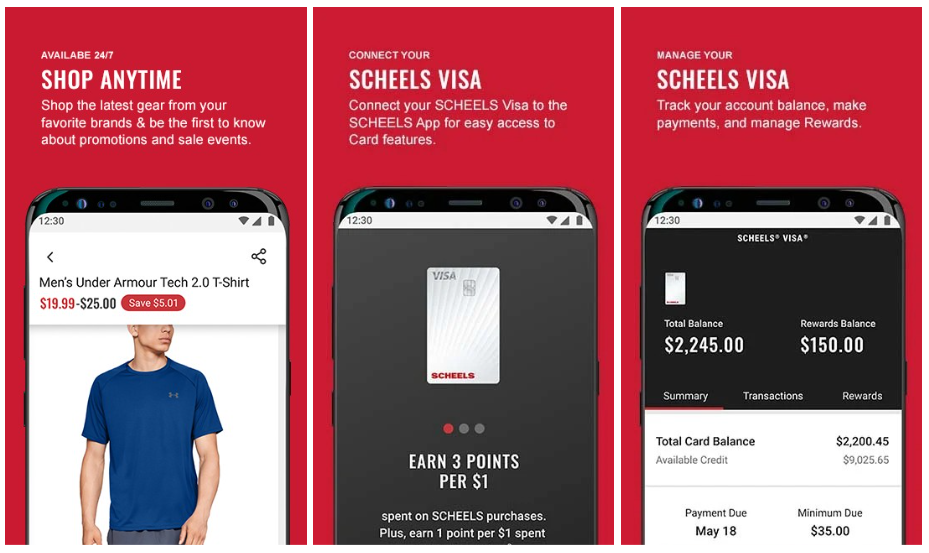
The brilliance of this program is how it actively integrates standard retail rewards with in-store entertainment to heavily subsidize the family visit. While the card earns 3 points per dollar spent in-store, it also earns 1 point per dollar on everyday outside purchases. The points automatically convert into $25 Scheels gift cards.
The psychological trap here is “Experiential Subsidization.” A family uses the Visa to buy their weekly groceries and pay their utility bills, silently accumulating those $25 gift cards. When Saturday rolls around, they don’t just go to Scheels to buy a pair of running shoes; they go to burn their “free” gift cards on Ferris wheel rides, arcade games, and lunch at the café. By bridging their loyalty currency directly with localized family entertainment, Scheels guarantees massive, hours-long dwell times in their stores, ensuring that when the family does eventually need a high-margin item like a kayak or a new winter coat, they buy it on site during one of their highly anticipated weekend excursions.
| Feature | Description |
| Loyalty program type | Co-Branded Credit Card & Automated Gift Card Payouts |
| Welcome reward | Frequently offers a massive initial bonus (e.g., a $75 e-gift card) if instantly approved at the register or online during a purchase. |
| Birthday reward | – |
| Earning method | Base Card: 3 points per $1 at Scheels / 1 point everywhere else. Premier Tier ($25k/yr spend): 5 points per $1 on Scheels purchases, 1.5 points on other purchases. |
| Referral reward | – |
| Rewards | 2,500 Points = $25 Scheels Gift Card (issued automatically upon reaching the threshold) Points worth 1¢ each; redeem for Scheels merchandise (no cash/exchanges); 3,000 points = $30 reward certificate. No minimum redemption; certificates expire after 12 months. |
| Exclusive perks | Personalized offers, |
| Mobile app integration | Android / iOS |
Why It Works
- The Destination Moat: By pairing the rewards currency with physical, un-shippable experiences (rides, arcades, food), Scheels entirely removes Amazon and pure e-commerce players from the competitive landscape.
- Sunk-Cost Weekends: Everyday household spending generates the reward certificates, mathematically forcing the customer to spend their weekends inside a Scheels location to cash in on the entertainment value they’ve already earned.
- Dwell Time Inflation: The longer a family stays in the building to utilize the experiential perks, the higher the probability of massive impulse purchases in high-margin departments like fashion and footwear.
The Scheels loyalty ecosystem is strictly gated behind their co-branded Scheels Visa credit card. Cardholders earn 3 points per $1 spent at Scheels stores or online, and 1 point per $1 spent anywhere else Visa is accepted. The system relies on immediate, automated gratification: every time a member hits 2,500 points, a $25 Scheels gift card is automatically mailed to them. These certificates act as universal cash across the entire store footprint, seamlessly usable for hard goods, apparel, or subsidizing the brand’s legendary in-store entertainment attractions.
Ohio – Kroger
Grocery loyalty is typically a low-margin race to offer the cheapest box of cereal. Kroger, headquartered in Cincinnati, Ohio, realized that offering a few cents off an apple wasn’t enough to build unbreakable retention in the modern era. They needed a currency that felt incredibly valuable to the consumer, but cost the company relatively little to fulfill.
They perfected this with Kroger Plus and its highly weaponized Fuel Points system.
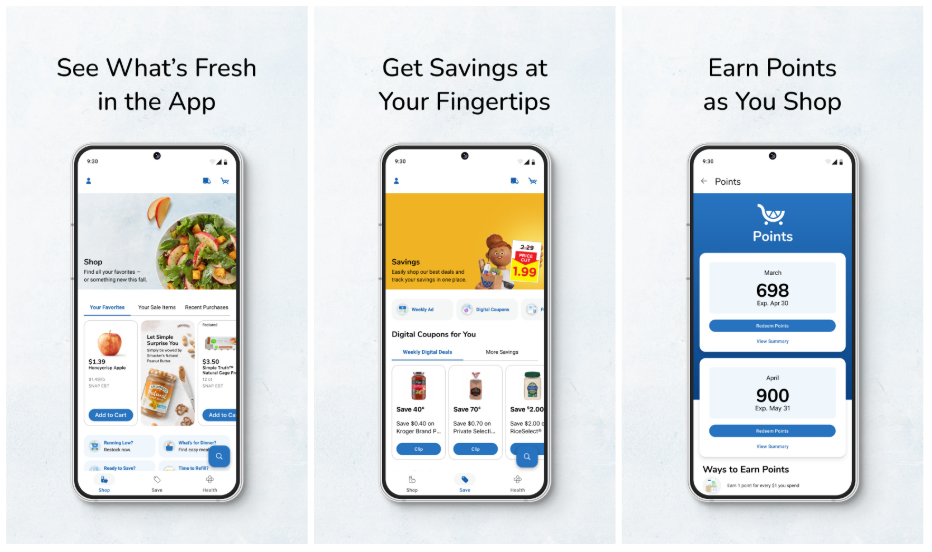
While the program offers standard digital coupons, the behavioral anchor is the gas pump. Members earn 1 Fuel Point for every $1 spent on groceries. Every 100 points knocks 10¢ off a gallon of gas (up to $1.00 off per gallon).
The psychological trap is “Ecosystem Inflation.” Kroger knows exactly how to artificially inflate a customer’s point balance to force a specific behavior. If they need to move high-margin gift cards during the holidays, they offer a 4X Fuel Point multiplier on all gift card purchases. If a customer buys a $100 Home Depot gift card, they instantly generate 400 points (40¢ off per gallon). The customer feels like they just robbed the store because they secured massive fuel savings for buying a gift card they were going to purchase anyway. Meanwhile, Kroger successfully shifted the customer’s secondary retail spending away from the mall and directly into their own cash registers, proving that a highly liquid, cross-vertical currency (gasoline) is the ultimate bargaining chip in retail.
| Feature | Description |
| Loyalty program type | Tiered Ecosystem, Paid Subscription & Cross-Promotional Fuel Points |
| Welcome reward | Base members receive immediate access to digital coupons; Boost members often receive an introductory discount or free trial upon sign-up. |
| Birthday reward | Periodic personalized digital discounts or free items loaded into the app during the birth month. |
| Earning method | Free Tier: 1 Fuel Point per $1 spent on groceries (2X on most gift cards). Boost Tier ($59-$99/yr): 2X Fuel Points on groceries. |
| Referral reward | No official, ongoing digital referral bonus built directly into the core app ecosystem. |
| Rewards | 100 Fuel Points = 10¢ off per gallon (up to $1 off per gallon at Kroger Fuel Centers). |
| Exclusive perks | The Commuter Anchor: Seamless integration with partner gas stations allows users to deploy grocery-earned points nationwide, neutralizing the high cost of travel. |
| Mobile app integration | Android / iOS |
Why It Works
- The Commodity Anchor: By tying grocery spend to highly volatile gasoline prices, the rewards feel like a critical financial lifeline rather than just a nice perk, severely punishing customers who defect to competing grocers.
- Targeted Multipliers: Kroger frequently uses 2X, 3X, and 4X Fuel Point promotions to aggressively steer consumer spending toward specific, high-profit behaviors (like utilizing their pharmacy or buying third-party gift cards).
- The “Boost” Subscription: Kroger evolved the free program by introducing Kroger Boost ($59 or $99/year), which locks in heavy users with free delivery and a permanent 2X multiplier on Fuel Points, acting as a massive sunk-cost moat against Amazon Fresh and Walmart+.
Kroger Plus is a massive, multi-vertical loyalty ecosystem. At the base level, it offers algorithmic digital coupons and tracks standard grocery spend (1 point per $1). The primary redemption vehicle is the Fuel Points program, where points convert into massive discounts at Kroger-owned gas stations. To capture the e-commerce shopper, they introduced the paid Boost by Kroger Plus subscription tier, heavily gamifying logistics by offering free next-day or same-day grocery delivery while doubling the user’s earning power at the pump to ensure absolute grocery consolidation.
Oklahoma – QuikTrip
Convenience stores compete in one of retail’s most unforgiving environments. Customers make dozens of tiny decisions every month—where to buy gas, grab coffee, pick up a drink, or stop for a quick meal—and switching costs are usually close to zero. Oklahoma-based QuikTrip approaches this problem by making repeat behavior easier and more rewarding than comparison shopping.
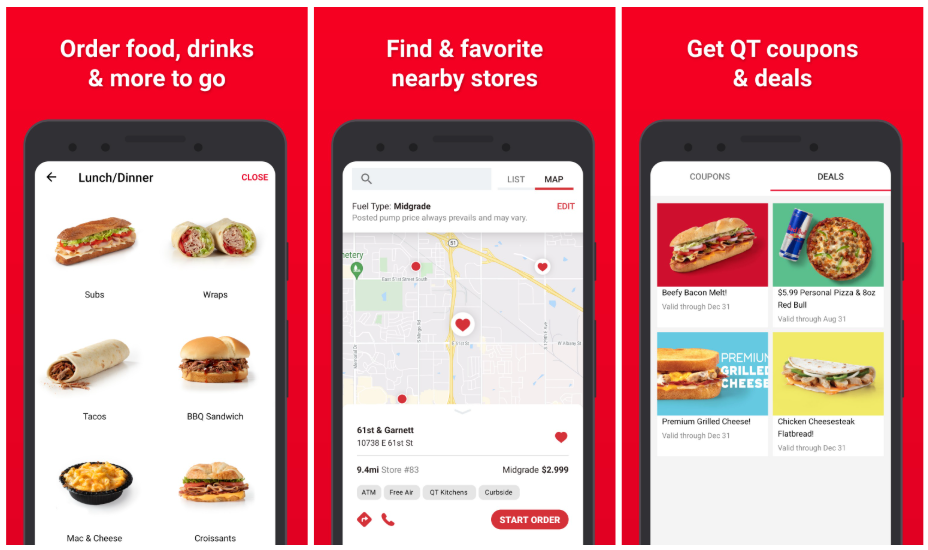
Its loyalty ecosystem, QT Rewards, is built around a free account tied to the QuikTrip mobile app and digital payment experience. Rather than creating a complicated points economy, QuikTrip emphasizes speed, stored value, personalized offers, and account-linked convenience.
The centerpiece of the system is QT Pay, QuikTrip’s integrated payment feature inside the app. Customers connect a payment method once and can then pay directly through the app while automatically accessing rewards and promotions. This matters because it removes one of the biggest sources of friction in convenience retail: the transaction itself.
Instead of asking customers to scan separate cards, enter coupons, or track balances, QuikTrip collapses payment and loyalty into one action.
Rewards are delivered primarily through targeted offers, fuel savings, app-exclusive promotions, and personalized incentives rather than through a large universal points balance. Customers may receive discounts tied to beverages, prepared food, snacks, or fuel activity, creating reasons to return repeatedly rather than wait to accumulate large future rewards.
This structure aligns closely with QuikTrip’s operating model.
Unlike traditional gas stations, QuikTrip has invested heavily in becoming a destination for fresh food, drinks, coffee, and fast-service retail, meaning profitability increasingly comes from inside sales rather than fuel alone. Loyalty therefore acts less as a discount engine and more as a mechanism to increase stop frequency and expand basket size.
The app deepens this effect by storing purchase behavior and making future transactions increasingly frictionless. Once customers routinely use the app to pay and redeem offers, changing stores means giving up convenience as much as giving up rewards.
Importantly, QuikTrip avoids overcomplicating the experience. There are no visible status ladders or complicated redemption tables. The customer simply sees occasional value appear inside an account they already use.
| Feature | Description |
| Loyalty program type | Direct-to-Bank (ACH) Payment Ecosystem & Instant Discounting |
| Welcome reward | Immediate access to fuel and in-store discounts upon successful bank linking and first QT Pay transaction. |
| Birthday reward | – |
| Earning method | No Points Earned. Replaces the legacy point system with an immediate price reduction at the point of sale. |
| Referral reward | – |
| Rewards | Flat, everyday cents-off-per-gallon at the pump, plus percentage discounts on mobile orders and QT Kitchens items. |
| Exclusive perks | The Swipe-Fee Subsidy: By eliminating credit card interchange fees, the app is able to fund permanent, ongoing discounts that standard credit-card-paying customers do not receive. |
| Mobile app integration | Android / iOS |
Why It Works
- Operational Brand Consistency: Every QuikTrip is laid out identically, removing the “search friction” for the customer. This physical reliability mirrors the digital reliability of the app.
- The “Snackle” Cross-Sell: By aggressively rewarding in-store food purchases more than fuel, QT successfully shifts the customer’s behavior away from the low-margin pump and toward their high-margin fresh food kitchens.
- Frictionless Checkout: The app is designed for “Scan and Go” speed, ensuring the digital interaction never slows down the physical transaction, which is the core of their brand promise.
QuikTrip demonstrates a modern convenience loyalty strategy: instead of maximizing reward depth, it minimizes effort. The less customers have to think about paying, earning, and redeeming, the more likely they are to repeat the same stop tomorrow.
Oregon – Nike
The global athletic footwear market is driven almost entirely by manufactured hype. When a highly anticipated shoe drops, standard retail logic goes out the window; consumers aren’t looking for a discount, they are begging for the opportunity to pay full price. Nike realized that traditional points-for-pennies programs were useless for their core demographic. Instead of gamifying discounts, they gamified access by building an impregnable digital wall: Nike Membership.
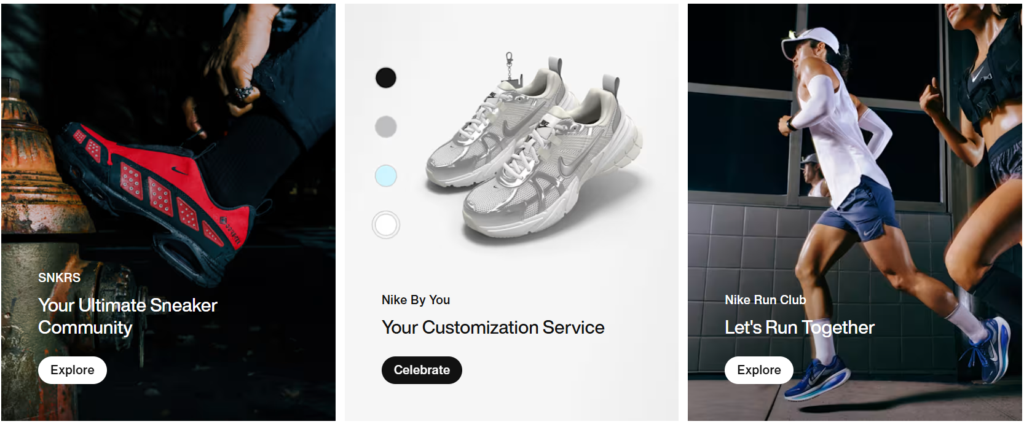
Nike Membership is completely free, but it acts as a mandatory digital passport. Joining Nike Membership unlocks access across the company’s digital and physical ecosystem, including Nike.com, the Nike App, SNKRS, the Nike Training Club app, and the Nike Run Club app. Members receive benefits such as free shipping, member-exclusive products, early access to launches, personalized recommendations, birthday rewards in selected markets, and access to events and experiences.
Notably, Nike avoids traditional spend-based accumulation; there are no points to collect and no cashback percentage to optimize. Instead, Nike uses access as currency.
Members gain access to limited sneaker releases, exclusive apparel drops, personalized collections, and time-sensitive purchasing windows unavailable to non-members. In categories where scarcity matters (like footwear) early access can carry more perceived value than a conventional discount.
Traditional loyalty asks: How much did you spend?
Nike asks: How engaged are you?
Someone who logs runs through Nike Run Club, follows training plans in Nike Training Club, tracks favorite products, and shops through the Nike App becomes increasingly embedded in the ecosystem. Purchases become one output of engagement rather than the sole objective. The model becomes especially powerful because athletic consumption compounds naturally. A runner buying shoes eventually needs apparel, socks, accessories, replacement footwear, and training content. Instead of rewarding each purchase individually, Nike builds a persistent account layer that connects all of those behaviors.
The result is that switching costs become psychological rather than financial. Leaving Nike means losing purchase history, personalized recommendations, launch access, saved preferences, and participation inside the broader community.
| Feature | Description |
| Loyalty program type | Access-Based Perks & Digital Ecosystem Integration |
| Welcome reward | Immediate access to free standard shipping and “Member-Only” product lines upon registration. |
| Birthday reward | A customized digital discount (typically 20% off) loaded into the user’s digital wallet during their birth month. |
| Earning method | No Standard Points. The program relies on benefit gating rather than spend-to-earn point accumulation. |
| Referral reward | |
| Rewards | Free shipping, receiptless returns, and exclusive access to hype sneaker drops via the SNKRS app. |
| Exclusive perks | The 60-Day Wear Test: Members have a full 60 days to heavily test physical footwear and apparel with zero-friction return capabilities. Early Access via SNKRS: Members get a head start on purchasing highly sought-after and limited-edition sneakers before the general public. Birthday Rewards: Members receive a personalized discount (typically 10% off) valid for the entire month of their birthday. Members-Only Sales: Access to special promotions and discount codes throughout the year (e.g., “deals just because” and exclusive percentage-off sales). |
| Mobile app integration | Android / iOS |
Why It Works
- Gated Hype: By moving their most desirable, high-margin inventory behind a membership wall, they leverage FOMO (Fear Of Missing Out) to drive millions of free app downloads and account creations.
- Engaging Ecosystem: Shopping, training, and activity all reinforce one customer identity.
- Strengthens affiliation over transactions: Customers remain connected between purchases through apps, content, and experiences.
Nike Membership is a free, access-driven digital ecosystem rather than a standard point-accumulation program. with exclusivity acting as its “currency”. Members receive free standard shipping, extended 60-day wear-test returns, and early access to sales. However, the true retention engine is the SNKRS app integration, which acts as a gated lottery system for high-heat sneaker drops, mathematically forcing sneakerheads to remain permanently active within the Nike digital infrastructure.
Pennsylvania – Urban Outfitters
Mall-based apparel brands generally struggle with digital retention because the average consumer only buys clothes a few times a season. If a brand only rewards financial transactions, the customer is going to forget the app exists during the months they aren’t shopping. Urban Outfitters, headquartered in Philadelphia, Pennsylvania, recognized that to capture Gen Z and young millennials, they had to reward attention instead of just cash.
They did so by creating UO Rewards.
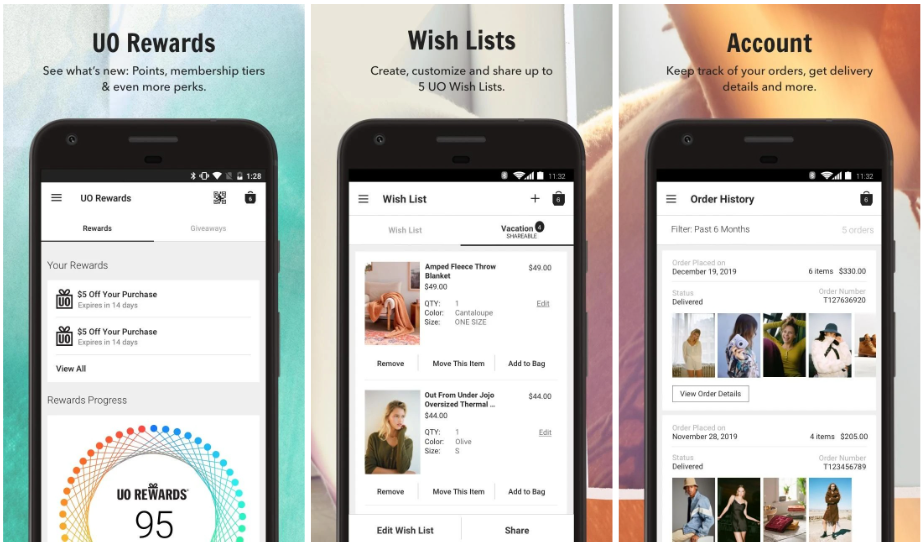
Members automatically enter the base tier upon signing up via the website, app, or in-store, earning fixed points on purchases supplemented by bonuses for actions like app downloads, email signups, reviews, referrals, and social media shares using #UORewards. Points accumulate at a rate where 100 points equate to a $5 reward credit, redeemable both online and in physical stores, with tiers (Member, Silver, and Gold) unlocking at escalating point thresholds. Silver and Gold members enjoy enhanced perks such as higher discounts, personal sale days, and priority access to limited drops, while all tiers benefit from gamified elements like giveaways and early sale previews. A welcome offer provides new members with a 10% first-purchase discount plus up to 205 bonus points, and an anniversary discount serves as a pseudo-birthday reward.
While members do earn points for buying clothes, the program’s strength lies in how it gamifies lifestyle by actively issuing points for non-transactional behaviors. A user earns points simply for downloading the app, turning on push notifications, writing product reviews, or even just bringing their own reusable bag to the physical store.
This creates a high-frequency digital habit. A teenager who doesn’t have the budget to buy a $60 sweater this week can still open the UO app, browse the new arrivals, write a review for a shirt they bought last month, and slowly inch closer to a $5 reward. By training the user to interact with the brand weekly even when their wallet is closed, Urban Outfitters completely dominates their mental real estate, guaranteeing they get the sale when that customer’s paycheck finally hits.
| Feature | Description |
| Loyalty program type | Tiered points-based loyalty program |
| Welcome reward | Typically a 10% off digital coupon upon profile creation and app download. |
| Birthday reward | 20% discount offered on the user’s birthday |
| Earning method | Fixed points per purchase (not per dollar), plus bonuses for reviews, referrals, social shares, app use; 100 points = $5 credit; tiers at point thresholds. |
| Referral reward | |
| Rewards | 100 Points = $5 Reward (issued automatically and expires in 60 days). |
| Exclusive perks | |
| Mobile app integration | Android / iOS |
Why It Works
- Non-Transactional Earning: Rewarding engagement (reviews, app visits) keeps low-budget, highly influential younger demographics actively interacting with the brand’s digital ecosystem.
- The “Green” Incentive: Issuing points for bringing reusable bags aligns the loyalty program directly with the eco-conscious values of their target demographic, building immense emotional goodwill.
- Tiered Aspiration: The three-tier system (Member, Silver, Gold) offers highly visible, escalating perks (like standard free shipping jumping to expedited shipping), giving members a clear psychological goal to strive for.
UO Rewards is a heavily gamified, three-tiered points program (Member, Silver, Gold) designed to monetize attention and engagement. Members earn baseline points for purchases, but can rapidly accelerate their earning through digital interactions, such as writing reviews, subscribing to emails, and simply browsing the UO app. Every time a user hits 100 points, they are automatically issued a $5 reward. As members climb to the Silver and Gold tiers, they unlock lucrative logistical perks, including waived shipping minimums and exclusive access to ticketed brand events.
Rhode Island – CVS Health
Most pharmacy loyalty programs reward shopping. CVS goes further: it rewards routines.
CVS Health operates ExtraCare, a free loyalty program, alongside ExtraCare Plus, a paid subscription tier. Together, they create a system that links retail purchases, pharmacy interactions, health services, and convenience benefits into a single account relationship. Rather than encouraging customers to buy more in one visit, CVS tries to become the default destination for dozens of small recurring decisions throughout the year.
At the center of that system is ExtraBucks Rewards.
ExtraBucks functions as CVS’s internal reward currency; members earn ExtraBucks through promotional purchases, personalized offers, health activities, and qualifying program actions, then redeem those rewards like store credit on future purchases. Unlike abstract points balances, ExtraBucks appear as actual dollar amounts available in the customer account and checkout flow, making future spending feel immediately discounted.
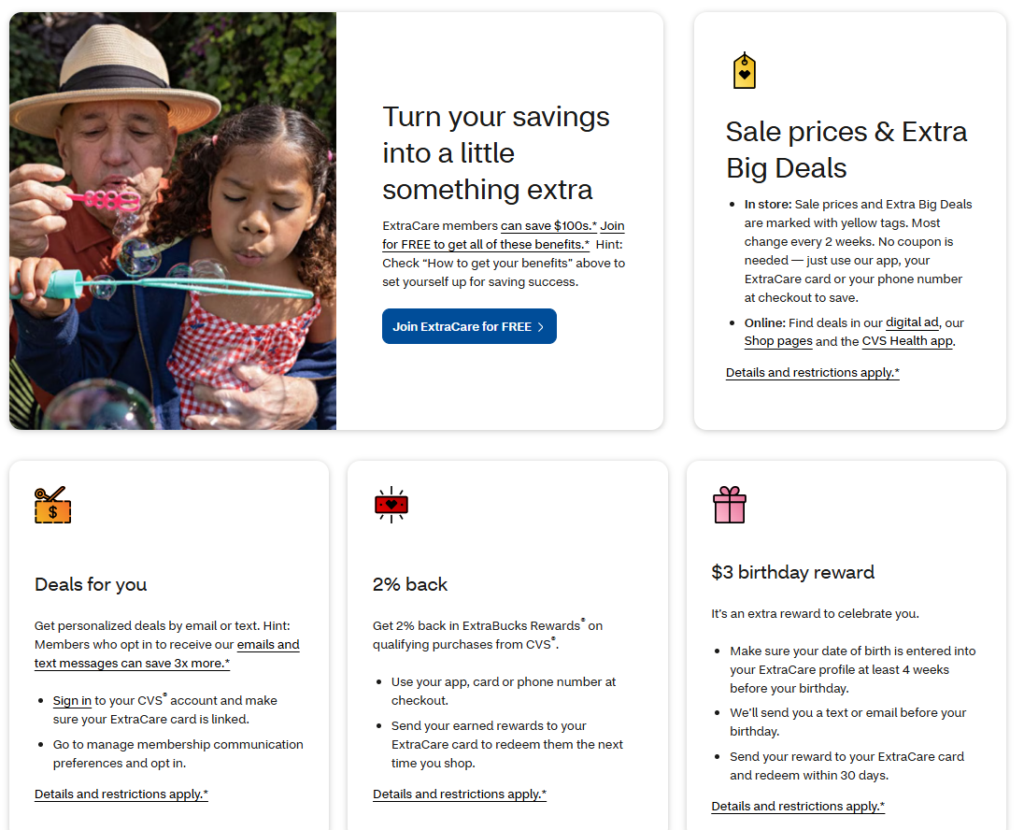
The free ExtraCare layer combines member pricing, personalized offers, and ExtraBucks accumulation. Customers frequently encounter promotions structured around thresholds—buy a qualifying product, fill a prescription, or complete an offer and receive a fixed amount of ExtraBucks back. This creates a different purchase mindset: shoppers stop evaluating items purely on sticker price and begin mentally calculating effective price after rewards.
CVS extends this logic into healthcare through ExtraCare Pharmacy & Health Rewards, where members can opt in to receive ExtraBucks for behaviors such as filling prescriptions, obtaining vaccinations, and engaging with pharmacy services. Instead of treating healthcare and retail as separate activities, CVS converts health interactions into spendable value across the broader store ecosystem.
The more strategically interesting layer is ExtraCare Plus.
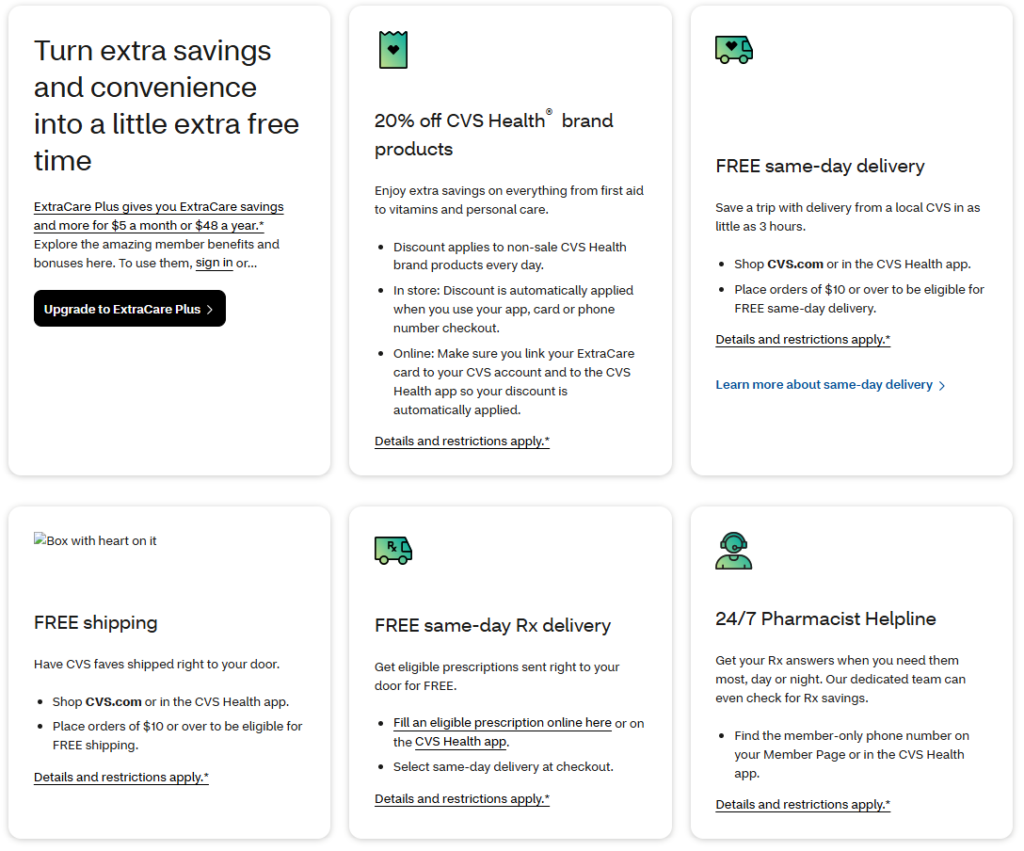
For a monthly or annual subscription fee, members receive recurring benefits including a $10 monthly ExtraBucks reward, member savings, and fulfillment conveniences such as shipping and delivery perks. This effectively reverses traditional loyalty economics: customers pay first, then become motivated to visit regularly to claim and redeem benefits. Missing a month means leaving value unused.
This structure matters because healthcare consumption is unusually repetitive.
Someone visiting CVS for a prescription may also purchase vitamins, skincare, cold medicine, snacks, household supplies, or personal care products. Once ExtraBucks begin accumulating, those categories become connected. The customer is no longer making isolated purchases—they are spending inside an account that already contains stored value.
CVS also adds controlled urgency. ExtraBucks generally carry expiration windows, transforming loyalty into a recurring loop: earn rewards, return before expiration, redeem, and generate the next cycle of rewards.
| Feature | Description |
| Loyalty program type | Spend-Based Points, Expiring Store Cash & Paid Subscription |
| Welcome reward | ExtraCare+ members receive their first $10 promo reward upon paying the $5 monthly fee. |
| Birthday reward | $3 in ExtraBucks Rewards loaded to the member’s account during their birth month. |
| Earning method | Free Tier: 2% back in ExtraBucks on most purchases. ExtraCare+ ($5/mo): 20% off CVS Health brand products. |
| Referral reward | – |
| Rewards | ExtraBucks: Flat store cash printed on receipts or loaded digitally, featuring aggressive, short-term expiration dates. |
| Exclusive perks | The Pharmacy Hook: ExtraCare+ offers free 1-to-2-day prescription delivery, brilliantly anchoring a vital healthcare need to a retail subscription. |
| Mobile app integration | Android / iOS |
Why It Works
- Cash-Like Appearance: ExtraBucks are displayed as dollar-value credits rather than abstract points, increasing perceived value and redemption rates.
- Turns Healthcare into Retail Spending: Prescriptions, vaccinations, and pharmacy engagement generate rewards that pull customers back into everyday shopping.
- The Subscription Anchoring: At $5/month or $48/year, ExtraCare Plus creates a break-even incentive that encourages frequent visits to justify ongoing value extraction.
CVS Health demonstrates a loyalty model built around circulation rather than accumulation: customers continuously earn, redeem, and regenerate ExtraBucks until routine healthcare and retail spending become part of the same economic loop.
South Carolina – Palmetto Moon
Palmetto Moon operates in a category built around identity consumption—apparel, collegiate merchandise, Southern lifestyle brands, and gift-driven purchases tied to events and seasonality. Its loyalty system, Palmetto Perks, is intentionally simple but structurally constrained to reinforce physical store behavior rather than omnichannel engagement.
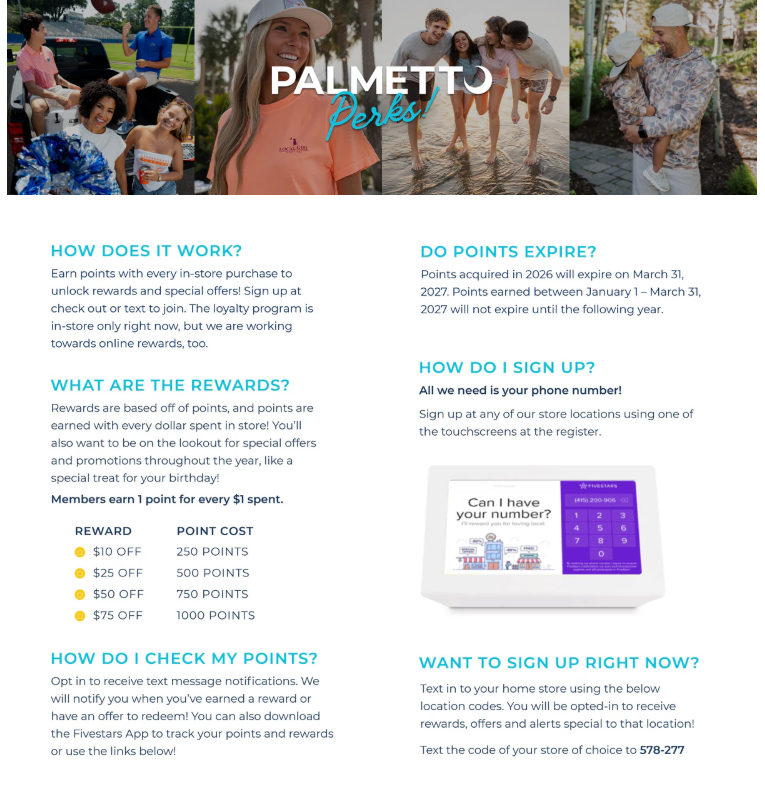
Palmetto Perks is an in-store only rewards program. Customers earn points on qualifying purchases made at physical Palmetto Moon locations, and those points can be redeemed as rewards and special in-store offers. The program is typically joined at checkout, making enrollment frictionless and tightly coupled to immediate purchase behavior rather than premeditated digital engagement.
The key mechanism is its transaction-linked earning structure: points are awarded per dollar spent in-store, and accumulation is tied directly to purchase volume during each visit. While exact redemption mechanics vary by promotion, the system generally converts accumulated points into discounts or rewards that are redeemable only within the retail environment. This ensures that the “value return” loop does not exit into third-party platforms or online marketplaces.
A critical design choice is the channel restriction itself.
By limiting Perks earning and redemption to in-store transactions, Palmetto Moon reinforces its physical retail footprint as the primary engagement surface. This is especially important in a category where purchases are often experiential and event-driven—college game weekends, gifting trips, and seasonal shopping spurts. The program effectively anchors these high-intent moments to store visits, rather than allowing them to diffuse into e-commerce competitors or broader digital retail ecosystems.
| Feature | Description |
| Loyalty program type | Spend-Based Points |
| Welcome reward | 10% discount for your first order |
| Birthday reward | $10 voucher automatically deposited into the member’s profile during their birth month |
| Earning method | 1 point = 1$ spent |
| Referral reward | – |
| Rewards | 250 Points = $10 off 500 Points = $25 off 750 Points = $50 off 1000 Points = $75 off |
| Exclusive perks | The Premium Loophole: The ability to rack up loyalty currency by purchasing high-demand, price-locked inventory (like YETI coolers) that rarely see traditional discounts. |
| Mobile app integration | – |
Why It Works
- Forces Channel Concentration: In-store-only earning and redemption keeps all loyalty value inside physical retail locations.
- Captures Seasonal Demand: College seasons, holidays, and gifting events naturally funnel customers into high-spend visits that generate meaningful point accumulation.
- Seasonal reinforcement loop: Emotional, event-driven purchases generate rewards that pull customers back between peak retail periods.
Palmetto Perks is a straightforward, spend-based digital program tailored for high-margin apparel and lifestyle goods. Members earn 1 point for every $1 spent in-store or online. The system is designed for frictionless, predictable gratification: every time a member hits 100 points, they are automatically issued a $10 reward certificate. The program frequently leans on app-exclusive multiplier events and early access to highly anticipated collegiate gear drops to keep the digital ecosystem active between major seasonal purchases.
South Dakota – Lewis Drug
In rural and suburban markets, the supercenter is king. However, regional general stores can successfully defend their territory against titans like Walmart and CVS by digitizing the local errand run into a unified ecosystem. Lewis Drug, headquartered in Sioux Falls, South Dakota, operates a unique blend of pharmacy, hardware, grocery, and home goods. To ensure their local demographic doesn’t fragment their shopping trips across multiple specialized national chains, they engineered the Lewis App (formerly the First Stop program).
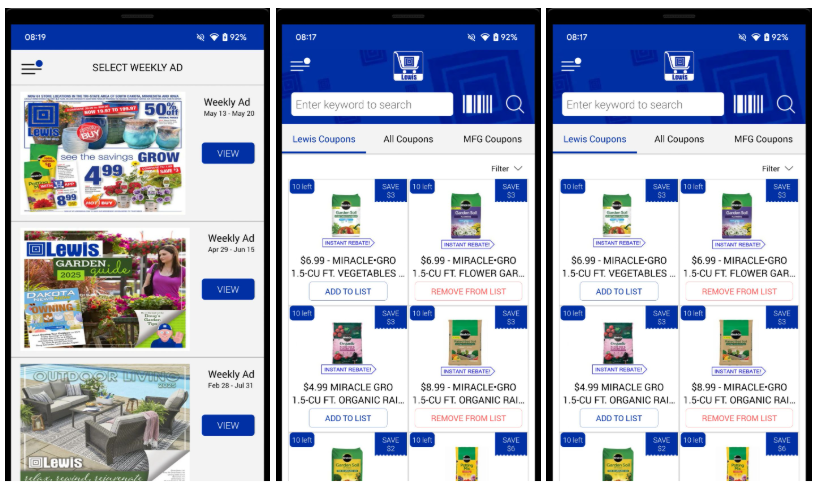
While standard pharmacies rely on generic cash-back, Lewis Drug utilizes a massive network of “Threshold Gamification” directly within their mobile app. Customers earn rewards by hitting specific spending targets across different departments. The brilliance lies in the categorical tracking. A shopper might see an offer stating: “Spend $30 on allergy medication, get $5 off your next purchase,” or “Spend $400 across the total store to automatically unlock a $10 reward”.
By pushing these highly visible, threshold-based goals directly to the user’s mobile device, the brand effectively gamifies routine restocking. It trains the consumer to buy their garden hoses, greeting cards, and prescriptions all under one roof, mathematically incentivizing them to consolidate their weekend errands into a single trip just to push their digital progress bar over the finish line.
| Feature | Description |
| Loyalty program type | Spend-Based Program |
| Welcome reward | Typically features introductory bonus points upon successfully registering a digital profile |
| Birthday reward | A localized digital perk or bonus multiplier loaded into the shopper’s account during their birth month |
| Earning method | Threshold-based: $30 on Allegra/Nasacort/Xyzal → $5 off next. $20 on Colgate oral care → $4 off next. $400 total store spend → $10 off next purchase. Buy 4 shakes/bars → 5th free Buy 6 candles → 7th free |
| Referral reward | – |
| Rewards | Discounts on next purchases within category (e.g., $5 off after $30 allergy meds/Claritin/Dove; $4 off after $20 Colgate; buy 4 shakes get 5th free; $1.25 off after $10 protein snacks). |
| Exclusive perks | App-exclusive tracking of progress, digital coupons, rotating brand promos (e.g., Native, Nature’s Truth vitamins at $30/$50 spend for $5 off). |
| Mobile app integration | Android / iOS |
Why It Works
- Threshold Gamification: Instead of earning a slow trickle of pennies, the app gives shoppers concrete, achievable spending goals (e.g., spending $25 on specific vitamins to get $5 off), creating a satisfying “win” state that drives repeat visits.
- Cross-Department Trapping: Because rewards are generated across disparate departments—from the pharmacy counter to the hardware aisle—the customer is mathematically incentivized to consolidate their entire shopping list with Lewis Drug rather than visiting specialized competitors.
- Frictionless App Redemption: The app acts as a digital hub where shoppers can browse deals and track their progress. At checkout, the cashier simply scans the customer’s phone screen to instantly apply all accumulated rewards and clipped coupons to the basket, keeping the line moving quickly.
The Lewis App is a threshold-based digital ecosystem designed to consolidate cross-category retail spending. Members use the mobile app to clip coupons and track their spending progress across various departments. By offering distinct, categorical goals (ranging from pharmacy purchases to total store spend), Lewis Drug effectively gamifies the return visit, guaranteeing that local shoppers rely on them as their primary neighborhood hub.
Tennessee – Tractor Supply Co.
The agricultural and rural lifestyle market is dominated by heavy, unwieldy, and expensive products. When a customer needs a 300-pound riding mower, a massive spool of barbed wire, or half a ton of livestock feed, free two-day shipping from Amazon is physically impossible. Tractor Supply Co., headquartered in Brentwood, Tennessee, realized their greatest competitive advantage wasn’t price, but logistics. To monetize this, they built a tiered ecosystem: Neighbor’s Club.
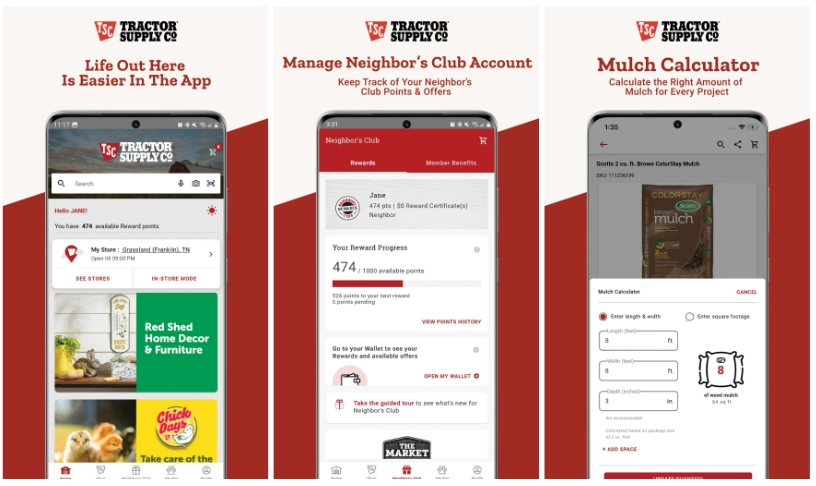
The strength of the Neighbor’s Club lies in the highest tier: Preferred Plus.
While the base tier offers standard points, hitting the $2,000/year spend threshold to unlock Preferred Plus fundamentally changes the consumer’s operational reality. The tier unlocks free standard shipping, free same-day delivery on qualifying items, and receiptless returns. In the agricultural world, same-day delivery of heavy feed or equipment is an incredibly expensive logistical nightmare. By gating this service behind a massive spend threshold, Tractor Supply forces the rancher or homeowner to actively consolidate every single purchase—from pet food to power tools—into their ecosystem just to maintain that coveted tier status.
| Feature | Description |
| Loyalty program type | Tiered Points-Based Program |
| Welcome reward | – |
| Birthday reward | |
| Earning method | Earn 1 point per $1 spent (Neighbor) 1.5 points/$1 (Preferred, $500+ annual spend) 2 points/$1 (Preferred Plus) TSC credit card holders get Preferred Plus status + 5 points/$1 |
| Referral reward | |
| Rewards | 200 points = $2 reward (redeemable at Tractor Supply/Petsense); personalized incentives based on purchase history |
| Exclusive perks | Receipt-free returns (all tiers). Preferred: Free same-day delivery/trailer rental 1x/quarter; free standard shipping ($29+). Preferred Plus: 2x same-day delivery/trailer rental quarterly; free everyday shipping. Military/veterans/first responders get Preferred status; personalized offers. |
| Mobile app integration | Android / iOS |
Why It Works
- Logistical Extortion: Free same-day delivery of heavy goods is a perk so valuable that customers will actively overspend on smaller items just to ensure they cross the $2,000 annual threshold to unlock it.
- The “Tax-Exempt” Utility: The program seamlessly integrates the customer’s agricultural tax-exempt status directly into their Neighbor’s Club profile, completely removing the friction of dealing with paperwork at the checkout counter.
- Pet Gamification: Knowing that pet and livestock feed is a massive, recurring necessity, the program frequently offers targeted multipliers on premium food brands to guarantee the weekly restock trip happens at Tractor Supply.
Neighbor’s Club is a massive, three-tiered points ecosystem (Neighbor, Preferred, Preferred Plus) built for the rural lifestyle consumer. Members earn baseline points on all purchases, converting 500 points into a $5 reward. The program is heavily focused on tier progression: spending $500/year unlocks Preferred status (accelerated earning), while the $2,000/year Preferred Plus tier acts as the ultimate logistical moat, offering free same-day delivery, free trailer rentals, and waived shipping minimums to completely dominate the local hardware and agricultural market.
Texas – H-E-B
In the ultra-competitive grocery landscape, the ultimate flex of a retailer is operating a brand so beloved that a traditional points program isn’t even necessary. H-E-B, headquartered in San Antonio, Texas, commands an almost cult-like following across the state. Because their organic loyalty is so impenetrable, they don’t force shoppers to calculate points-per-dollar. Instead, they engineer retention through a masterclass in private-label merchandising and their digital My H-E-B ecosystem.
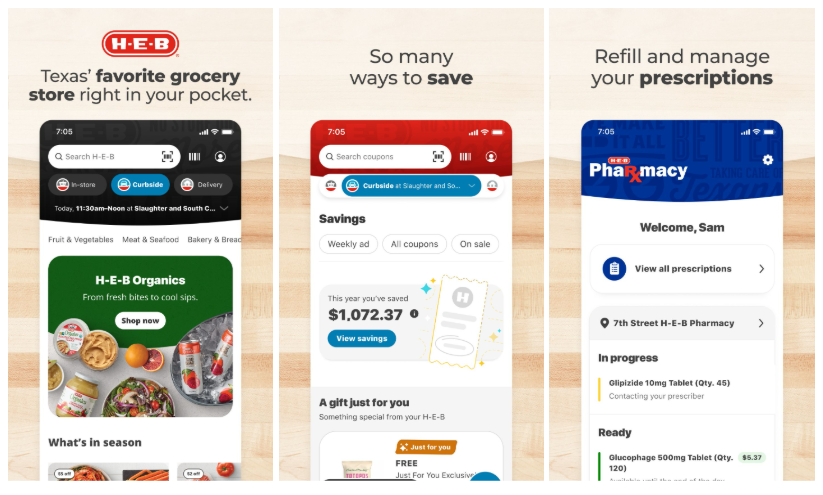
The behavioral trap is the “Private-Label Subsidization” Loop. Rather than offering generic cash-back on random items, H-E-B leverages their legendary digital coupons—specifically the “Combo Loco.” The Combo Loco is a highly aggressive cross-sell that forces brand trial. A digital coupon might offer: Buy a name-brand 12-pack of soda, get an H-E-B private-label bag of chips completely free, an enticing offer for the average customer. H-E-B uses the high-margin, name-brand product to actively subsidize the customer’s introduction to their house brands. Once the customer realizes the H-E-B brand chips are just as good (or better) than the national competitor, they permanently switch to the higher-margin private label.
In addition to their coupons, H-E-B introduced the H-E-B Debit Card. This payment utility offers a permanent, uncapped 5% cash back on all H-E-B, Central Market, and Hill Country Fare private-label items. By linking a massive financial incentive directly to their in-house brands, H-E-B mathematically forces the shopper to abandon national brands entirely.
| Feature | Description |
| Loyalty program type | Digital Couponing, Private-Label Subsidization & Banking Utility |
| Welcome reward | Frequent promotional digital coupons automatically loaded into the app upon sign-up. |
| Birthday reward | – |
| Earning method | The program relies on digital coupon clipping and the H-E-B Debit Card’s flat 5% cash-back on private-label products. |
| Referral reward | – |
| Rewards | Instant register discounts via the app, plus direct cash deposits back into the checking account for Debit Card users. |
| Exclusive perks | The Combo Loco: Legendary BOGO offers designed to cross-pollinate national brands with H-E-B exclusive products. |
| Mobile app integration | Android / iOS |
Why It Works
- The “Combo Loco” Sampling Engine: Giving away private-label products for free when tied to a name-brand purchase removes all financial risk for the consumer, rapidly accelerating private-label adoption.
- The Bank Link: The H-E-B Debit Card acts as a direct bank link, offering 5% cash back strictly on their own brands shifts the consumer’s entire shopping list toward H-E-B’s most profitable inventory.
- Frictionless Logistics: The My H-E-B app digitizes the physical store run by automatically sorting the customer’s digital shopping list by the exact aisle locations of their home store, creating a logistical “efficiency lock” that competitors cannot break.
H-E-B avoids standard point accumulation in favor of digital utility and aggressive in-house merchandising. The ecosystem is anchored by the My H-E-B app, which houses their weekly algorithmic discounts and the famous “Combo Loco” offers. For the highest-frequency shoppers, the H-E-B Debit Account acts as the ultimate retention engine, paying out 5% cash back strictly on the brand’s expansive private-label portfolio, ensuring absolute grocery consolidation.
Utah – Backcountry
When consumers are preparing to buy high-ticket, technical outdoor gear—like backcountry skis, climbing harnesses, or sub-zero sleeping bags—their purchasing habits are often highly seasonal, discretionary, and fragmented. A shopper might spend heavily ahead of a major winter expedition and then disappear for the rest of the year. Backcountry, headquartered in Park City, Utah, completely neutralized this cyclical churn by changing the financial dynamic of the transaction. They don’t just reward spending after the fact; they ask customers to commit before they buy.
They achieved this by engineering Summit Club, a paid loyalty program that turns commitment into long-term customer retention.
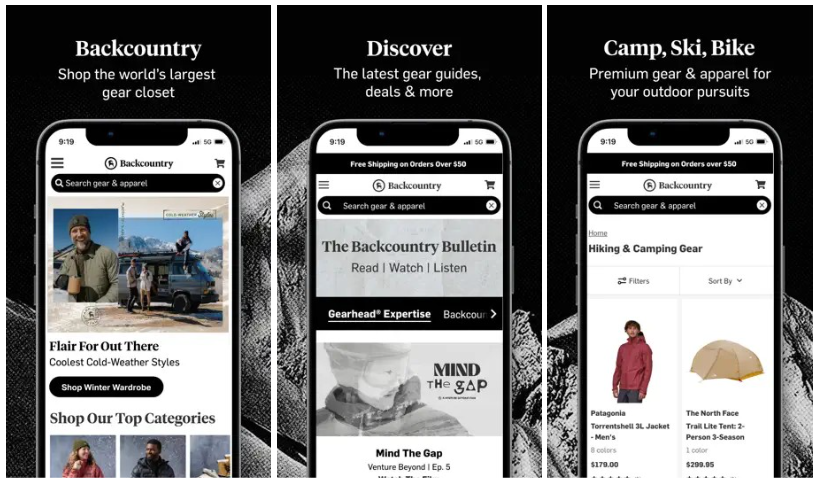
Summit Club is the standard paid membership designed around ongoing shopping benefits. Members receive 5% back in Backcountry Reward Dollars on eligible purchases, along with shipping benefits and access to exclusive offers. Reward Dollars accumulate and are redeemed on future orders, creating a delayed-value loop that encourages return purchasing.
Above that sits Summit Club+, a higher-tier membership designed for more engaged outdoor customers. Summit Club+ includes the core Summit Club benefits but layers on enhanced privileges such as higher-value rewards opportunities, premium shipping treatment, and expanded access benefits across the Backcountry ecosystem. Rather than simply offering bigger discounts, the structure creates progression between casual shoppers and customers who view outdoor recreation as a year-round activity.
This distinction matters because the two tiers reward different behaviors:
- Summit Club primarily encourages repeat purchasing. A customer buys a ski package, earns future credit, and returns for apparel or accessories.
- Summit Club+ encourages purchase consolidation. Once customers reach the higher tier, shopping elsewhere becomes more costly because they give up not just immediate rewards but elevated membership status and expanded benefits.
The reward mechanics create a deliberate feedback loop.
Unlike instant markdowns that reduce margin immediately, Reward Dollars postpone gratification. A customer buying a $2,000 ski setup earns future purchasing power rather than an immediate discount. That delay increases the probability of return visits for maintenance items, replacement gear, or adjacent categories. Backcountry strengthens the effect through category breadth.
Outdoor participation naturally expands over time: skis become layers, camping becomes hydration systems, hiking becomes travel gear. Membership transforms those disconnected purchases into a continuous progression.
| Feature | Description |
| Loyalty program type | Paid Annual Subscription & Delayed Cash-Back |
| Welcome reward | Immediate access to premium shipping upgrades and exclusive member pricing upon subscription. |
| Birthday reward | No official digital birthday reward currently active. |
| Earning method | Flat 5% back in rewards on eligible purchases for the $99/year membership. |
| Referral reward | No official digital referral program currently active. |
| Rewards | Earnings pool directly into the member’s account as “Backcountry Reward Dollars,” usable like flat digital cash on all future orders. |
| Exclusive perks | Members unlock free standard shipping and complimentary 2-day shipping upgrades on qualifying orders, alongside exclusive partner offers across the broader corporate ecosystem. |
| Mobile app integration | Android / iOS |
Why It Works
- Prepaid Commitment: Paying $99 annually encourages customers to consolidate purchases and recover membership value.
- Delayed Rewards: Reward Dollars turn major seasonal purchases into future shopping credit.
- Full Outdoor lifecycle: Equipment, apparel, accessories, and replacement purchases become connected inside one account.
Backcountry Summit Club demonstrates how an enthusiast retailer operating in a highly seasonal market can secure year-round customer lifetime value. For a recurring $99 annual fee, members unlock a flat 5% back in reward dollars alongside premium 2-day shipping upgrades. By delaying reward payouts and leveraging the psychology of a prepaid subscription, Backcountry successfully locks consumers into a continuous purchasing cycle that spans across every season and gear category.
Vermont – Burton Snowboards
The winter sports industry faces one of the most brutal sales cycles in retail: extreme seasonality. When a customer only uses your product for three to four months out of the year, maintaining digital engagement during the off-season is nearly impossible. Burton Snowboards, headquartered in Burlington, Vermont, realized that to keep snowboarders engaged year-round, they had to gamify the anticipation of winter rather than just the transactions.
They achieved this with the Burton First Chair loyalty program.
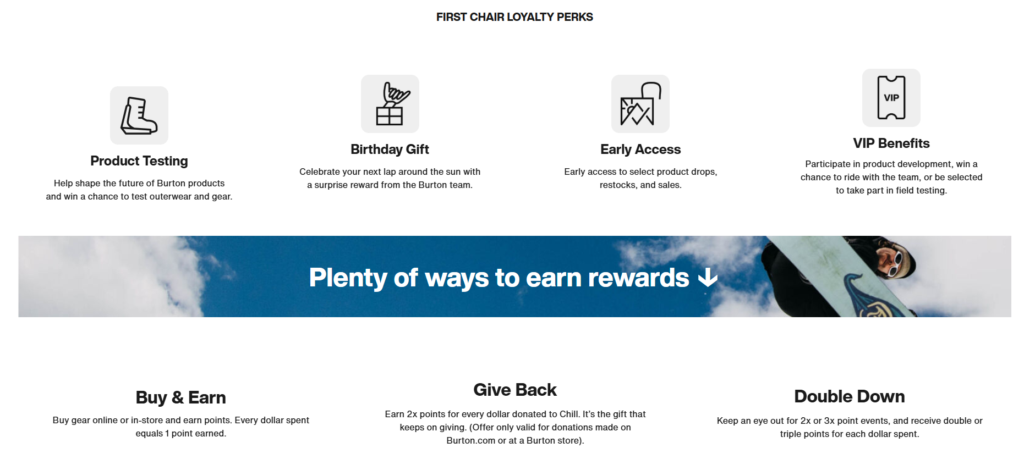
While generic customer loyalty programs train shoppers to obsess over collecting pennies and waiting for clearance sales, Burton completely removed monetary cash-back from the equation. In the First Chair ecosystem, points have absolutely zero cash value. Instead, points act strictly as a status tracker. By gating their most valuable assets (early access to limited-edition gear, VIP riding experiences, and actual product-testing opportunities) behind spend-based tiers, Burton mathematically incentivizes customers to consolidate their winter sports budget to achieve “insider” status. By refusing to let customers trade points for dollars off at the register, Burton preserves its bottom line. Instead of giving away a $20 discount, they give away “early access to product drops,” which costs the company virtually nothing to execute but holds massive psychological value in streetwear and snowboard culture.
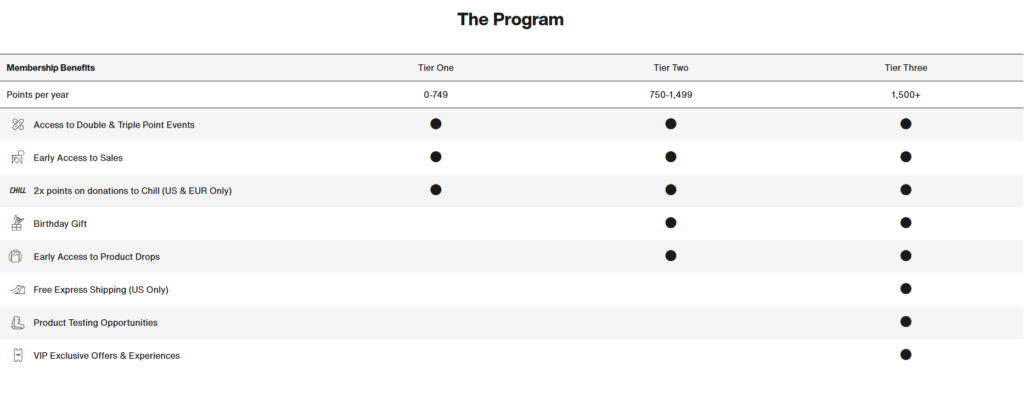
If a customer wants to guarantee they get a highly anticipated, limited-run snowboard before it sells out globally, they must reach Tier Two or Three, effectively forcing hype-driven consumers to spend heavily just to secure the right to buy popular items before they hit the general public. Burton also integrates organic influencer marketing and brand ethos by offering double points for every dollar a member donates to their youth-focused Chill Foundation. It softens the transactional nature of the spending tiers and makes the pursuit of VIP status feel community-driven rather than strictly commercial.
| Feature | Description |
| Loyalty program type | Tiered Spend-Based Points & Gated Access |
| Welcome reward | Immediate free standard shipping and access to Member-only product drops. |
| Birthday reward | A surprise birthday gift (unlocked only for members who reach Tier 2 or Tier 3 status). |
| Earning method | 1 point per $1 spent across all tiers. Bonus points awarded for completing a digital profile and attending brand events. |
| Referral reward | |
| Rewards | 100 Points = $10 Reward (usable on all e-commerce and flagship store purchases). |
| Exclusive perks | Tier 3 members unlock free express shipping, opportunities to participate in R&D field testing, and chances to win trips to ride with the Burton pro team. |
| Mobile app integration | – |
Why It Works
- The “Drop” Culture: By adopting the scarcity tactics of the sneaker industry (like Nike), Burton turns seasonal equipment purchases into highly competitive, gamified events that heavily favor their top-tier members.
- The Philanthropic Bridge: By offering double points for every dollar a member donates to their youth-focused Chill Foundation, the program makes the pursuit of VIP status feel like a shared lifestyle ethos rather than a commercial transaction.
- Experiential Validation: Elite tier members don’t just receive discounts; they gain access to exclusive VIP events and “test ride” days, transforming a retail transaction into an immersive lifestyle membership.
Burton First Chair is a tiered loyalty program with an engagement ecosystem built for the core snowboard demographic. Members earn points on every purchase, with a conversion rate of 100 points for a $10 reward. The program aggressively incentivizes tier progression: unlocking VIP ($200 annual spend) or Elite ($500 annual spend) grants the user free expedited shipping, free return shipping, and the highly coveted “Early Access” passes to new product launches, ensuring Burton monopolizes the customer’s high-ticket winter equipment budget.
Virginia – Fas Mart
In the modern convenience sector, the ultimate battleground is the parking lot. The hardest metric to move in the entire industry is getting a driver who just paid for gas at the pump to actually walk inside the physical store. Fas Mart (operated by GPM Investments/ARKO Corp), headquartered in Richmond, Virginia, cracked this code on a massive scale by engineering one of the most aggressive fuel-subsidy programs in the country: fas REWARDS.
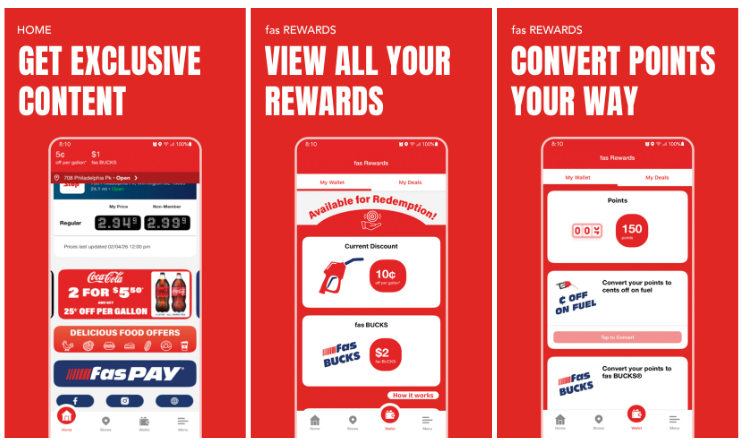
While the program offers the tried and true point accumulation method (10 points per $1 spent inside, 5 points per gallon pumped), the true behavioral hook is their “Fueling America’s Future” initiative and its highly stackable fuel discounts.
Fas Mart aggressively targets the daily commuter by tying specific high-margin inside merchandise directly to massive, stackable fuel rollbacks. If a member buys two promotional energy drinks, they don’t just earn standard points; they immediately earn a hard 50¢ off per gallon at the pump. The brilliance of the trap is that these cents-off promotions stack up to a staggering $2.50 off per gallon. The driver is mathematically forced to abandon their typical grocery store snack runs and consolidate all their daily consumable purchases inside Fas Mart just to watch their commute costs plummet. This strategy yields a staggering 55% crossover rate, meaning more than half of their loyalty members actively cross the threshold from the pump into the store.
| Feature | Description |
| Loyalty program type | Spend-Based Points, Gamification & Stackable Fuel Subsidies |
| Welcome reward | Typically features an immediate fuel rollback or digital freebie upon app download and registration. |
| Birthday reward | Special digital offers or “fas BUCKS” loaded directly into the app. |
| Earning method | 10 points per $1 spent on qualifying in-store items. 5 points per 1 gallon of fuel pumped. |
| Referral reward | Features a dedicated “Refer A Friend” function within the app to digitally scale the commuter user base |
| Rewards | 250 Points = $1.00 in fas BUCKS (can be spent on in-store items) or 5¢ off per gallon |
| Exclusive perks | Stackable Rollbacks: Purchasing specific promotional merchandise unlocks massive, stackable fuel discounts up to $2.50 off per gallon. Geo-Fenced Alerts: Location-based push notifications for high-value localized deals. |
| Mobile app integration | Android / iOS |
Why It Works
- Uncapped Basket Stretching: Because the fuel discounts stack so aggressively (up to $2.50/gallon), the customer will actively hunt the aisles for promotional items to add to their basket, massively driving up the Average Order Value (AOV).
- App-Gated Gamification: The redesigned fas REWARDS app features 16 different in-app games, turning the standard utility of checking a point balance into a highly addictive, daily digital habit.
- Geo-Fenced Urgency: The app utilizes location-based tracking to push geo-fenced offers for food and tobacco directly to the user’s phone the moment they drive near a Fas Mart location, perfectly capturing impulsive, mid-commute cravings.
fas REWARDS is a multi-brand convenience ecosystem designed to completely dominate the daily commute. Members earn organic points (10 points per $1 in-store; 5 points per gallon) which flexibly convert into either “fas BUCKS” (direct cash value) or cents-off-per-gallon. However, the core retention engine relies heavily on buying specific promotional items in-store to trigger massive, stackable fuel rollbacks. The entire experience is housed in a highly gamified digital app featuring live personalized fuel pricing, geo-fenced offers, and frictionless mobile checkout.
Washington – REI
The outdoor recreation market is filled with massive, high-ticket purchases (like $3,000 mountain bikes and $500 tents). In a normal retail environment, a consumer will ruthlessly price-shop these items across dozens of e-commerce websites. REI, headquartered in Seattle, Washington, completely neutralized this comparison-shopping behavior by changing the actual definition of their customer with their Co-op Membership loyalty program.
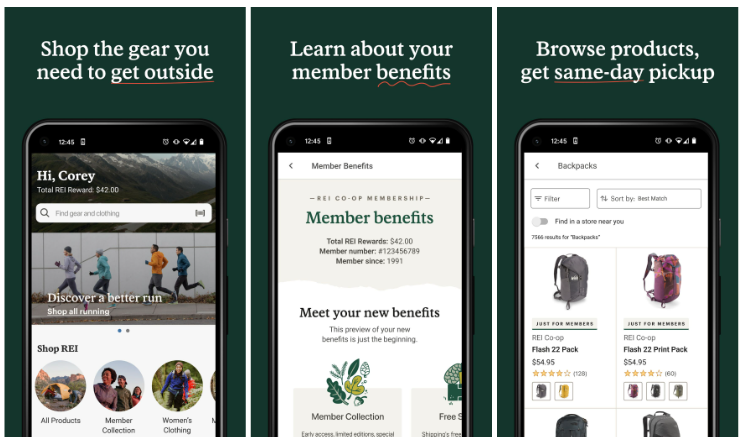
The structure begins with a single lifetime membership fee (currently $30 as of 2026). In exchange, members receive access to a collection of ongoing benefits including member-only offers, discounted services, special pricing, access to used gear events, and eligibility for annual member rewards on qualifying purchases.
Historically, the most recognizable feature was the annual member dividend, where eligible spending generated a percentage return distributed once per year. REI has since evolved the structure into Member Rewards, where members receive 10% back annually on eligible full-price purchases in the form of redeemable rewards rather than cash distributions. Additional rewards can also be earned through REI’s branded credit card and selected promotions.
This distinction matters because REI intentionally avoids making every transaction feel discounted.
Instead of offering immediate cashback at checkout, the reward is delayed until the following reward cycle. A customer who buys a $2,000 camping setup does not receive instant savings, they instead receive a future balance waiting to be used on another outdoor purchase. That delay transforms one expedition into the beginning of the next.
The model becomes even stronger because outdoor recreation naturally compounds. Someone buying hiking boots later returns for socks, then backpacks, then camping gear, then bike equipment. By concentrating rewards into a single annual event, REI encourages customers to think about their purchases as part of a longer outdoor journey rather than isolated transactions.
But the most unusual part of the program is psychological rather than economic.
Membership reframes the relationship from customer to participant. The one-time fee creates commitment without subscription fatigue, and the language of ownership encourages members to view spending at REI as supporting the co-op they belong to rather than simply purchasing from a retailer.
That identity effect is reinforced by benefits beyond merchandise: members receive access to experiences, trade-in opportunities, rentals, and outdoor services that make the relationship harder to compare directly against price-focused competitors.
| Feature | Description |
| Loyalty program type | Paid Lifetime Membership |
| Welcome reward | Frequent promotional windows offering a $30 digital gift card immediately upon sign-up, effectively making the membership free. |
| Birthday reward | – |
| Earning method | 10% Co-op Member Reward earned on all eligible full-price merchandise. |
| Referral reward | Gift cards (limited time only) |
| Rewards | Annual Reward issued every March, usable as direct cash on future gear or experiences. |
| Exclusive perks | Free U.S. shipping 20% off bike/snow services; up to 33% off rentals (select locations) 1-year return policy; member-only sales/events; Re/Supply used gear; early gear access. |
| Mobile app integration | Android / iOS |
Why It Works
- The Ownership Illusion: Charging an upfront fee changes the psychological dynamic. The consumer feels a sense of exclusivity and ownership, generating brand evangelism that free points-programs simply cannot replicate.
- The Annual Payout Trap: By paying out the 10% dividend once a year (typically in March), REI generates a massive, guaranteed surge of foot traffic right as their highly profitable Spring/Summer inventory hits the floor.
- Creates commitment without recurring fees: A one-time $30 membership encourages long-term engagement without subscription fatigue.
The REI Co-op abandons standard point-per-dollar accumulation in favor of a lifetime membership model. For a single $30 fee, members unlock a permanent 10% annual reward on all eligible full-price purchases. The program heavily subsidizes the outdoor lifestyle, offering free standard shipping with no minimums, exclusive access to highly discounted “Garage Sales” (used gear), and heavy discounts on physical equipment repairs, ensuring the Co-op is the absolute center of the member’s outdoor life.
West Virginia – GoMart
In rural and highly dispersed geographic markets, the local convenience store is often the only retail touchpoint a commuter hits twice a day. GoMart, headquartered in Gassaway, West Virginia, operates over 100 locations across the region. To prevent competitors from stealing their highly lucrative morning coffee and afternoon snack traffic, they digitized their physical footprint using GoMart Rewards.
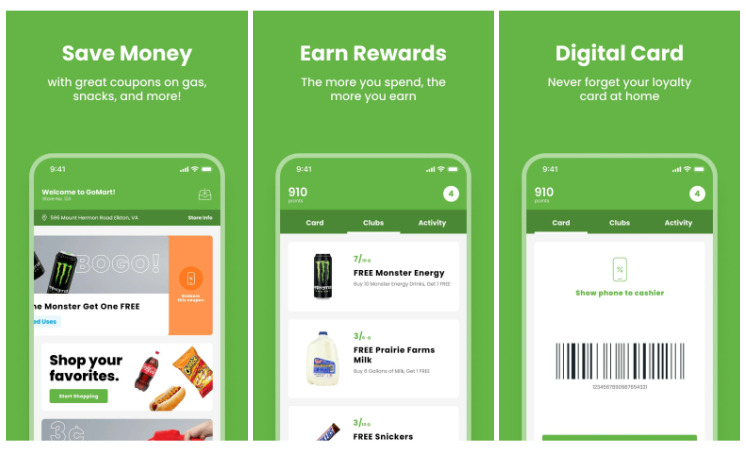
While the program offers the standard cents-off-per-gallon fuel discount, the true behavioral engine is the “App-Gated Commuter” Trap.
GoMart recognized that they couldn’t afford to give away margin to casual, infrequent drivers. So, they moved their most aggressive, high-value promotions entirely into the mobile app. If a customer walks in to buy two energy drinks and a bag of chips without the app, they pay full retail price. If they open the app, they instantly unlock “Member-Only Pricing” that significantly slashes the total. This creates a massive penalty for non-participation. By heavily gating their internal sales, GoMart mathematically forces the commuter to digitize their daily pitstop, allowing the brand to harvest invaluable consumer data and push time-sensitive, algorithmic coupons directly to the user’s phone right before the afternoon rush.
| Feature | Description |
| Loyalty program type | Spend-Based Points & Digital Frequency Clubs |
| Welcome reward | Typically features an immediate digital freebie (like a free fountain drink) upon app download. |
| Birthday reward | A special digital discount or free snack loaded during the birth month. |
| Earning method | 20 points per $1 spent on qualifying inside merchandise. 10 points per 1 gallon of fuel pumped. |
| Referral reward | – |
| Rewards | Points convert into digital cash discounts applicable to a specific catalog of in-store items. |
| Exclusive perks | Member-Only Pricing: Deep discounts on high-margin energy drinks, snacks, and candy strictly gated behind the digital app barcode. |
| Mobile app integration | Android / iOS |
Why It Works
- The Non-Member Penalty: Gating the best BOGO deals and snack discounts inside the app forces rapid, localized digital adoption, completely locking out casual highway traffic from eating into their promotional margins.
- The “Coffee Club” Frequency Loop: The app seamlessly tracks high-frequency consumable purchases. By digitizing the classic “Buy 6 Coffees, Get 1 Free” punch card, they guarantee the commuter’s morning routine is permanently tethered to a GoMart location.
- Instant Gratification: The program relies heavily on surprise “Freebie” drops (like a free candy bar or fountain drink) loaded directly into the app, triggering immediate, unplanned foot traffic simply because the reward expires in 24 hours.
GoMart Rewards is a digital ecosystem designed to maximize the lifetime value of the daily commuter. Members earn points on both fuel and in-store purchases, which can be cashed out for direct financial discounts. The program heavily utilizes the mobile app to deploy “Member-Only Pricing” on high-margin snacks, digital punch cards for high-frequency beverages, and targeted fuel discounts, effectively ensuring the customer’s entire automotive and snacking budget remains within the GoMart network.
Wisconsin – Kohl’s
Department stores have historically relied on confusing, overlapping percentage-off coupons that leave the customer completely blind to how much they will actually pay at the register. Kohl’s, headquartered in Menomonee Falls, Wisconsin, completely revolutionized mall-based retail by abandoning the percentage discount and creating their own highly aggressive, psychological currency: Kohl’s Cash.
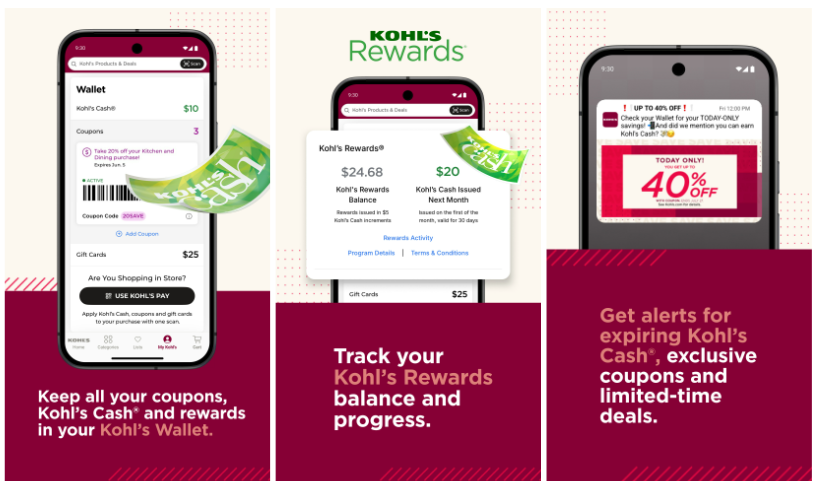
The behavioral trap lies in its manufactured expiration. During specific promotional windows, Kohl’s operates on a rigid math equation: spend $50, get $10 in Kohl’s Cash.
The brilliance of this mechanic is how it weaponizes loss aversion. Because the $10 is framed as literal cash, the consumer’s brain immediately takes ownership of it. However, the Kohl’s Cash is only valid during a highly specific, very short redemption window (usually just a few days). The customer is psychologically unable to let their $10 expire. This forces a manufactured, secondary trip to the store. The customer walks in just to burn their $10 on a pair of socks, but ends up impulsively buying a $40 sweater, triggering a perpetual, high-margin retail loop.
| Feature | Description |
| Loyalty program type | Cash-Back Equivalency & Highly Expiring Currency |
| Welcome reward | Frequently features a flat percentage discount (e.g., 15% off) upon profile completion. |
| Birthday reward | Bonus Kohl’s Cash on the user’s birthday month |
| Earning method | 5% Rewards: Earned daily on all purchases. Promotional Kohl’s Cash: $10 earned for every $50 spent during specific calendar windows. |
| Referral reward | |
| Rewards | Points and promotional earnings convert directly into Kohl’s Cash, acting as a flat dollar discount off the total transaction. |
| Exclusive perks | Frictionless Returns: E-commerce purchases (even those made on Amazon) can be seamlessly returned at physical Kohl’s locations, driving massive foot traffic to the sales floor. |
| Mobile app integration | Android / iOS |
Why It Works
- Loss Aversion Weaponized: A 20% off coupon expiring generates very little anxiety. A literal $10 bill expiring generates intense psychological panic, virtually guaranteeing a return visit.
- The “Basket Stretch” Effect: Because the currency is issued in rigid $50 increments, a customer with $42 in their cart will actively hunt for an $8 filler item just to trigger the $10 reward, artificially driving up the Average Order Value (AOV).
- The Triple Stack: Kohl’s allows members to stack Kohl’s Cash on top of standard Kohl’s Rewards points (5% back), on top of their store credit card discounts.
The Kohl’s loyalty ecosystem is an aggressive, multi-layered financial trap. The base Kohl’s Rewards program issues a flat 5% back on all purchases (which automatically converts to Kohl’s Cash at the end of the month). However, the primary retention engine is the promotional Kohl’s Cash earning windows, which issue expiring $10 certificates for every $50 spent. This ecosystem relies heavily on high-frequency, manufactured urgency to force the customer to continuously return to the store to defend the value they’ve already earned.
Wyoming – Sierra
The outdoor recreation industry is typically dominated by premium, price-controlled flagship brands like Patagonia or Arc’teryx. Finding deep discounts on premium tactical-styled gear is nearly impossible. Sierra (originally founded as Sierra Trading Post in Cheyenne, Wyoming) disrupted this by applying the aggressive “off-price” salvage model to the outdoor world.
To monopolize the customer’s budget across multiple lifestyle categories, they rely on the massive, interconnected TJX Rewards ecosystem.
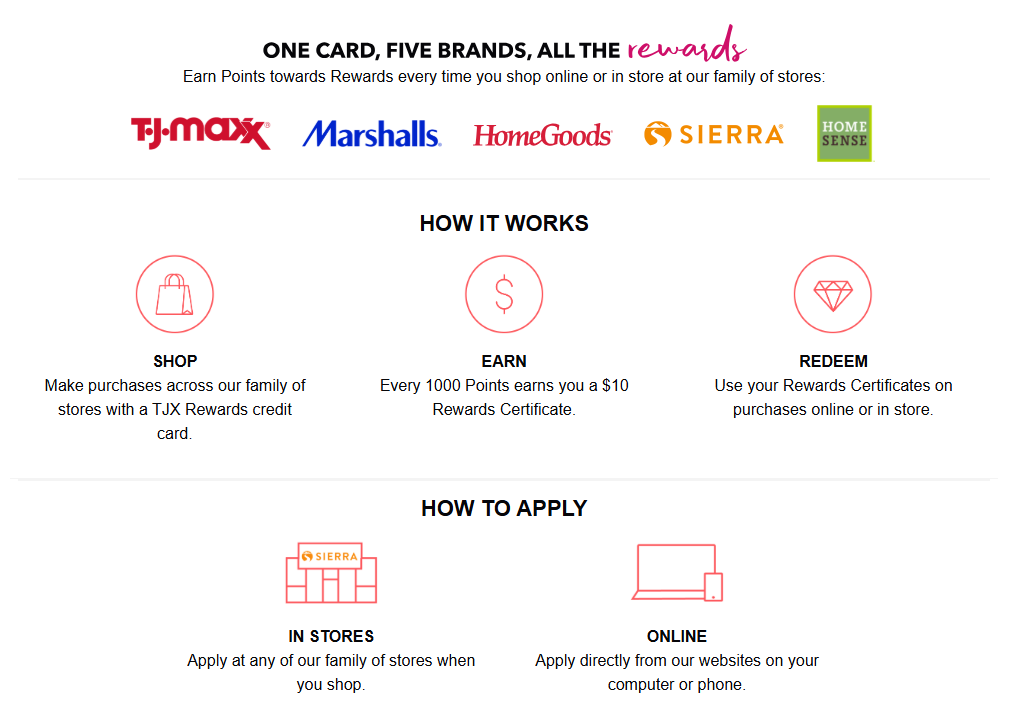
The TJX Rewards program is anchored by their branded credit card, which issues 5% back in rewards. The brilliance lies in the liquidity of the currency. The customer earns $10 in rewards by buying a discounted snowboard jacket at Sierra in Wyoming, but they can instantly cross the street and spend that $10 at T.J. Maxx to buy home goods, or at HomeGoods to buy furniture. By pooling the loyalty currency across entirely different retail verticals, the brand mathematically prevents the customer from ever leaving the corporate ecosystem.
| Feature | Description |
| Loyalty program type | Co-Branded Credit Card & Cross-Vertical Ecosystem |
| Welcome reward | Immediate flat discount (typically 10% off the entire first purchase) upon credit card approval |
| Birthday reward | – |
| Earning method | 5 points per $1 spent at Sierra, T.J. Maxx, Marshalls, and HomeGoods. |
| Referral reward | |
| Rewards | 1,000 Points = $10 Reward Certificate automatically issued across all TJX brands |
| Exclusive perks | Private Shopping Events: Cardholders receive exclusive invitations to private shopping hours to hunt for newly delivered, premium off-price inventory before the general public. |
| Mobile app integration | iOS |
Why It Works
- Ecosystem Fluidity: Allowing points to be earned and burned across Sierra, T.J. Maxx, Marshalls, and HomeGoods ensures the rewards are highly liquid, increasing their perceived value and guaranteeing they are quickly redeemed for high-margin inventory.
- The Gamified Treasure Hunt: Because Sierra operates as an off-price retailer, the inventory is highly unpredictable. The customer must physically visit the store constantly to see if a massive shipment of premium outdoor gear just arrived, bridging the digital rewards with a physical shopping addiction.
- The Credit Anchor: By gating the 5% earn rate exclusively behind the TJX credit card, the company drastically lowers their internal credit card processing fees while mathematically forcing the consumer to use their proprietary card for all lifestyle purchases.
The Sierra loyalty experience is heavily integrated into the overarching TJX corporate structure. Operating primarily through the TJX Rewards Credit Card, members earn an aggressive 5 points per $1 spent across the entire family of brands (Sierra, T.J. Maxx, Marshalls, HomeGoods). Every time a member hits 1,000 points, a $10 digital reward certificate is automatically issued. The program relies entirely on the addictive, unpredictable nature of off-price retail, using the highly liquid rewards certificates to subsidize the customer’s relentless physical “treasure hunts.”
5 Defining Trends Reshaping Modern Retail Loyalty Ecosystems
Based on the mechanics of the country’s most successful rewards programs, retail loyalty has evolved far beyond the traditional “spend a dollar, get a point” model. Today, the industry is dominated by five core behavioral and structural trends:
- Paid Subscriptions and Premium Tier Moats: Retailers are increasingly asking consumers to pay upfront for premium tiers to unlock high-value logistical perks. Programs like CVS ExtraCare Plus, Target Circle 360, Tractor Supply’s Preferred Plus, and Omaha Steaks Gold use annual or monthly fees to trigger the sunk-cost fallacy, mathematically forcing consumers to consolidate their shopping to justify the subscription cost.
- Non-Transactional Lifestyle Gamification: To maintain attention between long purchase cycles, brands are rewarding consumers for their daily habits rather than just their wallets. The North Face awards points for checking in at National Parks, Under Armour integrates “sweat equity” by rewarding physical fitness challenges via MapMyRun, and Timberland utilizes its Timberloop recycling program to turn sustainable actions into a direct retail replacement currency.
- Cross-Vertical and Brand Ecosystem Integration: Major players are building collaborative networks to trap consumer spending within a unified footprint. This is executed either through corporate cross-vertical pooling—such as the TJX Rewards card linking Sierra, T.J. Maxx, and HomeGoods—or through strategic external alliances, like Hibbett Sports linking directly with the corporate power of the Nike Membership program.
- Predictive and Frictionless Personalization: Brands are actively moving away from confusing manual “coupon clipping” and linear points economies. Club Publix relies entirely on predictive, point-free algorithmic tracking to build custom savings profiles, Meijer’s mPerks leverages historical consumer data to generate hyper-individualized “basket stretching” spend targets, and Target Circle automatically applies optimized deals silently at checkout to remove impulse-buying friction.
- Commodity Cross-Subsidization: High-frequency retailers are seamlessly connecting grocery and convenience shopping to highly volatile household expenses like gasoline. Ecosystems like Kroger Plus, Hy-Vee PERKS, Wawa Rewards, and Fas Mart’s fas REWARDS use high-margin in-store food and snack purchases to fund stackable, uncapped cents-off-per-gallon discounts at the pump, turning a mundane routine into a mandatory destination.
Recognizing these overarching trends is only half the battle; the true value lies in how they are executed. When synthesized, these mechanics form a definitive strategy for long-term brand survival.
Conclusion
The retailers winning the battle for wallet share today are those building deeply integrated digital ecosystems. Whether you are a regional storefront looking to protect your local turf or a growing brand aiming to scale nationally, the playbook remains the same:
In conclusion, the best retail loyalty programs in the U.S. succeed because they offer more than basic discounts—they create real value, stronger customer retention, and a seamless shopping experience. From digital rewards and app-exclusive offers to tiered memberships and fuel savings, these programs show how retailers can build long-term loyalty by giving shoppers more reasons to return.
As competition across the retail industry continues to grow, brands that combine convenience and personalization will stand out in search visibility and in customer loyalty. The most effective retail rewards programs are not just about saving money; they are about creating a smarter, more engaging, and more rewarding experience that keeps customers coming back.
For brands ready to launch or improve their loyalty strategy, platforms like SimpleLoyalty make it easy to create a program tailored to your restaurant’s goals. Whether you need a straightforward points system, tiered rewards, gamified experiences, or a subscription-based membership, you can customize the model to fit your menu, margins, and customer habits.
Build your loyalty program with purpose, and let growth follow. Get in touch with us today!